
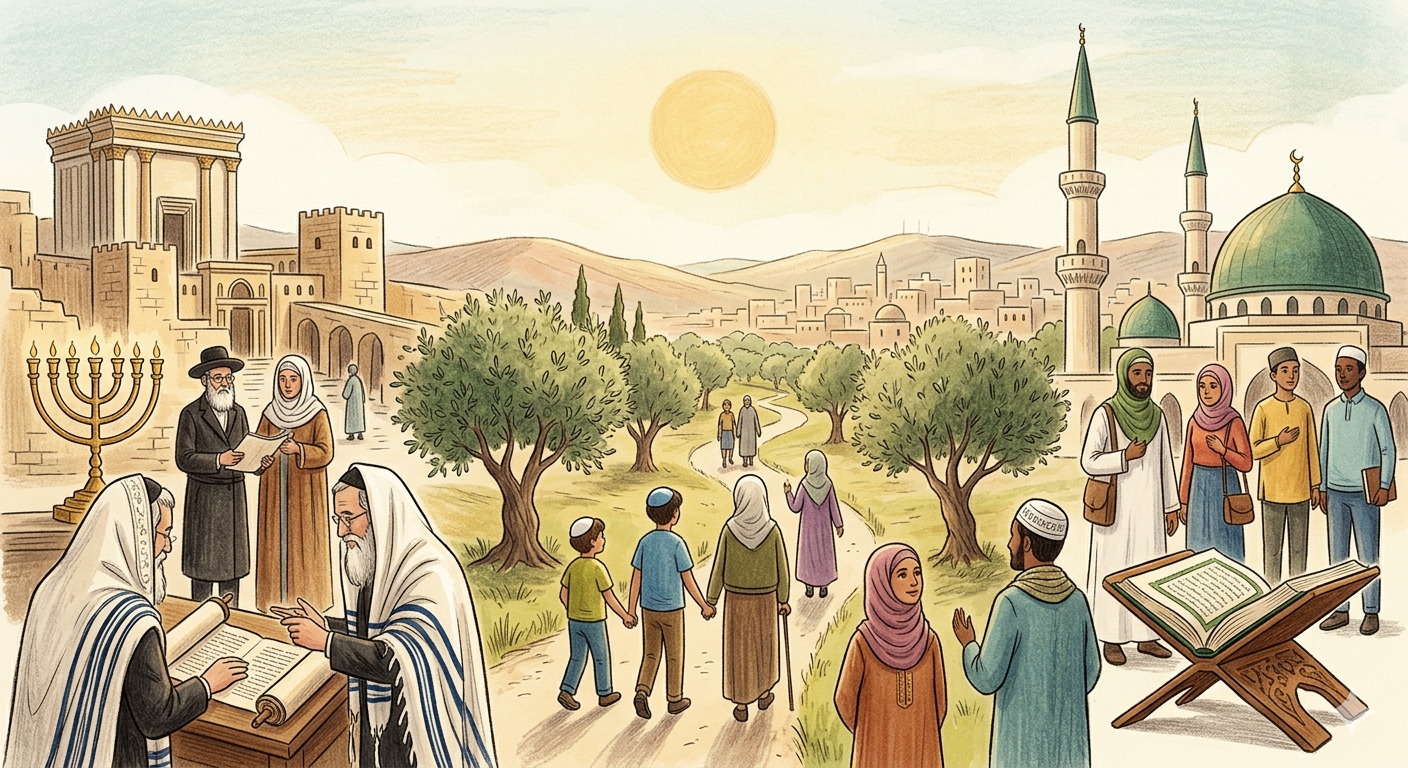
A Call for Balance: Understanding Jewish History, Islamic Teachings, and the Path to Peace – By Adamu Garba II
The Children of Israel occupy a unique place in human history—spiritually, intellectually, and culturally. Across centuries, they have been a force for creativity, innovation, and resilience. As a Muslim, I cannot ignore what the Qur’an itself affirms: that Allah elevated them among the nations, granted them blessings, and entrusted them with responsibilities. Verses such as Qur’an 2:40 remind us of this divine covenant. The Qur’an also recounts their struggles, often attributing these difficulties to moments of stubbornness or internal discord, but always within a framework of moral instruction—primarily as lessons for the Muslim community and the Prophet Muhammad (SAW).
When the Prophet migrated to Yathrib (later Madinah), the Jews were not outsiders. They were part of the social fabric of the city. Historical accounts describe how representatives from Jewish tribes were among those who met the Prophet during the pledge of al‑‘Aqaba. The tribes of Banū Naḍīr, Banū Qaynuqā‘, and Banū Qurayẓa lived alongside the Arabs and initially welcomed the Prophet’s arrival. Although political tensions later emerged, the Prophet consistently sought to avoid unnecessary conflict and upheld the Constitution of Madinah as a framework for coexistence.
To understand the Jewish condition today, one must look beyond modern politics and return to the long arc of history. Few peoples have endured as many attempts at total destruction. From the Babylonians to the Assyrians, from ancient Egypt to the Greeks and Romans—who destroyed the Second Temple and dispersed them for centuries—up to the horrors of Nazi Germany, powerful empires repeatedly sought their annihilation. Why has this pattern recurred?
One explanation, however imperfect, is that the Jewish people have historically possessed qualities—intellectual rigor, strong identity, communal cohesion, and spiritual purpose—that often made them influential in societies where they lived. These strengths sometimes threatened rulers who could not control or assimilate them. When intimidation failed, persecution followed. Yet, remarkably, every attempt to erase them ultimately failed. Time and again, they reemerged, reorganized, and rebuilt.
For this reason, I believe the Jewish people have the right to exist, the right to their homeland, the right to nationhood, and the right to pursue their aspirations—just as every people do. But these rights must never justify the oppression or destruction of others. Rights are not weapons; they are responsibilities.
In recent decades, however, a grave mistake has emerged within Israeli leadership: the rise of hardliners who frame their political objectives as existential religious battles. The current conflict with Iran is a painful example. Historically, Persians were among the few who protected the Jews—most famously during the era of Cyrus the Great, who allowed them to return to Jerusalem after the Babylonian exile. Even in later centuries, Persian societies often provided refuge when Europe turned hostile.
Yet today, Israeli hardliners treat Iran as an eternal enemy, dismissing centuries of shared history simply because Iran is now governed by an Islamic republic. This is a tragic miscalculation. People may change religions, ideologies, or governments, but their historical identity remains. Jews and Persians are not natural enemies. They never were.
Similarly, the tension between Arabs and Jews is often framed as an ancient religious conflict, but this is misleading. The roots lie in a family story—between the descendants of Sarah and Hagar, the wives of Prophet Ibrahim (AS). Islam is not an Arab religion; it is a universal faith. Only about 19% of Muslims are Arabs. The Qur’an repeatedly emphasizes that the Prophet Muhammad (SAW) was sent as a mercy to all creation, not to impose belief by force (Qur’an 6:107). Faith must be a choice, not a compulsion.
This is why turning Islam into an enemy, as some Israeli leaders have done, is not only dangerous but historically inaccurate. It drags an entire religion into a political dispute and risks igniting unnecessary wars. The recent rapprochement between Israel and several Arab states shows that many Arabs are motivated not by religious hostility but by a desire to reconcile with their extended family—something deeply commendable.
It is also important to acknowledge how political actors in the Arab world, especially after 1948, used religious rhetoric to mobilize global Muslim sentiment against Israel. Prior to the establishment of the modern Israeli state, Islamic teachings were not weaponized against Jews in this way. The Ottoman Empire—one of the most powerful Islamic states in history—protected and supported Jewish communities for centuries. Their conflicts were primarily with European powers, not with Jews.
Today, the world desperately needs peace. Every nation, tribe, and religion has the right to its beliefs and aspirations, but never at the expense of another’s survival. The current escalation between Israel and Iran is deeply troubling. Iran was provoked, and now the conflict risks spiraling into a regional catastrophe. If the world fails to intervene diplomatically, we may witness a descent into destruction that benefits no one.
We must learn from history. Empires rise and fall, but humanity remains. The Children of Israel survived every attempt to erase them. Muslims, too, have endured centuries of struggle. The path forward cannot be built on fear, revenge, or religious antagonism. It must be built on recognition, justice, and the courage to break from the cycles of the past.
May peace prevail, and may wisdom guide the leaders of all nations.