
By Farooq Ganderbali
Pakistan-occupied Kashmir (PoK) is witnessing one of the strongest anti-Islamabad movements in recent years. Thousands of people have gathered in Rawalakot and Muzaffarabad to protest against political suppression, inflation, excessive electricity tariffs, and the denial of basic democratic rights. Reports of innocent civilians being killed and injured during crackdowns by Pakistani authorities have once again exposed the grim human rights situation in the region.
The people of Pakistan-occupied Kashmir are openly questioning Pakistan’s decades-old narrative. Protest leaders have declared that PoK is “occupied, not free,” a statement that reflects the growing frustration of the people living under Pakistan’s control. Their demands are simple—political representation, economic justice, dignity, and freedom from oppression.
The Voice for Peace and Justice, a youth organisation of Jammu & Kashmir working for peace, development, youth affairs, and social welfare for many years, strongly condemns the human rights violations committed against innocent civilians in Pakistan-occupied Kashmir. The organisation has consistently opposed Pakistan’s illegal occupation of Indian territories in PoK and Gilgit-Baltistan and has raised its voice against attempts to legitimise Pakistan’s control through so-called elections.
History cannot be forgotten. On 22 October 1947, Pakistan-sponsored tribal invaders launched an attack on the erstwhile princely state of Jammu and Kashmir. Thousands of innocent civilians lost their lives, and countless families suffered unimaginable atrocities. Pakistan’s policy of violence and illegal occupation continues to deprive the people of Pakistan-occupied Kashmir of their democratic and human rights even today.
At the same time, Pakistan is facing growing internal unrest. Baloch nationalist voices have openly challenged Islamabad’s policies. Activist Mir Yar Baloch has announced claims regarding the establishment of a self-proclaimed Republic of Balochistan and has appealed for international recognition. Although these claims have not been independently verified or recognised internationally, they reflect the deep political and governance challenges confronting Pakistan.
Pakistan’s inability to address political grievances in various regions has further weakened its moral authority to speak on the future of Jammu and Kashmir. The people of Pakistan-occupied Kashmir are now openly demanding rights, justice, and accountability from Islamabad.
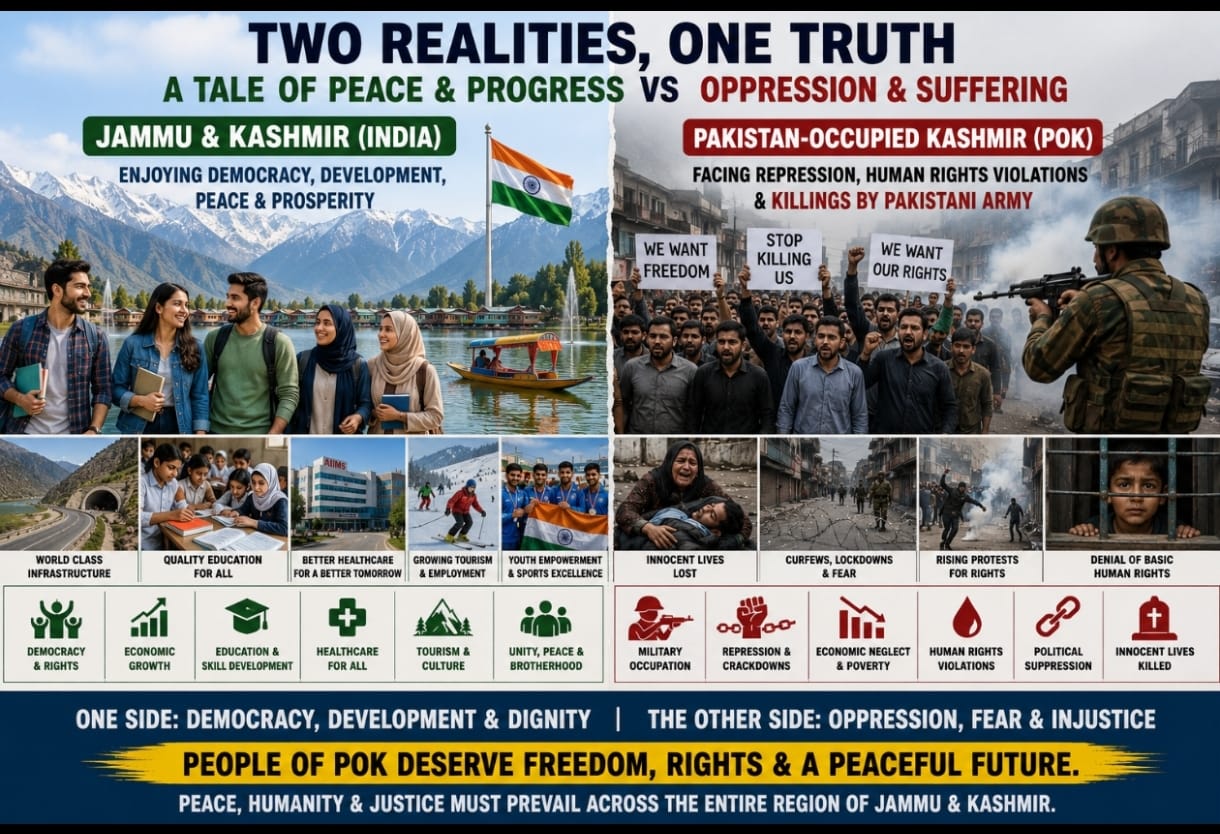
In sharp contrast, Jammu & Kashmir is witnessing unprecedented peace, development, and prosperity. The region has emerged as a symbol of democratic progress and inclusive development. Tourism has flourished, generating employment and economic opportunities for thousands of families. The youth of Jammu & Kashmir are excelling in education, sports, entrepreneurship, and innovation.
Today, Jammu & Kashmir is witnessing massive investments in infrastructure, healthcare, and education. New roads, tunnels, medical institutions, schools, colleges, and digital connectivity projects are transforming the lives of ordinary citizens. Young people are participating in national and international sporting events and contributing positively to society.
The successful and peaceful conduct of the Shri Amarnath Ji Yatra, record tourist arrivals, growing investment opportunities, and rapid infrastructure development are clear indicators of the region’s progress. The people of Jammu & Kashmir are enjoying the benefits of democracy, constitutional rights, and equal opportunities guaranteed under the Indian Constitution.
Most importantly, the people of Jammu & Kashmir have rejected terrorism, separatism, radicalism, and violence. They have chosen peace over conflict, development over destruction, and democracy over instability. Pakistan’s decades-long attempts to spread terrorism, drug trafficking, and propaganda in Jammu & Kashmir have been decisively rejected by the people.
The aspirations of Jammu & Kashmir’s youth are no longer shaped by conflict but by dreams of becoming doctors, engineers, entrepreneurs, sportspersons, and leaders of a modern and prosperous society. Kashmir today stands for tourism, education, culture, brotherhood, and peace.
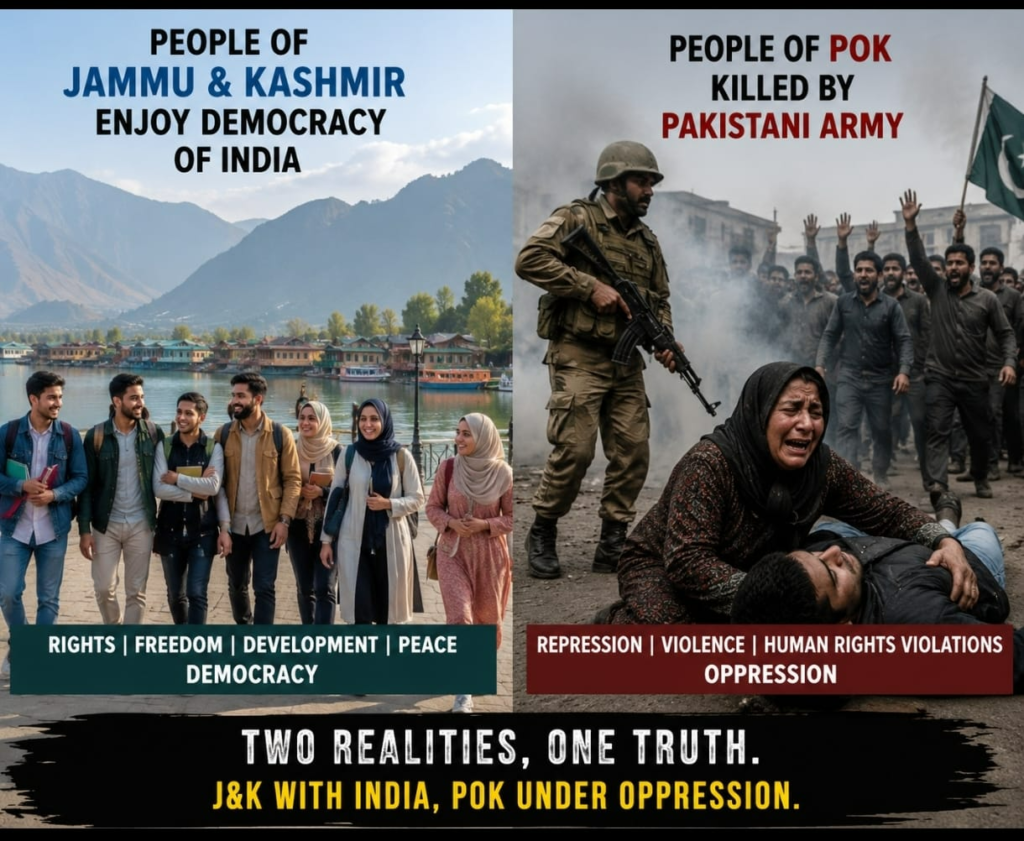
The growing protests in Pakistan-occupied Kashmir clearly demonstrate that its people seek the same democratic freedoms, economic opportunities, and peaceful future that the people of Jammu & Kashmir enjoy. Human rights are universal and cannot be denied on the basis of political narratives.
The contrast between the two regions is undeniable. On one side stands democratic, peaceful, and developing Jammu & Kashmir. On the other stands Pakistan-occupied Kashmir, where people continue to struggle for their basic political and civil rights.
The people of Jammu & Kashmir have spoken through their commitment to democracy, peace, and progress. The people of Pakistan-occupied Kashmir deserve the same rights and opportunities. Peace, development, and human dignity must prevail throughout the entire region of Jammu and Kashmir.