
By Farooq Ganderbali
Jammu & Kashmir today presents a powerful story of transformation, hope and opportunity. While Pakistan-occupied Jammu & Kashmir continues to witness serious public grievances, Jammu & Kashmir on the Indian side is moving forward with greater connectivity, development, tourism, education, healthcare, sports and economic opportunities.
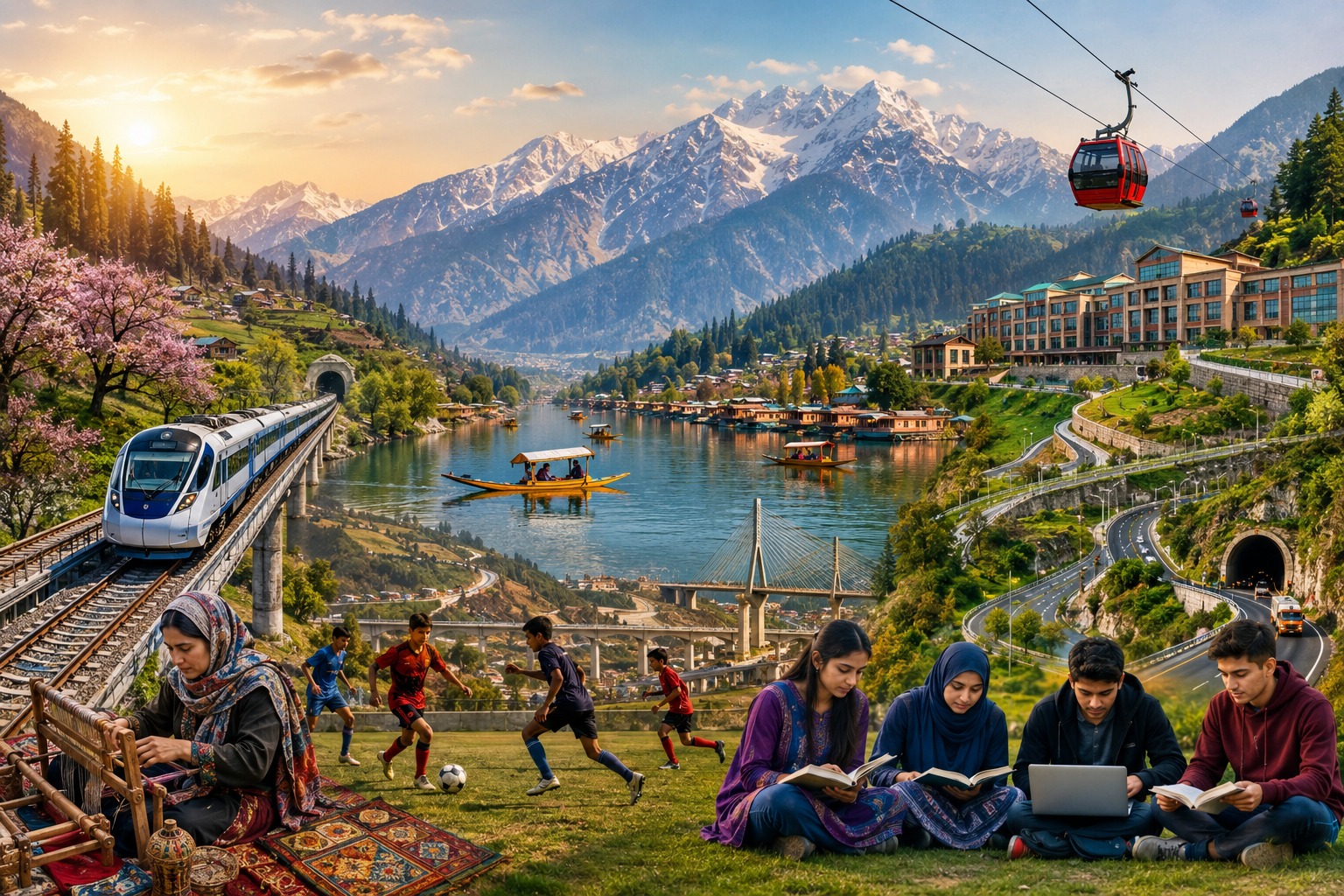
The people of Jammu & Kashmir are increasingly confident about their future and proud of their association with India. Across Jammu and Kashmir, people are witnessing roads, tunnels, rail connectivity, healthcare institutions, educational facilities, power projects, tourism infrastructure and sports facilities creating new opportunities for ordinary citizens, especially the younger generation.
The constitutional changes of August 2019 marked a significant turning point. Since then, greater emphasis has been placed on development, investment, grassroots governance, tourism, employment and public service delivery. The expansion of infrastructure and connectivity has brought previously remote areas closer to markets, educational institutions, hospitals and the rest of the country.
The transformation is particularly visible in tourism. Kashmir’s breathtaking landscapes, including Dal Lake, Gulmarg, Pahalgam and Sonamarg, continue to attract visitors from across India and around the world. Tourism generates employment for hoteliers, transport operators, guides, artisans, shopkeepers, houseboat owners and thousands of other families.
The recent visit of U.S. Ambassador to India Sergio Gor has added further international visibility to Kashmir’s changing tourism and security environment. During his first visit to Jammu & Kashmir, Gor described it as an “important part of India” and praised its beauty and improving environment. Pakistan subsequently summoned the U.S. Chargé d’Affaires in Islamabad and lodged a formal protest over his remarks.
For the people of Jammu & Kashmir, Gor’s words are significant because they reinforce a reality that millions of Indians have long regarded as settled: Jammu & Kashmir is an integral part of India. The region’s future should be measured by the aspirations and wellbeing of its people—not by propaganda or political rhetoric from across the Line of Control.
History also cannot be forgotten. On 22 October 1947, Pakistan-backed tribal forces entered the princely state of Jammu & Kashmir, advancing through areas including Muzaffarabad and towards Srinagar. Historical accounts describe widespread looting, killings and atrocities against civilians during the invasion.
The events of 1947 remain deeply embedded in the collective memory of Jammu & Kashmir. The invasion brought violence and suffering to innocent civilians, including women and children. Accounts of atrocities in areas such as Muzaffarabad and Baramulla remain an important part of the historical record.
The people of Jammu & Kashmir will never forget that painful chapter of history. The events of October 1947 were not merely a political dispute; they brought death, displacement, destruction and enormous human suffering.
Following the invasion, Maharaja Hari Singh signed the Instrument of Accession to India on 26 October 1947, and Indian forces arrived in Srinagar on 27 October to repel the invading forces.
Today, Pakistan continues to administer territory on the other side of the Line of Control, which India regards as illegally occupied. The people of Jammu & Kashmir have a legitimate right to remember the circumstances under which the conflict began and to reject attempts to rewrite that history.
The contrast between the two sides has become increasingly visible. Jammu & Kashmir is witnessing expanding infrastructure, rising tourism, educational opportunities, improved connectivity and greater participation in sports and entrepreneurship. Across the Line of Control, people in Pakistan-administered Jammu & Kashmir continue to raise serious concerns regarding electricity, food prices, unemployment, healthcare, education, roads, internet connectivity and political representation.
Recent protests and reports of deaths and the use of force have highlighted serious grievances among sections of the population. The international community should not ignore civilian concerns. Every civilian life matters, and credible allegations of unlawful killings or excessive force should be investigated transparently, with accountability wherever wrongdoing is established.
Pakistan’s objection to Sergio Gor’s description of Jammu & Kashmir as an “important part of India” cannot erase the aspirations of the people living on the Indian side of the Line of Control.
Nor can Pakistan’s political rhetoric hide the challenges faced by people within Pakistan itself. The repeated use of the Kashmir issue as an instrument of anti-India propaganda cannot substitute for providing citizens with economic opportunity, political stability, quality healthcare, education and basic public services.
The people of Jammu & Kashmir do not need propaganda to define their future. Their aspirations are visible in classrooms, universities, hospitals, sports grounds, businesses, tourist destinations and development projects.
Most importantly, the people of Jammu & Kashmir have the right to choose peace and development. Many citizens today feel a stronger sense of confidence, security and pride in being part of the world’s largest democracy. Their identity, aspirations and future are increasingly connected with the opportunities available across India.
Kashmiri youth are pursuing higher education, preparing for competitive examinations, entering technology and entrepreneurship, participating in national sports competitions and building careers across India and abroad. Their aspirations increasingly revolve around education, employment, peace and prosperity.
The revival of sports is another encouraging development. From football and cricket to athletics, martial arts and winter sports, young people are receiving greater opportunities to develop their talents. Sports provide not only careers but also discipline, confidence, teamwork and a positive alternative to drugs and violence.
Jammu & Kashmir’s cultural heritage is also witnessing renewed attention. Sufi traditions, shrines, handicrafts, music, literature and Kashmir’s centuries-old traditions of coexistence remain important elements of its identity. Development and modernisation can move forward while preserving the region’s rich cultural heritage.
The real measure of progress is the quality of life of ordinary people: children receiving better education, patients accessing healthcare closer to home, young people finding opportunities, women becoming economically empowered, entrepreneurs building businesses and families benefiting from improved connectivity.
Jammu & Kashmir is therefore no longer defined solely by the old narrative of conflict. It is increasingly a story of roads and railways, universities and hospitals, tourism and technology, sports and entrepreneurship, culture and opportunity.
The future belongs to the young people of Jammu & Kashmir—those who want to study, work, travel, compete, innovate, build businesses and contribute to society.
The message from Jammu & Kashmir is clear: peace creates opportunity, development creates confidence, democracy gives people a voice, and integration with India provides a wider horizon for the aspirations of its youth.
Jammu & Kashmir is moving forward. Its people have every reason to hope, aspire and take pride in being part of India.