
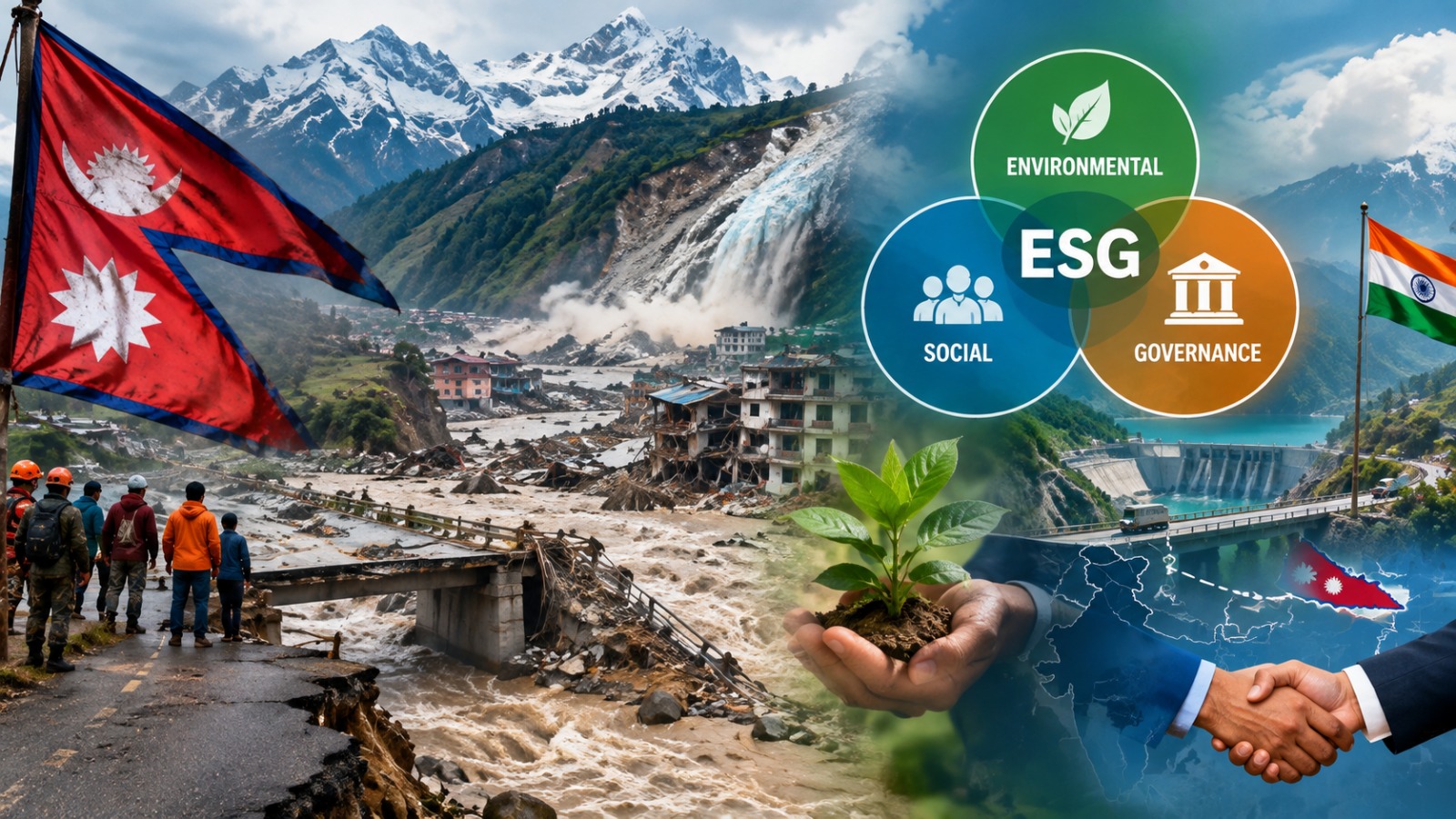
The disaster that unfolded in Nepal on August 26, 2026 is a reminder that the Himalayas do not give much room for complacency. A collapse of ice, rock and debris in the upper reaches triggered a destructive surge through the river system, damaging settlements, roads, bridges, power infrastructure and tourism routes. The scientific assessment of the exact trigger will take time. But even before all the technical questions are answered, there is something India should notice. What happened in Nepal is not only a natural disaster. It is also an ESG crisis in the most practical sense of the term.
We usually hear ESG in the context of annual reports, investors, ratings and corporate disclosures. In the mountains, however, ESG has a much more immediate meaning. The environmental part is visible in unstable slopes, shrinking glaciers, changing rainfall patterns and stressed river systems. The social part is visible in families losing homes, jobs and access to basic services. Governance appears in the quality of planning, early warning, construction standards and coordination between agencies. When any one of these is weak, the economic cost follows soon after.
India has enough experience to understand this. The Chamoli disaster in Uttarakhand in 2021 showed how quickly an event originating high in the mountains can move downstream and affect lives and infrastructure. Sikkim has faced the consequences of glacial lake-related flooding. Himachal Pradesh and Uttarakhand have repeatedly experienced landslides, road failures and extreme rainfall. Nepal’s latest experience is therefore not something geographically distant from us. The conditions are different from place to place, but the underlying concerns are familiar.One issue deserves more attention. India is investing heavily in roads, tunnels, hydropower, tourism and connectivity across the Himalayan states. Much of this development is necessary. People living in these regions cannot be told that environmental protection means living without roads, electricity or employment. At the same time, construction in the Himalayas cannot be treated in the same way as construction on a plain. The mountains are more fragile, and the consequences of a wrong assessment can be much larger.This is where the economic argument becomes important. When a bridge is lost in a flood, the cost is not merely the amount required to rebuild it. A broken bridge can cut off villages, interrupt tourism, increase transport costs and prevent local produce from reaching markets. A damaged road affects hotels, restaurants, taxi drivers, small traders and daily wage workers. A damaged power project can affect electricity revenue and investment returns. The final economic loss is therefore spread across many people and may continue long after the television cameras have moved away.
For Nepal, tourism and hydropower are important economic activities. India is closely connected with both. Nepal has been exporting electricity to India, and the two countries are trying to deepen their energy relationship. Trade also depends heavily on functioning road corridors and border infrastructure. A major Himalayan disaster can therefore move from an environmental problem to a trade, energy and investment problem rather quickly.
There is a lesson here for Indian banks and investors as well. A project may look financially attractive when we calculate expected revenue, interest costs and repayment schedules. But what happens if the access road is repeatedly closed by landslides? What if insurance premiums rise? What if a power station has to remain shut because of damage to surrounding infrastructure? These questions are no longer outside finance. They are part of finance.
Perhaps this is where ESG needs a small change in direction. Much of the discussion in India still revolves around reporting what a company has done on emissions, water, energy or social programmes. Those disclosures have their place. But ESG should begin much earlier, when a project is still on the drawing board. Environmental risk should enter investment appraisal. Social vulnerability should enter rehabilitation planning. Governance should determine whether scientific warnings are genuinely considered or merely recorded as part of a procedure.
There is another difficulty which Nepal’s disaster brings into focus. Himalayan risk is not confined by borders. Rivers flow from one country into another. Weather systems do not stop at immigration checkpoints. A glacier movement or sudden river blockage upstream may eventually affect people far away. India, Nepal, Bhutan and China therefore have practical reasons to improve the sharing of hydrological, weather and satellite information. In mountain disasters, warning time may be short. A good information network may sometimes be as valuable as a large piece of physical infrastructure.
The argument is not against development in the Himalayas. India needs better connectivity, renewable energy and economic opportunities in these regions. The question is what kind of development we are creating. If an asset has to be repeatedly repaired or reconstructed because environmental conditions were underestimated, then its original cost-benefit calculation becomes doubtful.
Nepal’s tragedy therefore carries a message that goes beyond Nepal. ESG in the Himalayas cannot remain a boardroom expression. It has to enter engineering, lending, public policy and local administration. For India, the warning is quite simple: environmental fragility eventually finds its way into economic accounts. We can either recognise that risk while planning development, or pay for it later through reconstruction, lost livelihoods and disrupted growth.
Authors
1. Dr. Ranjith Krishnan, Associate Professor, Christ University, Delhi NCR
2. Dr. Jitender Bhandari, Associate Professor, Christ University, Delhi NCR iski feture image banao english m