
by Pon Chandran
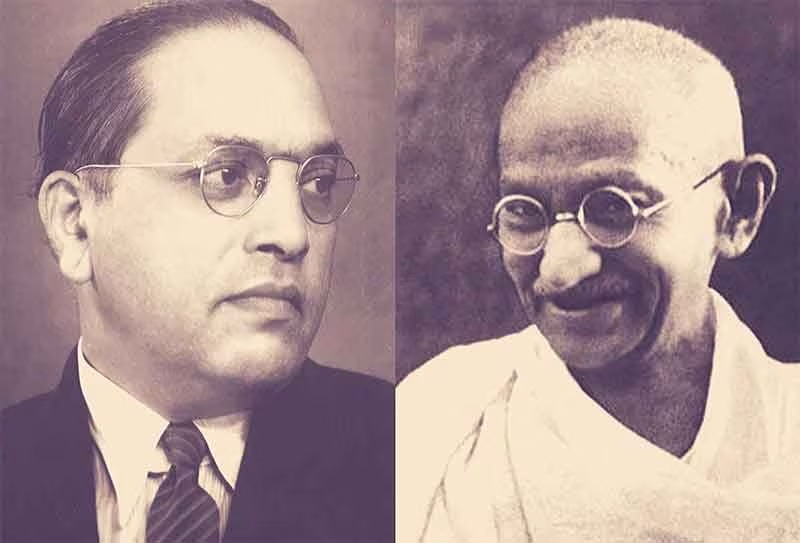
The intellectual and political engagement between Mahatma Gandhi and B.R. Ambedkar remains one of the most significant debates in modern Indian political thought. Their differences were not simply a matter of personality or political rivalry. They arose from fundamentally different understandings of caste, social reform, political representation, religion and the means through which an unequal society could be transformed.
Both opposed untouchability, but they approached the problem from different directions. Gandhi placed considerable emphasis on moral transformation and changes in social attitudes, while Ambedkar placed greater emphasis on political rights, constitutional safeguards and the dismantling of the institutional foundations of caste.
Caste, Varna and the Question of Social Reform
Gandhi regarded untouchability as a profound moral wrong and sought its eradication. His early position on the traditional varna system, however, differed significantly from Ambedkar’s. Gandhi viewed varna as a potentially functional division of social labour and believed that it could be reformed through moral and spiritual awakening.
Ambedkar approached caste more fundamentally. For him, caste was not merely a distorted social practice that could be corrected through changes in individual attitudes. He argued for the complete annihilation of caste and maintained that the foundations of caste inequality were embedded in Hindu religious and social structures. Reform, therefore, could not be confined to appealing to the conscience of those who benefited from the existing order.
This difference shaped almost every subsequent disagreement between the two leaders.
Gandhi’s method relied substantially on conscience, non-violence, self-purification and an appeal to members of the upper castes to recognise the injustice of untouchability and change their conduct. Ambedkar placed his confidence more firmly in institutional mechanisms: legal rights, constitutional guarantees, legislation and the political empowerment of oppressed communities.
The distinction was important. One approach sought to transform society through a change in moral consciousness; the other sought to give oppressed people the means to secure their rights irrespective of whether those who dominated society experienced a corresponding moral transformation.
Modernity and the Village
Their differences also extended to their understanding of modern India.
Gandhi was deeply critical of industrialisation and aspects of Western modernity. His vision of Gram Swaraj centred on decentralised, self-reliant village communities.
Ambedkar’s assessment of the traditional village was considerably more critical. He associated village society with entrenched local hierarchies and the reproduction of social inequality. His political vision was therefore more closely connected with modern constitutionalism, industrial development and urbanisation.
The contrast reflected their different assessments of where freedom could be secured. Gandhi placed considerable importance on reconstructing community life from below. Ambedkar was concerned that traditional community structures could themselves become instruments of exclusion and domination.
Political Representation and the Poona Pact
The sharpest political confrontation between Gandhi and Ambedkar emerged in 1932 over the question of separate electorates for the Depressed Classes.
The British Communal Award proposed separate electorates for Dalits. Ambedkar regarded political representation independent of upper-caste control as essential to the political agency of the oppressed. Gandhi opposed the proposal because he feared that separate electorates would permanently divide Hindu society.
While imprisoned in Yerwada Jail, Gandhi began a fast unto death in opposition to the provision. Ambedkar faced a difficult political and moral situation amid intense public pressure and concern over Gandhi’s life. The confrontation eventually resulted in the Poona Pact.
Under the agreement, separate electorates were abandoned in favour of a larger number of reserved seats for the Depressed Classes within joint electorates. The settlement resolved the immediate political crisis, but Ambedkar subsequently regarded it as a compromise that had weakened the possibility of independent Dalit political representation.
The episode reveals the depth of the disagreement between the two leaders. Gandhi’s concern was the preservation of a unified political community, while Ambedkar’s priority was ensuring that historically oppressed people possessed political power that could not simply be controlled by socially dominant groups.
Paternalism and Political Agency
Their differences were also visible in the language and organisational methods used in addressing untouchability.
Gandhi used the term “Harijan” for Dalits and established the Harijan Sevak Sangh as part of his campaign to change upper-caste attitudes and oppose untouchability.
Ambedkar rejected this approach. He objected to descriptions that, in his view, placed Dalits in a position of dependence on the sympathy or benevolence of others. His emphasis was instead on self-reliance, education, organisation and political assertion.
This distinction is central to understanding Ambedkar’s approach. The issue was not simply whether members of dominant castes should become more compassionate. It was whether Dalits themselves would possess the social, political and legal power necessary to determine their own future.
Religion and the Search for Equality
Religion formed another important area of divergence.
Gandhi drew much of his moral outlook from an inclusive interpretation of Hinduism and maintained a commitment to religious coexistence and respect for different faiths.
Ambedkar’s experience and analysis led him to a different conclusion. He came to believe that Hinduism, as structured through the caste system, could not provide Dalits with equal dignity and status. His eventual decision to leave Hinduism was therefore closely connected with his search for a social and ethical order based on equality.
In 1956, Ambedkar embraced Buddhism and led a mass conversion to Navayana Buddhism. His understanding of Buddhism emphasised liberty, equality and rational ethical principles.
The contrast between Gandhi and Ambedkar on religion again reflected their broader approaches to social change. Gandhi sought to transform Hindu society through an ethical and spiritual reorientation. Ambedkar increasingly concluded that liberation required a departure from the religious and social framework that sustained caste hierarchy.
National Freedom and Social Freedom
The differences between Gandhi and Ambedkar should not obscure the fact that both addressed the question of freedom in their own ways.
Gandhi’s contribution to the national movement rested heavily on mass mobilisation and the moral language of non-violence. His campaign against untouchability brought the issue of caste discrimination into a wider national political discourse.
Ambedkar concentrated on the institutional foundations of freedom. His work helped establish constitutional protections, fundamental rights and safeguards for communities subjected to historical discrimination.
Their approaches therefore illuminate two dimensions of democratic transformation. Political independence from colonial rule does not automatically eliminate social domination within society. Equally, legal provisions require social movements and changes in public consciousness if they are to become meaningful in everyday life.
The debate between Gandhi and Ambedkar consequently remains relevant beyond the particular disputes in which they confronted one another. Their disagreements raise a continuing question about the relationship between moral reform and structural change.
Social equality requires changes in attitudes, but attitudes alone cannot guarantee rights. Laws and constitutional protections can restrain discrimination, but institutions also depend upon a society willing to recognise the dignity of those whom they are intended to protect.
The historical engagement between Gandhi and Ambedkar can therefore be understood as representing two distinct but interacting approaches to social transformation. Gandhi placed greater faith in moral regeneration and the transformation of social consciousness. Ambedkar insisted on rights, representation, institutional safeguards and the dismantling of structures that reproduced inequality.
The history of Indian democracy contains elements of both approaches. The struggle against untouchability and caste discrimination cannot be understood solely through the language of individual morality or solely through constitutional provisions. It involves the relationship between social attitudes and political institutions, between personal transformation and collective power, and between the aspiration for national freedom and the demand for social equality.
Credit : countercurrent