
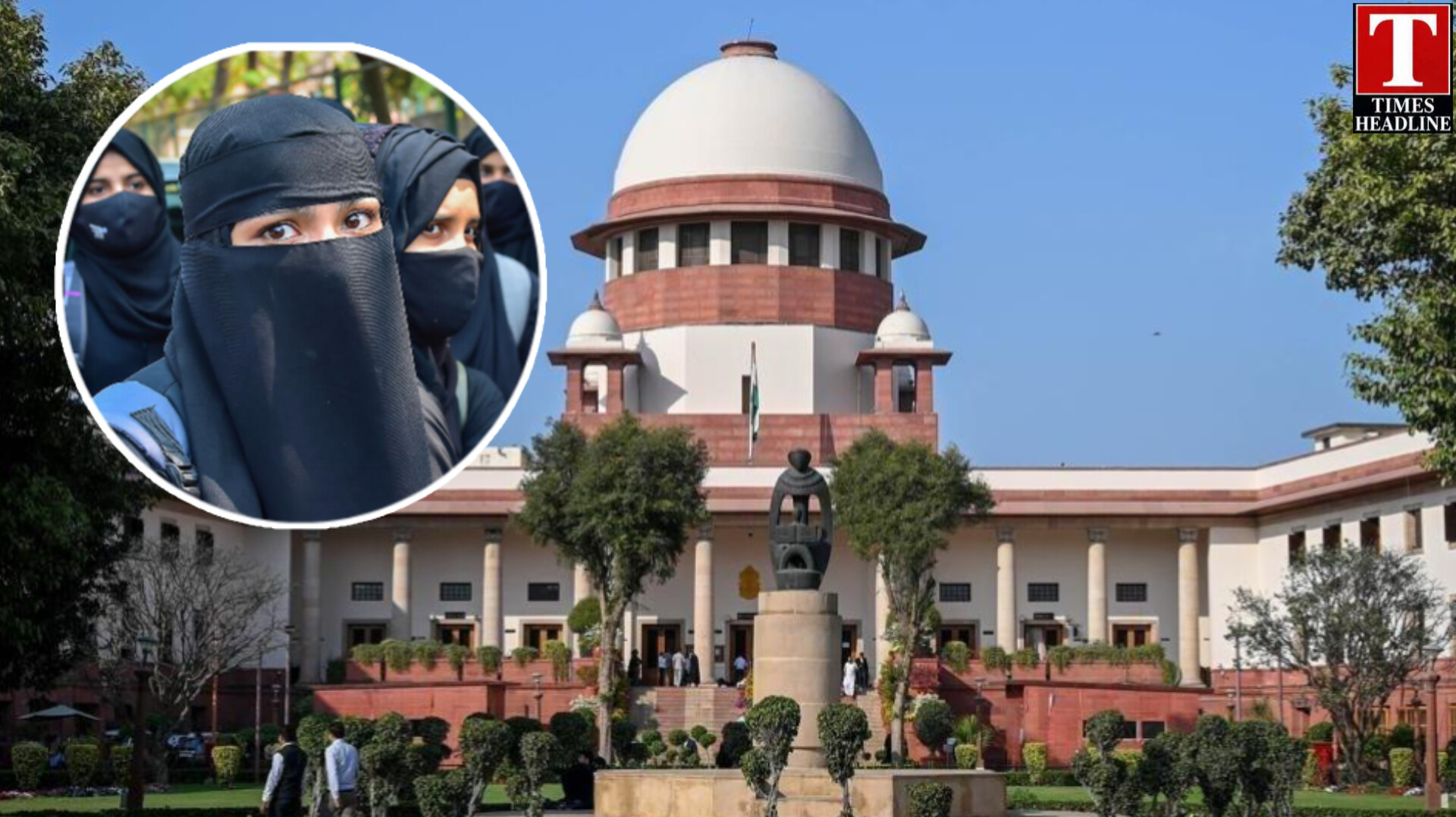
The Supreme Court of India has clarified that the Allahabad High Court’s judgment holding that wearing a hijab is not an essential religious practice in Islam cannot be treated as a legal precedent. The apex court has also sought a response from the Uttar Pradesh government on a petition challenging the High Court’s decision.
A bench comprising Justices Aravind Kumar and Vipul M. Pancholi issued notice on November 20 while hearing a petition filed by the Muslim Women’s Study Circle. The Supreme Court directed that the matter be tagged with the pending Karnataka hijab case and specifically stated that the Allahabad High Court judgment “shall not be treated as precedent.”
The case originates from a petition filed by a student, Sukaina Rizvi, who wanted to wear a hijab along with the prescribed school uniform at Tagore Public School in Prayagraj. She had reportedly worn a headscarf while studying at the school from Class VI to Class X but faced objections when seeking admission to Class XI.
On August 21, 2026, the Allahabad High Court dismissed her petition. The High Court held that students could not insist on adding clothing items to a prescribed uniform where the dress code was uniformly applied and intended to maintain discipline and institutional identity. It also ruled that the petitioner had not established hijab as an essential religious practice under Islam.
Challenging the ruling, the Muslim Women’s Study Circle argued before the Supreme Court that the High Court’s decision infringed fundamental rights, including equality, freedom of expression, personal liberty and religious freedom under Articles 14, 15, 19(1)(a), 21 and 25 of the Constitution. The organisation also argued that the judgment could adversely affect Muslim women’s religious rights and access to education.
The Supreme Court’s decision to tag the petition with the pending Karnataka hijab case is significant because the larger constitutional questions surrounding religious attire in educational institutions remain unresolved. In October 2022, a two-judge Supreme Court bench delivered a split verdict on the Karnataka hijab controversy, and the matter has remained pending for consideration by a larger bench.
The latest order does not amount to a final ruling on whether Muslim students have a constitutional right to wear hijab in educational institutions. Instead, it clarifies that the Allahabad High Court judgment cannot be relied upon as a legal precedent while the challenge is pending. The Supreme Court will consider the broader legal questions in the ongoing proceedings.