
INDIA: Maoist oblivion
On March 6, 2026, addressing a function marking the 57th Raising Day of the Central Industrial Security Force (CISF) at Mundali in Cuttack District, Odisha, Union Home Minister (UHM) Amit Shah asserted that the country was on the verge of eliminating the Communist Party of India-Maoist (CPI-Maoist) by the end of the month, adding:
Today, I want to assure the nation that the country will be Maoist-free by March 31. Our forces will defeat those who dream of building a red corridor from Tirupati to Pashupati. Our Security Forces (SFs) have reached the expectations, and the country is now on the verge of eliminating red rebels.
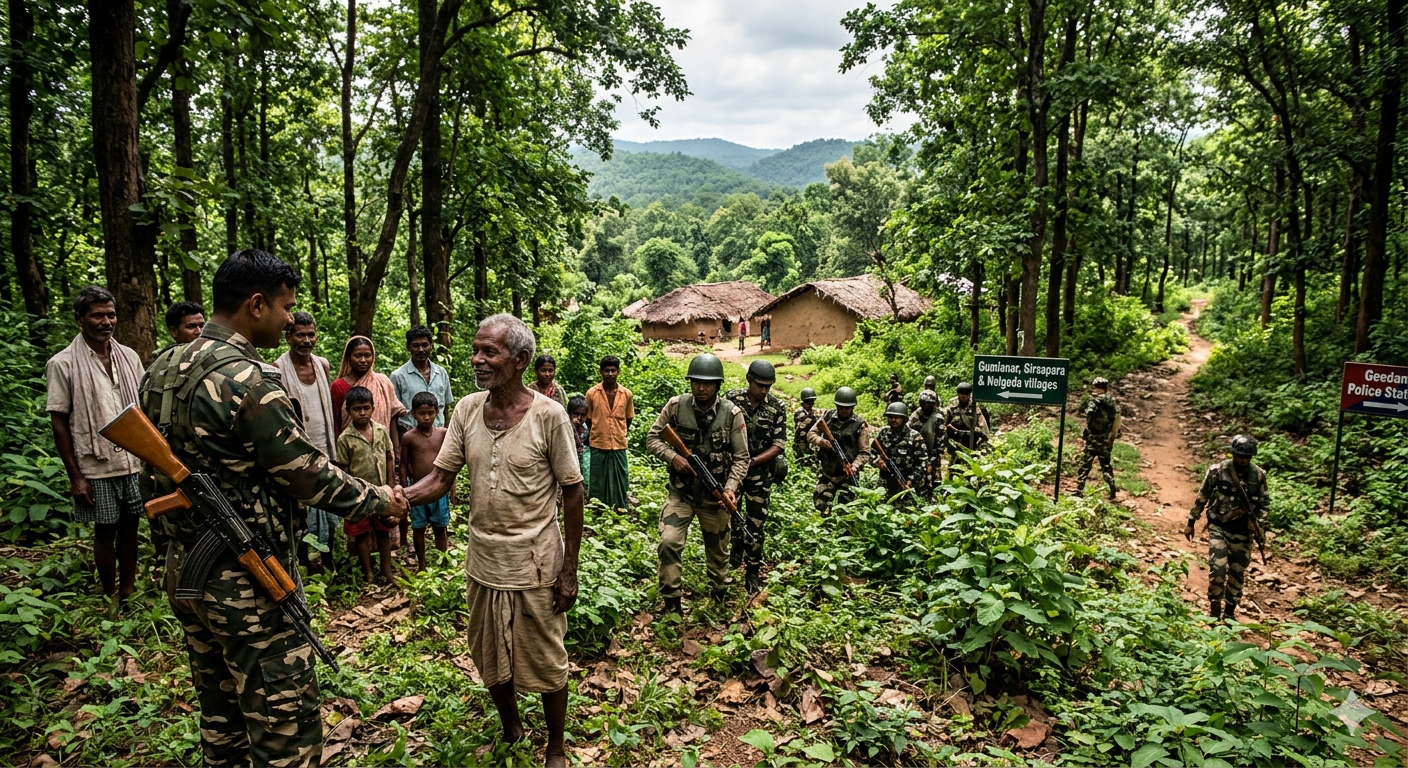
On March 3, 2026, Security Forces (SFs), engaged in an encounter with the Maoists, killed an armed CPI-Maoist cadre in the dense forest and hilly terrain between Gumlanar, Girsapara and Nelgoda villages under the Geedam Police Station area, along the Dantewada-Bijapur border in the Dantewada District of the Bastar Division of Chhattisgarh. The slain Maoist was identified as Rajesh Punem, an ‘area committee member (ACM)’ of the Bhairamgarh Area Committee, who carried a government reward of INR 500,000. During the post-encounter search of the site, a significant cache of weapons and equipment, including one SLR (Self-Loading Rifle), one INSAS (Indian Small Arms System) assault rifle, one pistol (with magazine) and one walkie-talkie set, was recovered.
On February 26, 2026, two CPI-Maoist cadres – ‘area committee members (ACMs)’ Hichami Madda and Manki Podiyam, both linked to the Bhairamgarh Area Committee, and each carrying a reward of INR 500,000 – were killed in an encounter with SFs during an anti-Naxalite operation along the Indravati River belt in the Jangla region of Bijapur District in Chhattisgarh. SFs recovered a cache of weapons, including one SLR, an INSAS assault rifle and a 12-bore gun, along with explosives and other Maoist materials.
On February 25, 2026, SFs recovered the decomposed body suspected to be that of Anvesh, a ‘Divisional Committee Member (DVCM)’ of the KKBN (Kalahandi-Kandhamal-Boudh-Nayagarh) Division of the CPI-Maoist, from a forested area in Tarabadi under Daringbadi Police limits in the Kandhamal District of Odisha. Kandhamal Superintendent of Police (SP) Harish B.C. confirmed that Anvesh was allegedly killed by his own associate, Shukru, a ‘State Committee Member (SCM)’, to prevent his surrender. Intelligence inputs suggested that Anvesh, who carried a bounty of INR 2.2 million and had been active in the region for several years, was preparing to surrender before authorities under the government’s rehabilitation policy for Maoists. Investigators believe the killing was intended as a warning to other cadres against laying down arms.
On February 22, 2026, two CPI-Maoist cadres were killed in an encounter with SFs in a forest along the Ganjam-Kandhamal border in the Karada Forest area under Raikia Police Station limits in the Kandhamal District of Odisha. The slain Maoists were identified as Jagesh, an ‘ACM’, and Rashmi, a party member, carrying a combined bounty of INR 2.75 million on their heads. Belonging to the KKBN division of the CPI-Maoist, the deceased were active in the district and allegedly involved in several violent incidents. Weapons and other items were recovered by the security personnel from the spot.
On February 19, 2026, five CPI-Maoist cadres were killed in an exchange of fire with SFs during a joint search operation in the dense forests of Karreguttalu near Doli and Jelia villages in Venkatapuram Mandal (administrative division) in the Mulugu District of Telangana. Part of Operation Kagar-2, some 5,000 security personnel from the Central Reserve Police Force (CRPF), Commando Battalion for Resolute Action (COBRA), Greyhounds and the District Reserve Guard (DRG), participated in the maneuvers in the Karregutta hillocks, considered a CPI-Maoist stronghold. The identities of the deceased were yet to be officially confirmed. Police sources indicated that those killed were suspected to be members of a Maoist area committee. SFs reportedly recovered automatic weapons, literature and other materials from the site.
According to partial data collated by the South Asia Terrorism Portal (SATP), at least 62 Naxalites [Left Wing Extremists, LWEs] have been killed by SFs in 2026 (data till March 22). During the corresponding period of 2025, SFs had killed 133 Naxalites. Through 2025, SFs killed 390 Naxalites, in addition to 296 killed in 2024, 56 in 2023, 67 in 2022, and 128 in 2021.
According to the SATP database, SFs arrested 491 Naxalites in 2025 as against 439 arrests in 2024. In 2026, as on March 22, 15 Maoists had been arrested. Since March 6, 2000, when SATP started documenting LWE-related violence across the country, 17,217 Naxalites have been arrested (data till March 22, 2026).
Mounting pressure on the Naxalites has resulted in a large number of surrenders over the past years. According to SATP data, at least 2,128 Naxalites surrender through 2025, in addition to 475 in 2024. During the current year, as on March 22, 2026, 718 surrenders have been recorded. Since March 6, 2000, 20,073 Naxalites have surrendered (data till March 22, 2026).
Through 2025, SFs recovered weapons and ammunition from the Maoists in 240 incidents, in addition to 205 such incidents of recovery in 2024. During the current year, as on March 22, 2026, the number of such incidents stands at 62. Since March 6, 2000, a total of 5,365 incidents of arms recovery have been documented.
Through 2025, the overall security situation was further improved by ongoing SF successes on the ground. The trend of declining overall fatalities, on year-on-year basis, in Left Wing Extremism-related violence, established since 2018, witnessed a reversal in 2023 at around 9.62 per cent (from 135 in 2022 to 148 in 2023), then spiked by 168.24 per cent (from 148 in 2023 to 397 in 2024) and further increased by 20.15 per cent (from 397 in 2024 to 477 in 2025). According to SATP data, a total of 477 persons (54 civilians, 33 SF personnel and 390 Naxalites) were killed in such violence through 2025, as against 397 fatalities (80 civilians, 21 SF personnel and 296 Naxalites) recorded in 2024. A total of 148 persons (61 civilians, 31 SF personnel and 56 Naxalites) were killed in 2023. As of March 22, 2026, the overall number of such deaths for the current year was 65 (two civilians, one SF trooper and 62 Naxalites), compared to 160 such fatalities (14 civilians, 13 SF personnel and 133 Naxalites) during the same period in 2025. Significantly, the reversal of the trend in overall fatalities in 2024 and 2025, was largely due to the elimination of increasing numbers of rebels, particularly after January 21, 2024, when UHM Amit Shah proclaimed that the country would be freed of the menace of Naxalism.
The number of civilian fatalities (54) reported through 2025 was the second-lowest in this category since 2000, according to SATP data. A previous low of 53 was recorded in 2022. 2010 saw the highest number of civilians fatalities in such violence, at 630.
Though the number of fatalities among SFs increased from 21 in 2024 to 33 in 2025, according to SATP data, the number of fatalities in 2025 was the fourth lowest in this category since 2000. Three previous lows were recorded at 15 in 2022, 31 in 2023, and 21 in 2024. 2009 recorded the maximum number of SFs killed in such violence, at 319.
The SF:Maoist kill ratio remained in favour of the SFs in 2025, at 1:11.81, an improvement over the ratio for 2022, at 1:4.46. The ratio in 2024 was at 1:14.09, which was the best since March 6, 2000. In 2010, the SF:Maoist kill ratio shifted to 1.01:1, favouring the Maoists. In 2009, again, the ratio was at 1.01:1. In 2007, the ratio was at 1.2:1 favouring the Maoists. However, since March 6, 2000, the overall kill ratio has been in favour of the SFs, at 1:1.85. In the current year, the kill ratio remains overwhelmingly in favour of the SFs at 1:62, so far (data till March 22, 2026).
Other parameters of violence indicate that, despite sustained SF pressure, the Maoists retain some operational capabilities across the country. At least five major incidents (each involving three or more fatalities) were recorded in 2025, compared to two such incidents in 2024. The Maoists orchestrated at least 53 incidents of Improvised Explosive Device (IED) explosions in 2025, compared to 42 such incidents in 2024. Although no major incident initiated by the Maoists has been recorded in 2026 so far, the Maoists have already orchestrated at least nine explosions in 2026 (data till March 22).
Moreover, the number of overall LWE-linked incidents of violence increased marginally from 574 in 2024 to 600 in 2025. However, incidents in which the Maoists killed civilians and SFs decreased from 84 in 2024 to 60 in 2025.
Meanwhile, according to the SATP database, Maoist activities were reported from eight States in 2025, in comparison to 10 States in 2024. (India has a total of 797 Districts in 29 States and nine Union Territories). The eight affected States have a total of 275 Districts, of which one district fell in the ‘highly affected’ category; 11 in the ‘moderately affected’ category; and 15 were ‘marginally affected’. By comparison in 2024, of 35 affected districts from 10 states, out of a total of 320 Districts in these States, two districts fell in the ‘highly affected’ category, nine in the ‘moderately affected’ category, and 24 were ‘marginally affected’. It is significant to recall here that at peak, in September 2009, the Maoists were ‘active’ in as many as 223 Districts across 20 States, out of a total of 626 Districts and 28 States in the country.
Analysis of every state in the nation hit by LWE activities clearly demonstrates a general downward trend in violence as well as a significant improvement in the security situation of the impacted areas, and the waning power of the insurgents, specifically in Chhattisgarh, Jharkhand, Telangana, Odisha, Bihar and Maharashtra, as well as in Andhra Pradesh and Madhya Pradesh.
On February 4, 2026, Nityanand Rai, Minister of State in the Ministry of Home Affairs, in a written reply to a question in the Rajya Sabha, asserted that the number of LWE-affected districts had been reduced from 126 in 2018, to just eight [Bijapur, Sukma and Narayanpur in Chhattisgarh; West Singhbhum in Jharkhand; Gadchiroli in Maharashtra; and Kandhamal, Kalahandi and Malkangiri in Odisha] by December 2025, with only three districts (Bijapur, Sukma and Narayanpur in Chhattisgarh) now categorized as “Most LWE Affected”.
On February 22, 2026, Senior CPI-Maoist functionary Thippari Tirupathi aka Devuji aka Devji aka Deoji (60), believed to be the Maoist ‘general secretary’, who carried a reward of INR 2.5 million in Telangana, and Malla Raji Reddy aka Sangram (76), a ‘Central Committee (CC)’ and ‘Politburo’ member, surrendered along with 21 other cadres, before the Special Intelligence Bureau of the Telangana Police, in the Komaram-Bheem Asifabad District of Telangana. The development, seen as the last nail in the coffin of the outlawed organisation, came just weeks before the Centre’s March 31 deadline to eliminate Naxalism from the country.
Other significant surrenders of the recent past include: October 17, 2025 – senior ‘CC’ member Takkalapalli Vasudeva Rao aka Satish aka Rupesh aka Aashanna (59), along with 209 CPI-Maoist cadres, including 110 women, laid down arms at the Reserve Police Line in Jagdalpur in the Bastar District of Chhattisgarh. On October 15, 2025, Mallojula Venugopal Rao aka Abhay aka Bhupati aka Master aka Sonu (69), a ‘Politburo’, ‘Central Committee Member (CCM)’, and ‘Central Military Commission (CMC)’ member who served as official spokesperson and long-time ideologue of the CPI-Maoist, accompanied by 60 cadres, including Zonal and Divisional Committee Members, surrendered before Chief Minister Devendra Fadnavis in the Gadchiroli District of Maharashtra.
Prior to these surrenders, CPI-Maoist had already faced critical leadership attrition, crippling the insurgency and creating a leadership vacuum. On November 18, 2025, Madvi Hidma aka Hidmanna aka Santosh (51), second-in-command in the CPI-Maoist ranks, a CC member, Commander of the Maoist ‘Central Military Commission’ (CMC) and of the elite People’s Liberation Guerrilla Army (PLGA) ‘Battalion No. 1’, was killed in an encounter with Andhra Pradesh Police Greyhounds in the Maredumilli Forest area, near Kondavada village, in the Maredumilli Mandal (administrative division) of the Alluri Sitarama Raju District of Andhra Pradesh. On May 21, 2025, Nambala Keshava Rao aka Basava Raju aka Ganganna aka Krishna aka Vijay aka Prakash (70), the ‘general secretary’ of the party (the highest executive post), a ‘Politburo member’, ‘CCM’, and ‘CMC’ member, was killed along with 26 other Maoists, in an encounter with SFs in the dense jungles between the Abujhmad Forest and the Indravati National Park in the Narayanpur District of the Bastar Division of Chhattisgarh.
At present, from the 2014 list of ‘Politburo’ and ‘CCMs’, as of March 22, 2026, at least three Politburo and CC members – Muppalla Laxmana Rao aka Ganapathi (75), former general secretary who resigned on November 10, 2018, Sumanand Singh aka Sujith Da aka Sumith, and Mishir Besra aka Bhaskar aka Sunirmal (63) – remain at large. In addition, the whereabouts of Mohan aka Mahesh, among the 18 additional ‘CCMs’, and Pankaj, among the five alternate CCMs, are unknown. Thus, only five members – three of the Politburo, one of the CC, and one of the alternate CC – continue to elude the SF dragnet.
To further consolidate gains, the National Investigation Agency (NIA) took positive action against the Maoist rebels on 52 occasions. Most recently, on March 18, 2026, the State Investigation Agency (SIA) of Chhattisgarh filed a chargesheet against nine persons before a Special Court in Bilaspur for alleged links with the CPI-Maoist ‘urban network’. The chargesheet was submitted in the court of Principal District and Sessions Judge (NIA Court) Sirajuddin Qureshi. The accused include Jaggu Kursam and Kamla Kursam, arrested on September 25, 2025, in Raipur, along with seven others. The other accused were identified as Ram Incham, Pawan aka Akash aka Pushkar, Dhansingh Gavde, Sandev Podiyami, Girdhar Nag, Sukaru Ram, and Shankar Korsa. Most are natives of Bijapur, Narayanpur, and neighboring regions. Investigations revealed they posed as labourers in urban areas to pass intelligence, spread ideology, and provide logistics. Seizures included gold, cash, laptops, and digital devices. The case, registered at DD Nagar Police Station, invokes Sections of the BNS and Unlawful Activities Prevention Act (UAPA).
Earlier, on January 28, 2026, NIA filed a chargesheet against Lakshman Paswan, an accused in a Bihar-based attempt to revive the CPI-Maoist organization in the Magadh zone. Paswan, who was arrested by the NIA from Lutua in Gaya District, Bihar, in August 2025, is the fifth person to face charges under the Indian Penal Code (IPC) and the UAPA in this case. He is alleged to have actively collected levies from businesses to provide logistical support to Maoist cadres and to have organized meetings aimed at recruiting and inciting new members.
Despite tremendous gains by the SFs, concerns will persist as long as the CPI-Maoists’ armed wing, the PLGA, survives. On March 14, 2026, surrendered senior CPI-Maoist leader Thippiri Tirupathi aka Devji urged the Telangana Government to recommend lifting the ban on the CPI-Maoist, stating that the outfit would disband PLGA and function legally, if political space is provided. Devji stated that the proposal was conveyed during a meeting with Chief Minister A. Revanth Reddy, on February 27, requesting that the matter be forwarded to UHM Amit Shah. Devji also demanded the release of jailed Maoist leaders, cadres and sympathisers booked under UAPA, suggesting they be recognised as ‘political prisoners.’ He maintained that the Maoist movement retains social support, despite the decline in armed cadres. Until Devji’s appeal is addressed, the threat of Maoist violence cannot be entirely ruled out.
The threat is underscored by an October 30, 2025, report, according to which surrendered senior Maoists, including CCM Pullari Prasad Rao aka Chandranna, and Telangana SCM Bandi Prakash aka Prabhath, who surrendered on October 28, 2025, are believed to have informed the Police that the organisation possesses sufficient cash reserves to sustain itself for nearly four years, even if all fresh inflows from extortion and ‘levy’ collection were to cease. In this context, an unnamed senior Police officer, quoting the wife of a CCM, noted, “Even if there are no new funds from contractors or illegal donations, the party can financially sustain itself for about four years.”
The Maoist movement has been pushed to the wall over the past decade and a half, following aggressive SF campaigns against the rebels in areas long under their sway. These campaigns have intensified in a terminal phase, to meet the Centre’s March 31 deadline, and have severely circumscribed the rebels’ capacities to sustain dominance.
This has been achieved despite severe limitations under which the Police have functioned. According to the Bureau of Police Research and Development (BPR&D) data, the all-India Police-population ratio was 154.96 (as on January 1, 2024), in comparison to 154.84 per 100,000 on January 1, 2023. The sanctioned ratio for these years was 197.44 and 196.88, respectively. Some of the Maoist-affected States have much worse police-population ratios, as compared to this relatively poor national average: Bihar, at 80.15; Madhya Pradesh at 122.94; and Odisha at 126.50. Even in States like Chhattisgarh, where the police-population ratio, at 213.89, exceeds the national average of 154.96, it remains lower than the 220/100,000 ratio regarded as desirable for ‘peacetime policing’. Moreover, there were 192 (11.59 per cent) vacancies in the apex Indian Police Service (IPS) in the eight affected States, considerably weakening executive direction of the Force. Further, huge vacancies persist in the total strength of the State Police forces, which have been increasingly used in the fight against the Naxalites: there were 213,465 vacant posts in the eight affected States, as on January 1, 2024, against a sanctioned strength of 964,353 (actual strength: 750,888). Significantly, these constituted 36 per cent of the 592,838 vacant posts across India, as on January 1, 2024. Moreover, against a sanctioned strength of 325,201 in the CRPF, the lead counter-insurgency Force in the country, the actual strength stood at 300,222, a vacancy of 24,979 personnel.
Stark deficits are visible in the profiles of some of the worst afflicted States. According to BPR&D data, as on January 1, 2024, there were at least 23 Police Stations in Chhattisgarh, the worst Naxalism-affected State, which did not have a telephone. Likewise, the second worst affected State, Jharkhand, had 211 such Police Stations without telephone connections. The number of Police Stations without a vehicle in Jharkhand was 47, while 31 Police Stations in the state had no wireless/mobile phone. Similarly, Maharashtra had 11 Police Stations without telephone connections and 55 Police stations with no wireless/mobile phone.
Looking ahead, the trajectory of the Maoist insurgency appears to be one of continued decline, albeit with residual risks. The Government of India has articulated an ambitious target of ‘eliminating’ LWE by March 2026. While this objective may be substantially attainable in terms of reducing violence to negligible levels, the complete eradication of Maoist influence and activities, particularly in remote and underdeveloped areas, remains a more complex challenge. The immediate outlook suggests that Maoist violence will persist at low intensity, characterised by sporadic attacks, particularly in Bastar and adjoining regions, unless an abrupt political accommodation is reached. The possibility of high-impact attacks cannot be entirely ruled out, especially as Maoists may seek to demonstrate relevance in the face of declining capabilities. However, the overall strategic balance has shifted decisively in favour of the state.
Sustaining and consolidating these gains will require a multi-pronged approach. Continued emphasis on intelligence-led operations, capacity building of state police forces, and inter-agency coordination will be critical. Equally important is the need to address underlying socio-economic grievances through effective governance, inclusive development, and community engagement.
2025 can be characterised as a year of consolidation in India’s fight against Left Wing Extremism, marked by sustained operational successes, increased surrenders, and a shrinking geographical footprint of Maoist activity. As India moves beyond the March 2026 deadline, the challenge will not merely be to sustain low levels of violence, but to ensure that the conditions enabling insurgency are comprehensively addressed. The Maoist movement, though significantly weakened, is not entirely extinguished. Its residual presence serves as a reminder that counterinsurgency is not solely a military endeavour, but a broader process of state-building, and socio-economic and political transformation.
Author: Deepak Kumar Nayak
Research Associate, Institute for Conflict Management