
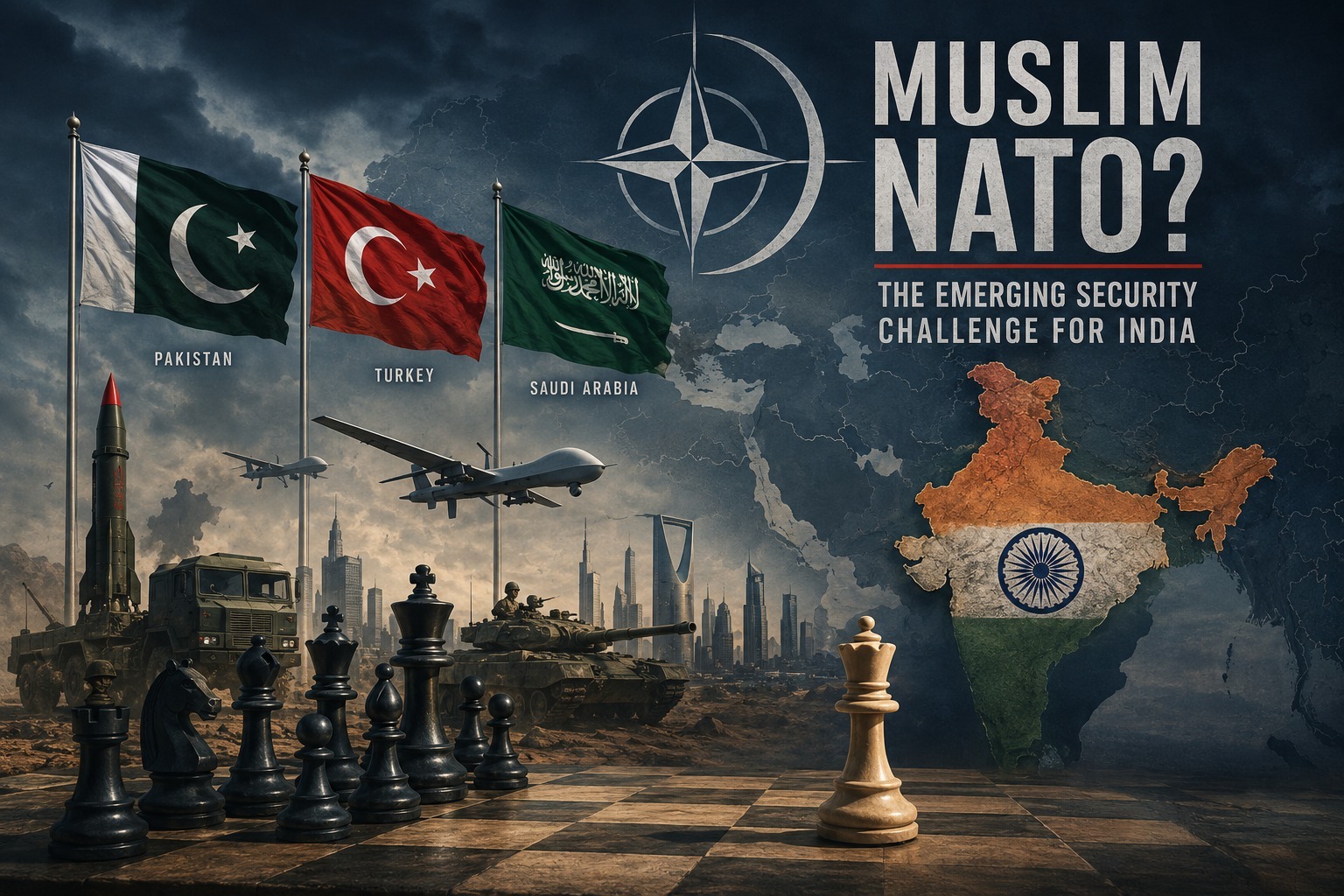
The idea of an “Islamic NATO” has resurfaced repeatedly over the last decade, often dismissed as rhetorical posturing among Muslim-majority nations seeking symbolic unity. However, recent remarks by Pakistan’s Defence Minister Khawaja Asif suggesting that Qatar may soon join a developing defence arrangement involving Pakistan and Saudi Arabia, with Turkey also in advanced discussions, indicate that the concept may be evolving into something more structured. While many geopolitical constraints continue to limit the practical viability of such a bloc, India cannot afford to ignore the strategic implications of an emerging trilateral military understanding between Pakistan, Turkey and Saudi Arabia.
At first glance, the proposed alliance appears attractive for its members. Pakistan offers nuclear deterrence and battle-tested military experience. Turkey brings advanced drone warfare capabilities, a strong domestic defence industry and NATO-standard military training. Saudi Arabia contributes immense financial resources and strategic influence across the Gulf and the wider Islamic world. Together, these elements create the perception of a powerful Muslim security architecture stretching from West Asia to South Asia.
For India, the concern is not necessarily the immediate creation of a formal NATO-style military alliance, but the gradual institutionalisation of strategic coordination among states that increasingly share overlapping geopolitical interests.
Turkey’s growing military cooperation with Pakistan is already visible. Ankara has supplied advanced drones, naval cooperation and military technology to Islamabad in recent years. Turkish political rhetoric has also become increasingly aligned with Pakistan on issues such as Kashmir. During periods of India-Pakistan tension, Turkey’s diplomatic positioning has often moved beyond symbolic solidarity into active strategic support. This convergence matters because Turkey is no longer merely a regional Middle Eastern power; under President Recep Tayyip Erdoğan, Ankara seeks influence across the Muslim world through defence exports, ideological outreach and geopolitical activism.
Pakistan, meanwhile, continues attempting to internationalise regional disputes with India by building coalitions within the Islamic world. Islamabad understands that it cannot match India economically or conventionally in the long run. As a result, it seeks asymmetric leverage through diplomatic blocs, military partnerships and religious solidarity. A trilateral arrangement involving Turkey and Saudi Arabia would significantly strengthen Pakistan’s strategic depth and international standing.
Saudi Arabia’s role is more complicated. Riyadh today shares strong economic and strategic ties with India. Under Vision 2030, Saudi Arabia sees India as a critical investment and energy partner. Yet geopolitics is rarely static. The Kingdom also faces increasing regional insecurity, uncertainty about long-term American commitments in the Gulf and growing competition with Iran and Turkey for influence within the Islamic world. Participation in a Muslim security framework may therefore appear attractive to Saudi policymakers, even if Riyadh avoids overt anti-India positioning.
Many analysts argue that the proposed Muslim NATO remains structurally weak because all three states remain deeply dependent on the United States. Pakistan relies heavily on American financial institutions and strategic calculations. Saudi Arabia’s security establishment remains intertwined with US defence systems and intelligence networks. Turkey, despite periodic tensions with Washington, remains a NATO member with operational integration into Western military structures. These are valid observations. However, alliances do not need to become fully operational military blocs to reshape regional equations.
Even limited defence coordination, intelligence sharing, joint military exercises and political alignment can alter strategic perceptions. The symbolic value of a Muslim military grouping itself may encourage broader ideological mobilisation and create new diplomatic pressures in multilateral forums.
India must also recognise the technological dimension of this emerging alignment. Turkey’s drone warfare successes in Libya, Syria and Nagorno-Karabakh have transformed its reputation as a defence exporter. Pakistan’s close military ties with China add another layer of concern. A future network involving Turkish drones, Pakistani military infrastructure and Gulf financing could gradually create an alternative security ecosystem operating parallel to Western and Indian strategic influence.
Another overlooked consequence is the impact on India’s neighbourhood diplomacy. Smaller South Asian states often calibrate their foreign policies according to shifting power centres. If an Islamic security grouping begins projecting itself as a protector of Muslim geopolitical interests, countries with significant Muslim populations may increasingly face pressure to align diplomatically with such narratives.
India should therefore avoid two strategic mistakes: panic and complacency. Panic would unnecessarily inflate the bloc’s actual capabilities and feed alarmist narratives. But complacency would be equally dangerous. Strategic alignments often begin informally before evolving into more durable frameworks over time.
New Delhi’s response must be multidimensional. First, India should deepen strategic partnerships with the United States, France, Israel and Gulf countries simultaneously, ensuring that no single bloc dominates regional security calculations. Second, India must continue strengthening indigenous defence manufacturing, especially in drones, cyber warfare and naval capabilities. Third, India should intensify diplomatic engagement with Saudi Arabia and the UAE to prevent Pakistan from monopolising Islamic geopolitical narratives.
Most importantly, India must project itself not merely as a regional power but as a stabilising global actor capable of balancing competing geopolitical currents. The proposed Muslim NATO may not become a full-fledged alliance tomorrow. But its gradual emergence reflects a shifting geopolitical reality that India cannot afford to underestimate.