
Dr Jitender Bhandari, Associate Professor, Economics, School of Social Science, CHRIST University Delhi NCR Campus
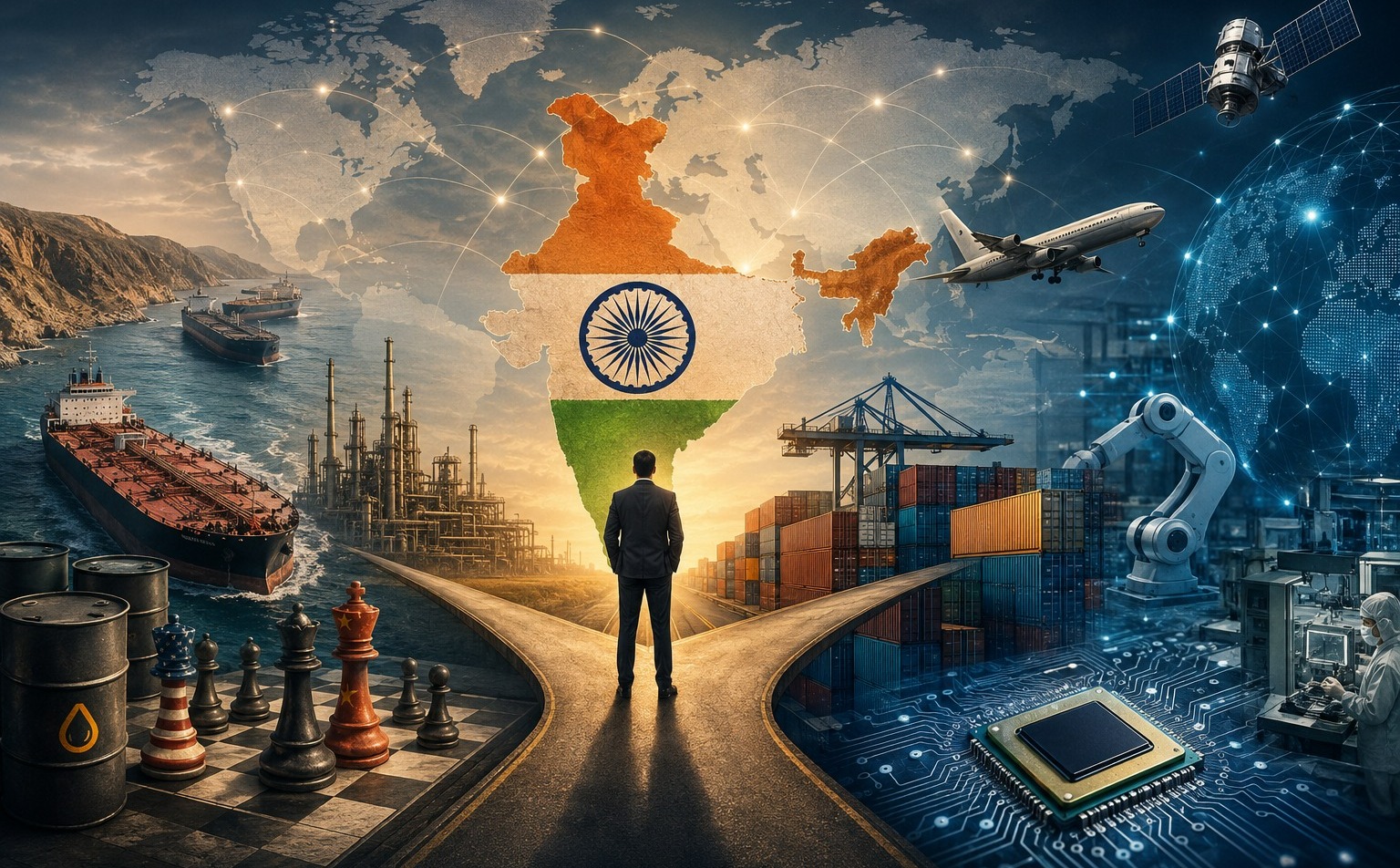
In a world where Pakistan is cast as a mediator of peace, we are undoubtedly living through extraordinary times. As tensions in West Asia repeatedly threaten the smooth transit of oil through the Strait of Hormuz and as geopolitical rivalries grow, an uncomfortable reality is becoming harder for India to ignore: growth alone is not enough. Nations increasingly derive power not merely from the GDP hierarchy but from control over strategic technologies, supply chains, financial systems, critical resources, and geopolitical chokepoints. By that measure, India’s rise, though impressive, still lacks a decisive source of global leverage. In the 21st-century geopolitical economy, power increasingly belongs to countries that control strategic choke points, technological ecosystems, critical resources, or indispensable platforms. Today, the world’s major powers possess forms of strategic indispensability that allow them to determine global outcomes. The United States still dominates the global financial architecture through the dollar system and leads frontier technologies through firms such as OpenAI and NVIDIA. China controls large segments of global manufacturing, rare-earth processing, battery supply chains, and clean-energy production. Even relatively smaller economies enjoy leverage through strategic assets: Iran influences global energy flows through the Strait of Hormuz, while Taiwan sits at the heart of advanced semiconductor manufacturing.
India’s Strengths Are Real — But They Are Not Leverage
India possesses substantial advantages in multiple domains. It has political stability, stable macroeconomic fundamentals, a large domestic market, favourable demographics, and one of the world’s most sophisticated digital public infrastructure (DPI) systems, such as Unified Payments Interface and Aadhaar. These are significant achievements for any developing economy. Yet, unfortunately, they do not amount to strategic leverage in the way advanced technology ecosystems, reserve currencies, manufacturing dominance, or resource control do.
This distinction is important because the global economy is entering a far more fragmented and coercive phase. Economic interdependence is increasingly weaponised. Technology restrictions, sanctions, import controls, industrial subsidies, and supply-chain nationalism are becoming central instruments of statecraft. Countries that control indispensable systems can absorb shocks and influence others. Countries without such leverage remain more exposed to external disruptions, which ultimately leads to internal instability.
Energy Dependence and the Limits of Economic Autonomy
India’s energy dependence illustrates this vulnerability clearly. India now imports over 90% of its total crude oil requirements, making it one of the world’s most import-dependent major economies. Crude oil imports alone cost India $134.7 billion for the FY 2025-26. West Asian countries accounted for over 54% of India’s crude imports. This means that any geopolitical disruption in West Asia immediately transmits economic stress into the Indian economy through shortages, inflation, currency pressure, and fiscal deficit.
India adopted a pragmatic policy during the Russia–Ukraine conflict by purchasing discounted Russian crude, but tactical flexibility should not be mistaken for structural energy security. India remains largely a price-taker in global energy markets. By contrast, countries that control energy routes or production possess leverage over the global system. Saudi Arabia influences oil markets through production capacity, while Iran derives strategic relevance from its geographical position near one of the world’s most critical maritime energy corridors. India, despite being one of the world’s largest energy consumers, lacks comparable influence.
The IT sector in the Era of AI
For three decades, India’s IT services industry symbolised the country’s successful integration into globalisation. This year, the IT sector is expected to reach $315 billion in revenue, with the sector generating more than $230 billion in exports, and in the process, has created millions of jobs directly or indirectly. Yet India’s IT sector success was concentrated primarily in labour-intensive services rather than ownership of technological ecosystems. The next phase of the digital economy may increasingly reward countries that control foundational AI models, semiconductor design, cloud infrastructure, advanced computing power, and proprietary platforms. In these areas, India remains largely a participant rather than a producer. The rise of generative AI has suddenly exposed the nature of the Indian IT sector’s business model. Technologies capable of automating coding, documentation, testing, and back-office functions threaten the labour-arbitrage model on which much of India’s IT exports were built. While India undoubtedly possesses strong engineering talent, the country still lacks globally dominant AI infrastructure, semiconductor production capabilities, and frontier research ecosystems comparable to those emerging in the United States or China.
The issue is not whether the Indian IT industry will survive; it is whether India can move from being a service provider to becoming a creator of core technologies. Recently, some steps have been taken by the Government to establish the semiconductor production facilities
Manufacturing: The Missing Piece
Historically, every major economy that achieved broad-based prosperity did so through large-scale industrialisation. China transformed itself into the “factory of the world”; South Korea built industrial champions in electronics and automobiles; Vietnam integrated deeply into global supply chains. India, however, transitioned relatively early toward a services-led growth model without achieving comparable manufacturing depth. Manufacturing contributes roughly 15–17% of India’s GDP, which is significantly below the levels observed in many other emerging economies, especially East Asian industrial economies. At the same time, over 40% of India’s workforce remains trapped in low-productivity agriculture. This imbalance constrains employment generation, export competitiveness, and industrial scale. Initiatives such as Production Linked Incentive schemes and Make in India are important steps, but the challenge is much larger. India must build industrial ecosystems that global markets depend upon. Without manufacturing depth, India risks remaining a large consumer market rather than becoming a central node in global production networks.
Participation without leverage
Trade patterns further reinforce the leverage deficit. India’s share in global merchandise exports remains modest at roughly 2–3%, despite being one of the world’s largest economies. Its export markets also remain concentrated in a few advanced economies, particularly the United States and Europe. This creates a structural asymmetry. Access to advanced markets is critically important for India, but India’s ability to influence the policy choices of those markets remains limited. In moments of geopolitical stress, such asymmetry can quickly become vulnerability. This is the broader challenge facing India today. The country participates actively in the global economy, but participation is not the same as leverage. Leverage emerges when the world depends on something you control —whether semiconductors, reserve currencies, rare earths, manufacturing ecosystems, technological platforms, or strategic trade routes. India currently controls a few such strategic bottlenecks.
The way forward
There are seemingly some notable limitations that India is currently operating in the current geoeconomic sphere. However, this does not mean India’s rise is illusory. India remains one of the fastest-growing major economies and possesses long-term structural advantages that many ageing advanced economies lack. But the next phase of global competition will likely be shaped less by growth rates alone and more by control over strategic assets. The countries that dominate semiconductors, AI models, rare earths, energy corridors, advanced manufacturing, financial infrastructure, and digital platforms will exercise disproportionate influence over the global order. India’s challenge, therefore, is not merely to grow faster. It is to convert economic scale into strategic indispensability. That requires sustained investments in frontier technologies, semiconductor ecosystems, energy resilience, industrial capability, research and development, and deeper integration into high-value global supply chains. It also requires moving beyond the comfort of services-led expansion toward technological and manufacturing depth. The real danger for India lies not in an abrupt decline, but in gradually becoming a participant in global systems that it ultimately does not influence. In the emerging geo-economic order, influence increasingly belongs to countries the world cannot function without. India has achieved scale. The next challenge is achieving leverage; otherwise, it will be like Amitabh Bachchan in the famous Bollywood movie ‘Deewar,’ where he had almost everything, but the real leverage (Ma) was with Shashi Kapoor.