
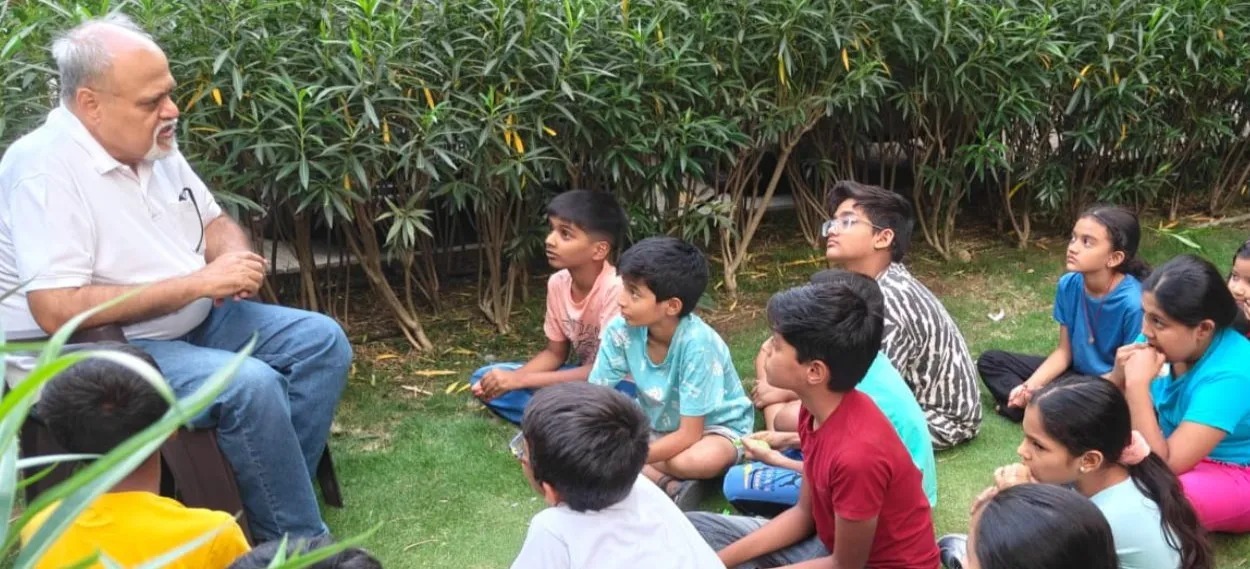
In an age where most children spend evenings glued to mobile screens, a quiet revolution is unfolding in the residential societies of Pune. Instead of video games and endless scrolling, children can now be seen running around with balloons, magnets, plastic bottles and mirrors in their hands not as toys, but as tools of scientific discovery. Behind this remarkable initiative is Mujtaba Lokhandwala, an engineer, educator and science mentor who has transformed ordinary housing society lawns into vibrant open-air science laboratories. Through simple experiments and activity-based learning, he is reigniting curiosity among children and proving that science can be exciting, practical and deeply connected to everyday life.
At a time when education is increasingly becoming exam-oriented, Prof. Lokhandwala’s work stands out as a refreshing alternative. Rather than encouraging rote memorisation, he teaches children to ask questions, observe carefully and understand the logic behind natural phenomena. Using everyday household objects, he explains scientific principles in ways children never forget. A straw and bottle become tools to understand air pressure. Mirrors turn into lessons on reflection of light. Games help children grasp gravity, motion and energy without fear or pressure.
For Prof. Lokhandwala, science is not merely a subject to score marks in examinations. It is a way of thinking. He believes that curiosity is the foundation of real education and that children learn best when they are allowed to experiment freely. In his workshops, there are no “wrong questions.” Every child is encouraged to think independently and explore ideas with confidence. What makes his initiative even more remarkable is its community-driven model. Once a workshop is completed in a housing society, a “Science Club” is formed there. Interested parents and residents are trained to continue organising science activities regularly, ensuring that learning becomes part of the society’s culture rather than a one-time event.
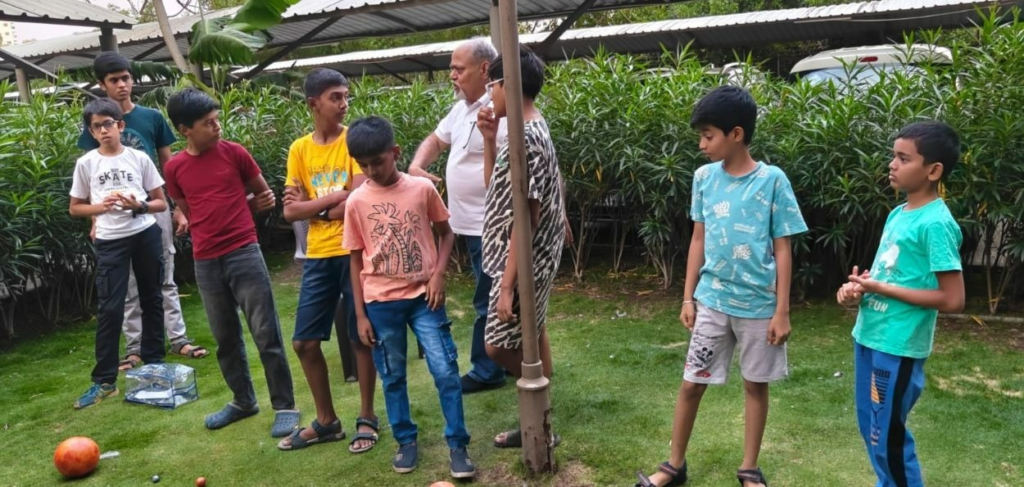
The impact has been extraordinary. Parents who initially attended merely to watch their children now actively participate in experiments themselves. Conversations in many societies have changed. Instead of discussing malls or gadgets during holidays, children now debate which science experiment they should try next. Prof. Lokhandwala’s passion extends far beyond classroom science. Astronomy, in particular, occupies a special place in his mission to inspire young minds. As evening turns into night, many of these workshops shift from lawns to terraces. Telescopes are set up, and children get an opportunity to witness the Moon’s craters, Jupiter’s moons and constellations shining across the night sky.
For many of them, it is the first time they truly look upward with wonder. Prof. Lokhandwala, who served as the former President of the prestigious Jyotirvidya Parisanstha, uses storytelling to make astronomy deeply engaging. Children learn how to identify the North Star, the Big Dipper and other constellations while also understanding humanity’s place in the vast universe. The sparkle in their eyes, he says, is worth more than any textbook achievement. His own journey is equally inspiring. A mechanical engineer by qualification, Prof. Lokhandwala taught engineering students for nearly two decades and now mentors CEOs of major companies. Yet despite working with top professionals, he dedicates his evenings to answering the curious questions of schoolchildren with patience and warmth. His initiative carries an important social message as well.
At a time when society often complains about children becoming addicted to screens, Prof. Lokhandwala asks a simple but powerful question: have adults given them an equally engaging alternative? Through science, observation and interaction with nature, he is offering precisely that alternative. In many ways, his work reflects the finest tradition of Indian Muslim intellectual contribution one rooted in knowledge, inquiry, education and service to society. Quietly and without publicity, Prof. Mujtaba Lokhandwala is nurturing a generation of curious young minds who may one day become scientists, innovators and thinkers. Most importantly, he is teaching children that science is not confined to laboratories or textbooks. Sometimes, it begins right in the middle of a society lawn.