
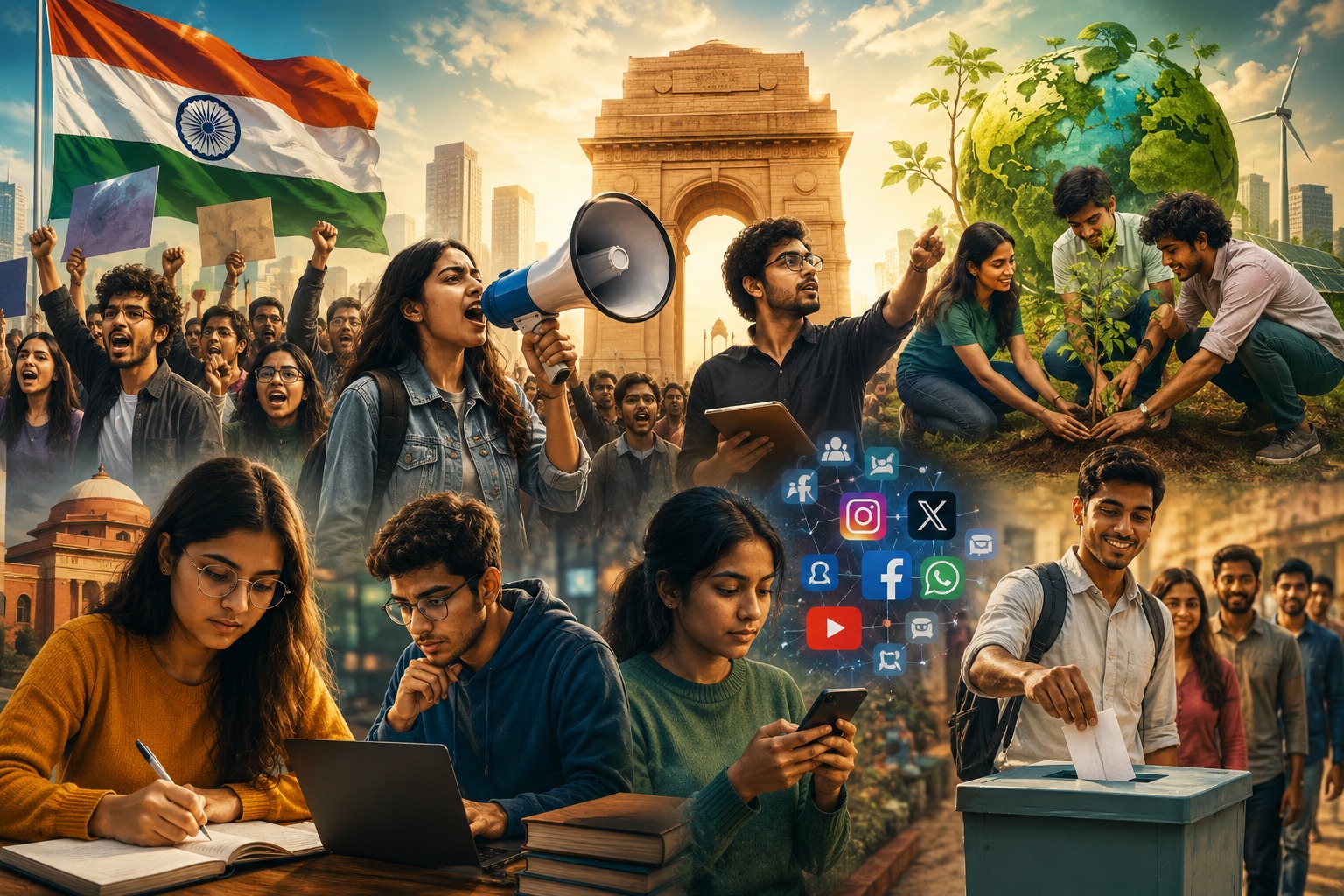
As India celebrates the world’s largest democracy, a significant transformation is unfolding beneath the surface of electoral politics. Young Indians are increasingly moving beyond the role of passive voters to become active participants in public discourse, civic engagement, and political accountability. Whether through climate campaigns, digital activism, student movements, or grassroots initiatives, they are attempting to awaken society to issues that often remain neglected in mainstream political conversations.
India is one of the youngest nations in the world, with nearly 65 percent of its population below the age of 35. This demographic advantage is often discussed in economic terms, but its democratic significance is equally important. A democracy remains vibrant not merely through elections but through continuous citizen engagement, and young people are emerging as some of its most energetic stakeholders.
Historically, youth have played a decisive role in shaping India’s political trajectory. From the freedom struggle led by young revolutionaries such as Bhagat Singh to the student-led mobilizations during the Emergency, young Indians have consistently challenged injustice and demanded accountability. Today’s generation is carrying forward that tradition, though the battlegrounds have changed from public squares to digital platforms, university campuses, and community networks.
Recent years have witnessed several examples of youth-led engagement. Students from institutions such as the Jawaharlal Nehru University, Jamia Millia Islamia, and Delhi University have consistently participated in debates around education policy, freedom of expression, gender justice, and social inclusion. While opinions may differ on their methods or demands, their willingness to engage with public issues reflects an important democratic impulse—the refusal to remain indifferent.
Climate activism has emerged as another powerful arena of youth participation. Inspired by global movements and adapted to local realities, young Indians have organized campaigns highlighting air pollution, water scarcity, waste management, and climate resilience. Across cities such as Delhi, Bengaluru, Mumbai, and Chennai, students and young professionals have participated in climate marches, awareness drives, and sustainability initiatives. Their message is simple yet urgent: environmental degradation is not a future problem but a present reality that will shape their lives more than any previous generation.
The digital revolution has further expanded the political agency of young citizens. Social media platforms have enabled students, journalists, researchers, and ordinary citizens to discuss public policies, expose local grievances, and mobilize support for social causes. Campaigns related to road safety, women’s rights, environmental protection, mental health awareness, and public accountability frequently gain momentum because young people amplify them online. In many instances, digital engagement has compelled authorities to respond more swiftly than traditional channels of communication.
The 2024 General Elections also highlighted the growing importance of young voters. Political parties across ideological lines actively sought to engage first-time voters, recognizing their influence on electoral outcomes. Beyond voting, however, many young citizens participated as volunteers, digital campaigners, policy advocates, and fact-checkers. This broader involvement signals a shift from transactional politics toward issue-based engagement.
Yet the significance of youth activism extends beyond specific movements or elections. At its core, it represents a desire to make governance more responsive and inclusive. Young people are asking difficult questions about employment, education, technological disruption, gender equality, climate change, and social justice. These are not merely youth issues; they are national concerns that will define India’s future.
Critics often argue that contemporary youth activism is driven by emotion rather than experience. However, every generation of reformers has been accused of idealism. The right to question authority, scrutinize public institutions, and demand accountability lies at the heart of democratic citizenship. A society that discourages such participation risks nurturing apathy rather than responsibility.
At the same time, activism must remain informed, constructive, and democratic. Social media can amplify misinformation as easily as it amplifies truth. Therefore, the challenge before young leaders is not only to raise their voices but also to ground their arguments in evidence, dialogue, and a commitment to democratic values. Responsible activism requires both passion and patience.
India stands at a critical juncture marked by technological transformation, economic aspirations, and complex social challenges. In such a moment, the participation of young citizens is not merely desirable; it is essential. Their energy, creativity, and willingness to challenge the status quo can help strengthen democratic institutions and foster a culture of accountability.
The future of Indian democracy will not be determined solely by those who govern. It will also be shaped by those who question, engage, organize, and participate. Young Indians are increasingly choosing to do exactly that. Their voices may be uncomfortable at times, but democracies grow stronger when citizens speak up rather than remain silent.
In the end, the true measure of a democracy is not how loudly governments speak but how freely its young citizens can ask questions—and how seriously society listens to their answers.
Dr. Nipunika Shahid
Assistant Professor, Media Studies, South Asian University