
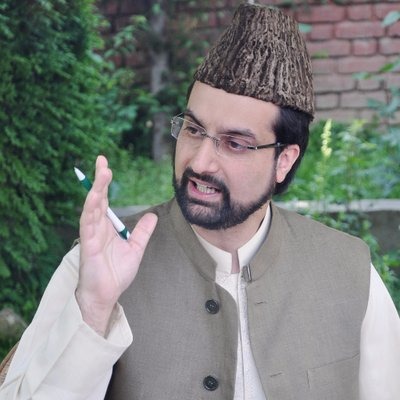
Srinagar, July 6: Mirwaiz-e-Kashmir, Mirwaiz Umar Farooq, on Sunday emphasized that Kashmir’s history and identity cannot be viewed through a selective lens, asserting that the region’s civilisational legacy stretches back thousands of years and encompasses multiple religious and cultural traditions. He also called for renewed dialogue between India and Pakistan, as well as between New Delhi and Srinagar, describing engagement as the only sustainable path to peace.
Speaking to the media after inaugurating an educational consultancy initiative at Lal Chowk in Srinagar, the Mirwaiz addressed a range of issues, including the ongoing Amarnath Yatra, Kashmir’s historical identity, and the need for political dialogue.
Amarnath Yatra Should Remain a Symbol of Faith and Harmony
Commenting on the annual Amarnath Yatra, the Mirwaiz said the pilgrimage is a religious occasion that has historically been respected by the people of Kashmir. He noted that Kashmir has a long tradition of hospitality and mehmaan-nawazi, and said pilgrims visiting the Valley should be welcomed with dignity and care.
At the same time, he stressed that it is the responsibility of the administration to ensure adequate security and essential facilities for the pilgrims while minimizing disruption to the daily lives of local residents. He also underscored the importance of protecting Kashmir’s fragile ecological environment during the pilgrimage. The Mirwaiz urged that the Yatra should not be politicised and should instead remain an occasion promoting faith, communal harmony, peace, and mutual respect. He expressed hope that the pilgrimage would conclude peacefully and safely.
‘Kashmir’s History Cannot Be Selectively Presented’
Speaking about Kashmir’s historical identity, the Mirwaiz said the region’s civilisational heritage spans over 5,000 years and includes the Buddhist era, the traditions of Shaivism and Hinduism, and the later Islamic period, all of which have collectively shaped Kashmir’s spiritual, cultural, and social character.
He further noted that the events following 1947 also form an inseparable part of the region’s modern political history. “You cannot erase history or selectively project only that part of history which suits a particular narrative,” he said, adding that societies progress through openness, discussion, and engagement rather than by restricting books or suppressing differing viewpoints. He maintained that facts cannot be altered by censorship and emphasized the importance of preserving intellectual freedom and historical discourse.
Dialogue Remains the Only Way Forward
On India-Pakistan relations, the Mirwaiz reiterated his long-standing support for dialogue, recalling that he continued to advocate talks even during periods when such views attracted criticism and allegations of disloyalty.
Referring to difficult periods in his personal life, he said that despite the killing of his uncle, Molvi Mushtaq, attacks on his residence, and the burning of Islamia School, he remained committed to the belief that dialogue is the only viable path toward resolving longstanding disputes. As global geopolitical realities continue to evolve, he said, it has become increasingly evident that war cannot provide lasting solutions. He welcomed the efforts of civil society groups from India, Pakistan, and Jammu & Kashmir that continue to advocate peace and constructive engagement.
The Mirwaiz also recalled the dialogue initiatives undertaken during the tenures of former Prime Ministers Atal Bihari Vajpayee and Manmohan Singh, expressing hope that such efforts could be revived.