
By Dr. Shujaat Ali Quadri
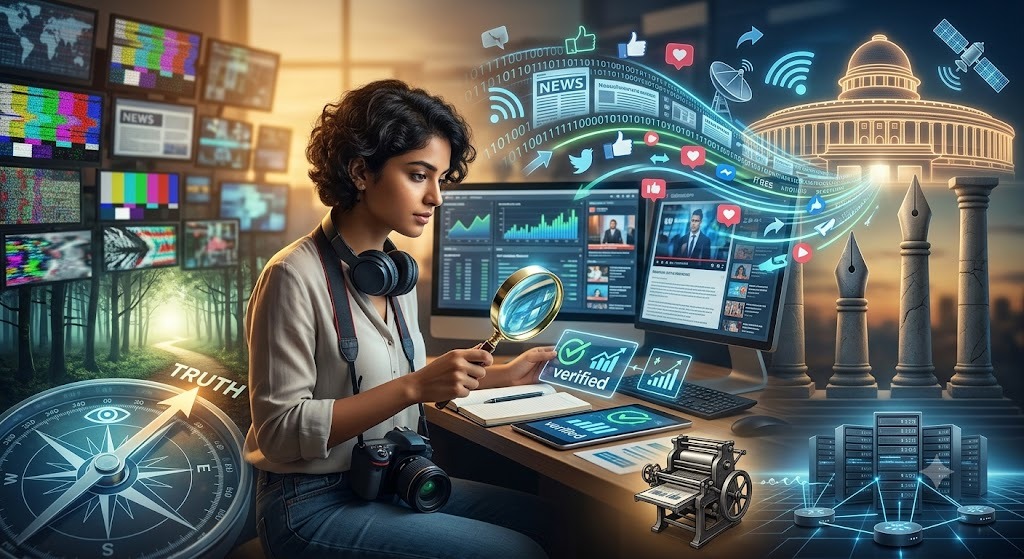
In today’s digital era, information travels faster than ever before. A news update, photograph or video can reach millions of people within minutes through social media platforms. While this technological revolution has made access to information easier, it has also led to an unprecedented rise in misinformation, disinformation and fake news. As a result, the role of journalism has become more important than ever. Alongside traditional journalism, emerging fields such as digital media and fact-checking have opened exciting career opportunities for young people who are passionate about truth, communication and public service.
Journalism is often described as the fourth pillar of democracy because it informs citizens, holds institutions accountable and strengthens democratic values. A journalist’s responsibility is not merely to report events but to verify facts, present multiple perspectives and provide accurate, balanced and ethical reporting. In an age where anyone with a smartphone can publish content online, professional journalism stands apart because of its commitment to credibility, verification and public interest.
The media industry has undergone a remarkable transformation over the last decade. Newspapers and television continue to play a significant role, but digital platforms now dominate news consumption. Online news portals, mobile journalism, podcasts, newsletters, YouTube channels and social media have created an entirely new media ecosystem. Consequently, career opportunities have expanded far beyond the conventional roles of reporters and news anchors.
Students entering this field today can explore careers as digital journalists, multimedia reporters, news editors, content writers, copy editors, documentary filmmakers, podcast producers, photojournalists, video journalists, social media managers, media researchers and communication specialists. Corporate organisations, government departments, international institutions, non-governmental organisations and think tanks also recruit media professionals to manage communication, public relations and digital outreach.
One of the fastest-growing professions within this ecosystem is Fact-Checking. The rapid spread of fake news, manipulated images, AI-generated videos and misleading narratives has made professional verification an essential public service. Fact-checkers investigate viral claims, authenticate photographs and videos, verify official records and use digital forensic tools to determine the authenticity of online content. Their work helps prevent misinformation from influencing public opinion, creating communal tensions or undermining democratic institutions.
As Artificial Intelligence becomes increasingly sophisticated, fact-checking is gaining even greater importance. While AI can generate convincing text, images and videos, trained fact-checkers equipped with verification techniques and investigative skills remain indispensable in identifying manipulated or fabricated content. Consequently, governments, media organisations, technology companies and international institutions are investing significantly in combating misinformation.
For students aspiring to build a career in journalism and media, developing the right skill set is essential. Strong communication skills, excellent writing ability, critical thinking, analytical reasoning, research aptitude and curiosity form the foundation of successful journalism. Knowledge of current affairs, constitutional values, politics, economics, technology and international relations provides a broader perspective necessary for meaningful reporting. Additionally, familiarity with digital tools, video editing software, photography, social media analytics and data journalism significantly enhances employability.
Educational pathways are equally diverse. After Class XII, students can pursue Bachelor of Journalism and Mass Communication (BJMC), BA in Journalism, BA in Mass Communication or Media Studies. Postgraduate programmes such as MA in Journalism, MA in Mass Communication and specialised diploma courses further strengthen professional competence. Today, numerous online certification programmes in digital journalism, investigative reporting, media ethics and fact-checking also allow professionals to continuously upgrade their skills.
Career opportunities exist across newspapers, television channels, digital media organisations, news agencies, radio stations, magazines, OTT platforms, communication consultancies, corporate communication departments, public relations firms, international organisations and specialised fact-checking organisations. Independent journalism and digital content creation have also become viable career options, enabling individuals to build their own platforms and audiences.
The financial prospects are steadily improving as well. While entry-level salaries generally range from ₹20,000 to ₹40,000 per month depending on the organisation and location, experienced journalists, editors, digital media professionals and communication specialists often earn substantially higher incomes. Successful independent journalists, YouTubers and media entrepreneurs can generate significant revenue through subscriptions, advertising, consulting and content partnerships.
Many students worry that Artificial Intelligence will replace journalists. However, AI is better viewed as a tool rather than a substitute. Technology can assist in transcription, data analysis and drafting routine reports, but it cannot replace ethical judgment, investigative reporting, field verification, human empathy or accountability. The journalists of the future will be those who effectively combine technological expertise with strong editorial ethics and professional integrity.
Above all, journalism remains a profession built on public trust. Society depends on credible information to make informed decisions. Responsible journalists and fact-checkers protect not only truth but also social harmony, democratic institutions and national resilience against information warfare.
For young people who are naturally curious, passionate about public affairs and committed to serving society, journalism, media and fact-checking offer more than just employment—they offer an opportunity to make a meaningful difference. In an era defined by information overload, the ability to distinguish fact from fiction has become one of the most valuable skills of the twenty-first century.
The future of journalism belongs to those who uphold truth, embrace innovation and remain committed to ethical reporting. As the media landscape continues to evolve, India needs a new generation of responsible journalists and professional fact-checkers who can strengthen democracy by ensuring that truth always prevails over misinformation.