
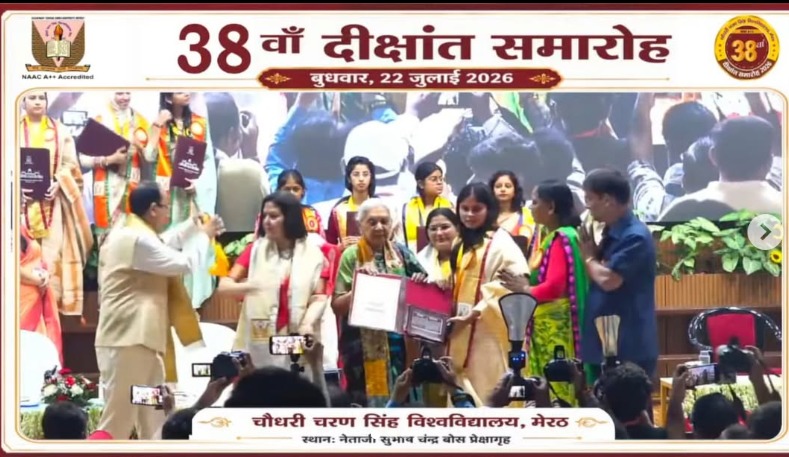
In a country as diverse as India, there are moments that remind us that education has the power to transcend every social, economic and religious boundary. One such inspiring story is that of Anam Chaudhry, a young Muslim woman from Uttar Pradesh who emerged as the topper in Sanskrit at the 38th Convocation of Chaudhary Charan Singh University (CCSU), Meerut, and was honoured by Uttar Pradesh Governor and Chancellor Anandiben Patel for her outstanding academic achievement. What makes Anam’s achievement truly remarkable is not merely that she excelled in one of India’s oldest classical languages. It is the journey behind her success. Coming from a humble family where her father works as a labourer, Anam overcame financial hardships through perseverance, dedication and an unwavering commitment to education. Her success demonstrates that talent and determination are not defined by economic status.
For many, Sanskrit is often viewed only through the lens of religion or tradition. However, Anam’s accomplishment sends a much deeper message. A Muslim girl mastering Sanskrit and securing the highest academic honours challenges stereotypes and highlights the inclusive nature of India’s intellectual heritage. Languages belong to humanity, not to any one community. Sanskrit, like Persian, Arabic, Urdu, Tamil or Hindi, forms an important part of India’s civilisational legacy, and Anam’s achievement beautifully reinforces this truth. At the 38th Convocation Ceremony of CCS University, held on 22 July 2026, Anam was felicitated by Governor Anandiben Patel, who presented medals and degrees to outstanding students. The ceremony recognised hundreds of meritorious graduates across disciplines, with Anam standing out as one of the brightest achievers for her exceptional performance in Sanskrit.
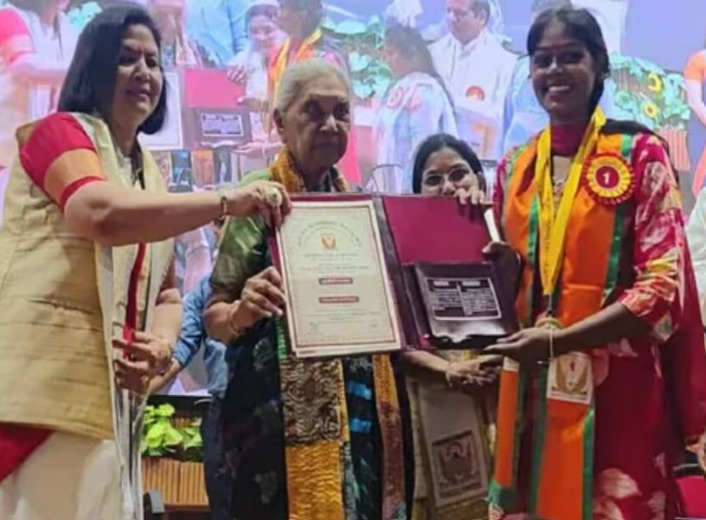
Anam has pursued her higher education in Sanskrit with remarkable dedication and has expressed a clear academic ambition to become a Professor of Sanskrit. Rather than viewing Sanskrit as belonging to one religion or community, she sees it as a language of knowledge, philosophy and literature that should be accessible to everyone. Her dream reflects the spirit of scholarship that has historically connected people across different faiths and backgrounds. Her story is also an inspiring example of women’s empowerment. In many economically disadvantaged families, especially where parents work as daily wage labourers, pursuing higher education can be a significant challenge. Yet Anam refused to allow financial limitations to define her future. With determination and family support, she proved that hard work can overcome circumstances.
The significance of Anam’s success extends far beyond personal achievement. At a time when social media often amplifies narratives of division, her journey offers a refreshing reminder that India’s greatest strength lies in its diversity. Throughout history, Indian civilisation has witnessed scholars from different religious traditions contributing to languages and knowledge systems beyond their own communities. Anam’s achievement continues that tradition in contemporary India. Her success also carries an important message for students. Academic excellence is not confined to mainstream or commercially popular subjects. Whether one studies Sanskrit, Arabic, Persian, Urdu, Philosophy or any other discipline, sincere scholarship and passion can open doors to recognition and meaningful careers. By aspiring to become a professor, Anam hopes to inspire future generations to appreciate classical languages and preserve India’s rich intellectual traditions.
The recognition she received from Governor Anandiben Patel further underscores the value that educational institutions place on academic merit, irrespective of a student’s social or economic background. Public recognition of achievers like Anam encourages countless other young students particularly girls from underprivileged families—to believe that excellence is within their reach. Anam Chaudhry’s journey is ultimately a story of hope, resilience and national harmony. She is the daughter of a labourer who transformed adversity into achievement. She is a Muslim woman who became a Sanskrit topper, demonstrating that knowledge has no religious boundaries. She is a scholar with the dream of becoming a professor, proving that education remains the most powerful instrument of social mobility.
Her success is not merely a personal milestone it is a celebration of India’s pluralistic ethos. In Anam’s achievement, we see an inspiring example of communal harmony, women’s empowerment, educational excellence and the timeless truth that learning unites where prejudice divides.