
By Farhan Siddiqui
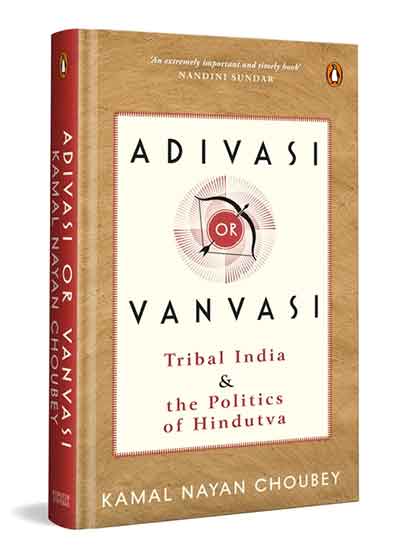
Kamal Nayan Choubey. Adivasi or Vanvasi: Tribal India & the Politics of Hindutva. New Delhi: Penguin Vintage, 2025. 281 pages.
Kamal Nayan Choubey’s Adivasi or Vanvasi: Tribal India and the Politics of Hindutva, published by Penguin Random House India in 2025, represents a significant and timely contribution to the scholarship on Hindu nationalism’s penetration into India’s tribal heartlands. As an Associate Professor of Political Science at Delhi University’s Dyal Singh College, Choubey’s academic rigour in analysing the tribal wing of the Rashtriya Swayamsevak Sangh (RSS), the Akhil Bharatiya Vanvasi Kalyan Ashram (VKA), a group which has functioned for more than 70 years, but has received little attention in mainstream academia. It traces the history of VKA from its inception in Jashpur in December 1952, through the Gramscian analytical lens, to the present position as one of the “traditional intellectual” forces, maintaining the status quo while claiming to be a progressive organisation working for the welfare of the tribes. The book provides invaluable insights from a communist perspective on the mechanisms of cultural hegemony, of the co-optation of social service for reactionary political ends and of the contradictions involved in the expansion of Hindutva into the tribal areas, which makes it an indispensable resource for understanding contemporary Indian politics.
Choubey has set out to establish that the VKA was born out of a mix of anxiety by Congress leaders in the Christian missionary movement and the perceived separatist trends in the tribal areas, and that both Chief Minister of Central Provinces Ravishankar Shukla and Thakkar Bapa were significant proponents of it urging Ramakant Deshpande to do something about the influence of Christian missionaries. The book details how Rajendra Prasad’s letters to Adivasi Mahasabha member Jaipal Singh Munda from the late 1930s showcased the concerns of the Congress leadership about the demands of the Adivasi Mahasabha for a separate Jharkhand province, concerns that would become fertile ground for the intervention of the RSS in tribal regions. Founded in December 1952 with the aid of the Maharaja of Jashpur and under the guidance of RSS chief M.S. Golwalkar, the VKA’s roots clearly show that it was a movement meant to serve the tribal people but in reality it was one designed to fight religious conversion; a movement that was all about asserting Hindu supremacy and not tribal autonomy, and which would cast its shadow as it developed for many years to come. The organization of VKA is carefully documented, thirty-nine state level affiliates are registered separately with each one operating under the control of the Sangathan Mantri appointed by RSS and 1978 expansion in the NorthEast under Balasaheb Deoras represents a major strategic step to push Hindutva politics into the region where Christian influence is strong and the presence of a Sangathan Mantri ensured ideological uniformity. The president of the VKA has been a tribal from the founding days of the organisation by Ramakant Deshpande (now a tribal, then Jagdev Ram Oraon) and the patronizing nature of ‘tribal leadership’ in the Sangh Parivar is evident from the fact that the president, ever since Ramakant Deshpande’s death, has been a RSS appointee, never a tribal, so that ideology remains intact.
The author mentions three key ideologies of VKA’s work: Shradha Jagran (faith awakening) activities, such as pilgrimages to Kumbh Melas, founding of Bhajan Mandalis, recitation of Ramayana, and appropriation of tribal icons like Birsa Munda and Rani Gaidinliu as Hindu icons; the use of the term ‘Vanvasi’ instead of ‘Adivasi’ which is a systematic erasure of tribal claims to indigeneity through the slogan “Tu Main Ek Rakt” (You and I have the same blood) and the support of the Niyogi Commission report in 1956, which was used to justify the anti-missionary campaign of VKA. The “fundamental violence” of Choubey’s selective memory in the context of Birsa Munda, who built his own religion and who was a critic of both Christian missionaries and Hindu landlords, is a fundamental violation of tribal memory and identity, which were also shaped and sustained by tribal political traditions that were often autonomous and opposed to colonialism and Hinduism. The VKA has been very active in education, medical services, and women empowerment and is well documented to provide two hundred twenty nine hostels, serving more than eight thousand students, two hundred formal education centers, two thousand twenty four Ekal Vidyalayas and medical services to approximately six hundred fifty thousand beneficiaries each year as of 2023. Choubey shows how these services work as tools to create ‘consent’ with respect to the Hindutva ideology and provide material support, that is, ‘good results’ and ‘affordability’ as the reasons parents would send their children to VKA schools; while the children seem to graduate with a strong sympathy for the Sangh, they don’t become ‘ideological converts’ since ‘consent’ is being created through seemingly innocent educational institutions.
A very important chapter in the book focuses on the changing stance of the VKA regarding forest rights, the “Hit Raksha Vibhag” was formed in 1990 and the organization has gone on to demand proper enforcement of the Forest Rights Act and the Panchayats Extension to the Scheduled Areas Act. Choubey mentions a big irony: the VKA is demanding progressive demands but isn’t willing to mobilize people through protest movements or demonstrations; it’s all about the ‘politics of persuasion’ by sending out memoranda and press releases, as in the case of the eviction of forest-dwellers by the Supreme Court in February 2019 or as in the case of the proposed amendment in the Indian Forest Act, which would affect the rights of forest dwellers. It shows that the VKA is basically accepting the state and the role of capitalism in development, it is in the process of reforming with its operations in the system but it never challenges the system itself, and Choubey says that “no state government ever considered it as a challenge to their policies in tribal areas” because the VKA never challenges the state’s fundamental role in facilitating capitalist exploitation. The last substantive chapter focuses on the VKA’s positions on controversial issues such as opposing the Sarna Code while at the same time demanding cultural autonomy for tribals, participating in state violence against Maoists by different organizations under the VKA banner while invoking the term Naxal violence against those who did not participate in the VKA’s campaigns, supporting state violence against Maoists while at the same time condemning “Naxal violence”, and maintaining ambivalence in campaigns for Ghar Wapsi, which it participated in using different names like Dharma Jagran Samiti, etc., but not under the VKA’s banner.The last substantive chapter deals with the VKA’s positions on controversial issues such as opposing the Sarna Code while at the same time demanding cultural autonomy for tribals, participating in state violence against Maoists by different groups and organizations under the VKA banner, calling others “Naxal violence” who did not participate in the VKA’s campaigns, supporting state violence against Maoists while condemning “Naxal violence”, and maintaining ambivalence on Ghar Wapsi campaigns, participating in it under different names like Dharma Jagran Samiti, etc., but not under the VKA’s name. Choubey has acutely spotted contradictions in the ideology of VKA: they oppose Uniform Civil Code while holding on to Sarna Code; they are against the Pathalgadi movement and at the same time promote forest rights – contradictions that expose the tactic and conditional nature of VKA’s “progressivism” in favour of rights that do not threaten the basic structures of the state and capital.
A book from a communist point of view would include the following as some of its more important features: the good use made of the categories of intellectuals of the communist thinker Antonio Gramsci to analyse the VKA; the ability to distinguish between the “traditional intellectuals” who uphold existing power structures and the “organic intellectuals” who challenge them, which proves to be a useful framework for understanding the VKA’s dual nature. Choubey is right to note that the VKA “shows a combination of tendencies included in Gramsci’s typology of the intellectuals,” but also “the features of the traditional intellectuals prevail” and hence the VKA can “advocates progressive forest rights legislation” and at the same time “defends the development model of the Indian state and opposes any challenge to the capitalist relations of production in the tribes. This valuable empirical documentation of the use of education, healthcare and women’s empowerment programmes in an ideological manner, as well as the keen detection of internal contradictions of the VKA ideology, exposes the essentially reactionary character of an organisation that is based on the production of dependency and gratitude, instead of autonomous political consciousness and political mobilisation. From the communist point-of-view, however, there are several major drawbacks to this book, most importantly a lack of class analysis and the failure to pay due attention to the capitalist mode of production as the root cause of tribal dispossession. Choubey talks about the contractors, businessmen and the mine owners exploiting them, but does not do enough analysis of the way that the capitalist state has cheated on laws like PESA and FRA to allow for the extraction of resources, and instead assumes that the problem lies in the failures in regulation rather than the fundamental contradiction between the process of capitalist development and the survival of tribal livelihoods, which is a contradiction that must be resolved at a systemic level, not just by policy tweaks.
Moreover, the book’s analysis of the Indian state’s role in tribal areas is not class-critically adequate, lacking any critical analysis of the state as an instrument of the capitalist class; though Choubey does mention the demand of the VKA of ‘Indian demands getting primacy over exports’ in the Indian policy of mining, he does not critically analyze the nationalist framework that accepts resource extraction within capitalist parameters. The treatment of Maoist groups and left organisations is also not satisfactory, offering a simplistic impression of the Maoists as a violent group without explaining the historical conditions that gave rise to armed struggle in the tribal areas; and the discussion of VKA and All India Union for Forest Working People is tempting but not fully developed discussion of the conceptual difference between political consciousness and mass mobilisation. While valuable, the chapter on women’s work is limited, as the VKA “has never used the term patriarchy in its meetings or published literature” and “does not encourage foundational questions related to gender inequality,” and there is a need to explore how VKA’s ’empowerment’ programs reinforce patriarchal structures, as opposed to others such as Tharu Adivasi Mahila Mazdoor Kisan Manch, who directly challenge patriarchal structures. The book also does not devote much attention to the complicated linkages among caste, tribe and Hindutva, which the VKA has tried to “Hinduise” tribals, despite which it has subjected them to a form of historical violence that merits more in-depth discussion.
The success of the VKA is in its ability to provide service while simultaneously indoctrinating with a Hindu ideology, setting up the material conditions which allow for consent while simultaneously building a Hindu identity which negates tribal identity and merges it with Hindu majoritarianism, as Choubey’s book shows clearly. The VKA has a fundamentally reactionary understanding of tribal autonomy, as it acknowledges some manifestations, such as the creation of cultural autonomous bodies and traditional rulers, through the PESA while rejecting political autonomy (such as the Pathalgadi movement) as “instigated by Christian missionaries and Naxals” despite its legitimate constitutional claims. The appropriation of tribal symbols by the organization, its work to depoliticize tribal history, which often involved opposition to colonialism and even to Hindu domination, and the portrayal of tribal heroes as ‘Hindu’ figures, all help to create a distortive historical memory which serves the organization’s contemporary political agendas. For communists, the VKA is not merely a political counter but a specific type of reactionary mobilisation that needs to be understood and opposed – this opposition must involve the creation of a class consciousness that cuts across religious lines, mass mobilization for true tribal autonomy and control of resources, and a critique of the state’s role in supporting the advance of Hindutva and capitalist dispossession in tribal zones.
Overall, Choubey has written a scholarly and painstakingly thorough book that offers historical documentation of the evolution of the organization, a rigorous Gramscian analytical framework, empirical detail on the provision of services and the ideological work of the organization, identification of internal contradictions and strategic flexibility, and much to compare the VKA with other left organizations, and makes complex concepts accessible in academic prose. The book, however, would have benefited if the author had offered greater class analysis of capitalist exploitation, a more limited critique of the role of the state in the tribal areas, a more thorough discussion of the historical context of the Maoist and left movements, a more thorough discussion of women’s agency and of patriarchy, and a more thorough engagement with Dalit-Bahujan politics. However, the political context today makes Adivasi or Vanvasi ever urgent and offers analytical tools to better understand the complicated nature of Hindutva’s relationship with tribal politics, as the BJP government celebrates Janjatiya Gaurav Divas, while simultaneously undermining the Forest Rights Act. However, some key aspects of VKA’s selective agenda and selective adoption of progressive demands clearly indicate the nature of the ‘inclusive Hindutva’ – a policy that absorbs and neutralises opposition by co-opting some demands, but in the process, the fundamental structures of domination are maintained. The book also sheds light on the BJP’s flexibility with respect to the Northeast where it advocates for eating beef and not aggressively Hinduizing them, while the VKA’s consistent Hindutva project shows that the fundamental contradiction between the two wings of the Sangh may provide a space for progressive forces.
It is an alarming and instructive book for communists and all progressive forces active in the tribal areas; not only warnings to the dangers of providing services which render the people dependent, and not liberating them, but also the fact that the language and some of the demands of the progressive movements have been appropriated by the right-wing forces and that they are serving reactionary politics while playing with the language of the progressive movements. The success of the VKA is a basic challenge to the left and democratic camp that represents the struggle for genuine tribal autonomy and liberation and Choubey’s book is a great light that shines on the challenge and gives analytical tools to deal with it. It must not only expose the reactionary nature of the VKA, but it has to create alternative organizational systems offering authentic services to the tribals without any ideology, nurture their inner political sense, and go to the roots of the problems of exploitation and domination both capitalist and caste-Hindu, which mould the process of tribal life in India today. The VKA’s “service” is really service to the Hindutva project which attempts to subordinate tribal people in a Hindu majoritarian framework, continuing capitalist relations of exploitation; any attempt to liberate tribal people must therefore block both aspects of the subordination of tribal people in a Hindu majoritarian framework, and the continuation of capitalist relations of exploitation through systematic class analysis, mass mobilization and the development of autonomous organizations that can provide a genuine alternative to the capitalist state’s extractive policies and the cultural domination of tribal people by Hindutva.
(Farhan Siddiqui is an independent researcher with a postgraduate degree in Human Rights from Aligarh Muslim University. His research interests include indigenous rights, environmental justice, tribal governance, constitutional law, and sustainable development. He is actively engaged in human rights research, advocacy, and socio-legal studies.)
Source : Counter Currents .org