
By Dr Abhay Kumar
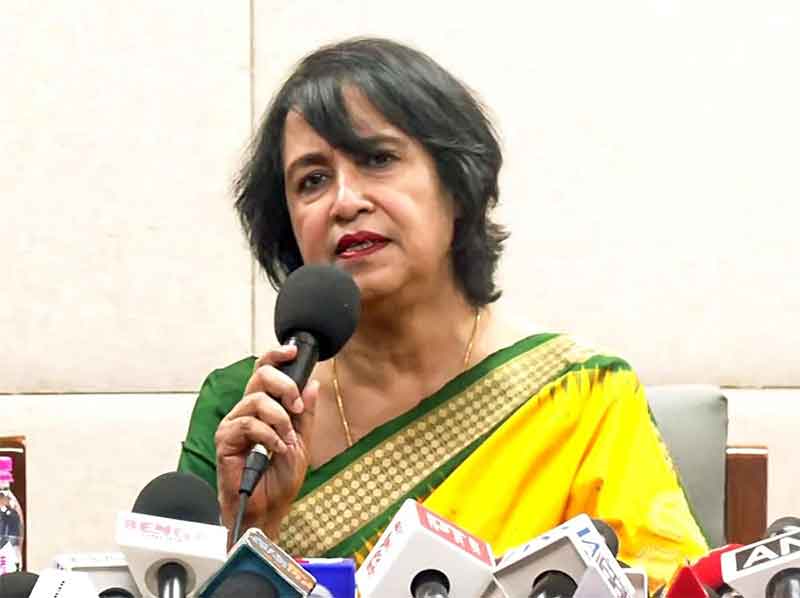
Soon after the BJP came to power in West Bengal, it rolled out the red carpet for the controversial and exiled Bangladeshi writer Taslima Nasrin. After a gap of 19 years, she returned to Kolkata on Friday (July 31), with the state’s newspapers giving her visit extensive coverage through prominent headlines, reports, and photographs. The following day, on Saturday (August 1), Chief Minister Suvendu Adhikari attended a civic reception in her honour at Rabindra Sadan in Kolkata, highlighting the government’s warm welcome.
What is particularly noteworthy is that, upon arriving in Kolkata, Taslima Nasrin made no mention of poverty, unemployment, or the challenges faced by minorities in the state. Nor did she address what critics describe as an increasingly anti-minority political climate, which they argue contributed significantly to the BJP’s electoral success. Instead, she opened her remarks by speaking about madrasas, claiming—without presenting evidence—that they pose a terrorism threat. She also reiterated her support for a Uniform Civil Code, arguing that such legislation is essential to ensuring equal rights for women.
In this context, it is reasonable to ask whether the BJP’s rise to power, the state government’s plan to implement the Uniform Civil Code, and the 64-year-old writer’s return to Kolkata after nearly two decades are merely coincidental, or whether these developments reflect a broader political strategy.
An even more important question is this: Why does a writer who presents herself as “progressive,” “secular,” and a “champion of women’s rights,” and who has long been a vocal critic of right-wing forces in Bangladesh, have no qualms about sharing the dais with Hindutva leaders across the border, despite critics’ accusations that Hindu nationalism promotes religious majoritarianism, exclusionary nationalism, and discrimination against Dalits and Muslims? What explains this apparent alliance between Hindutva forces and Taslima Nasrin? How can someone be an uncompromising opponent of one right-wing political force in one national context while maintaining a close association with another in a different one? Does this not suggest a selective approach to opposing right-wing politics?
During a press conference in Kolkata on Sunday (August 2), Taslima Nasrin spoke in favour of banning madrasas and claimed that many—though not all—madrasas are allegedly involved in jihadi activities. She said: “Religious schools produce jihadis”… In my opinion, madrasas should not exist. Not in all cases, but in some, it is seen that jihadis are being produced in madrasas. Child abuse is going on there, rapes are happening, and imams and madrasa teachers are being held… There is no need for madrasas to exist” (The Hindu, August 2, 2026)”.
Although Taslima Nasrin maintained a distinction between some madrasa and all madrasa, saying that not all madrasas are involved in jihadi activities, but only some are. However, several Hindi newspapers and news portals published did not carry this distinction in their news report. Here are a few examples, “Madrasas Produce Only Jihadis” (Madarse Sirf Jihadi Paida Karte Hain), “Taslima Nasrin Says: Madrasas Produce Only Jihadis” (Taslima Nasrin Bolin— Madarse Sirf Jihadi Paida Karte Hain) and “Madrasas Are Breeding Grounds for Jihadis” (Madrasa Jihadiyon ke Panapne ki Jagah…).
A writer who claims to speak for minorities in Bangladesh seems to overlook the fact that such remarks constitute sweeping generalizations. In doing so, they reinforce the Hindutva narrative and provide ammunition for those seeking to stigmatize Muslim educational institutions.
Is Taslima Nasrin so politically naïve that she could not have anticipated how eagerly sections of the mainstream media—particularly the Hindi media—would seize upon and amplify her sweeping statements? Or were these remarks made deliberately, with full awareness of the political and media response they were likely to provoke?
The reality is that madrasas are neither centres of terrorism nor institutions that teach jihad in the militant sense. Their curriculum is based on Islamic teachings, history, philosophy and literature, and includes Arabic, Persian, and Urdu. Many madrasas also teach English, computer education, science, and social studies.
History bears witness to the fact that madrasas played an active role in the anti-colonial struggle. During the period leading up to India’s Partition, Darul Uloom Deoband was among the leading supporters of secular Indian nationalism. Until quite recently, not only Muslims but also a considerable number of Hindu students studied in madrasas.
Apart from Mahatma Gandhi, freedom fighter, Congress top leader, and India’s first President Dr. Rajendra Prasad also had close associations with madrasa education. In his autobiography, Rajendra Prasad devoted the third chapter to fondly remembering his association with “Maulvi Saheb”, who “initiated” him “into the alphabet”. Prasad, the big Congress leader from Bihar, went to Maktab in his childhood where he learnt Persian. It was because of his Maulvi Saheb that Rajendra Prasad learnt to read Persian texts such as Karima, Gulistan, Bostan etc. Paying tribute to the Maulvi Saheb, Rajendra Prasad wrote in his autobiography, “The little Persian we learn goes entirely to this Maulvi’s credit. We had started liking him and we felt sorry to leave when we had to go to Chapra” (Rajendra Prasad, An Autobiography, NBT, New Delhi, 2018, p. 8).
Before adopting such a prejudiced view of madrasas, Taslima Nasrin should also reflect on how the global discourse that emerged after the Cold War—particularly following the launch of the “War on Terror” after 2001—contributed to the rise of Islamophobic narratives and fostered an atmosphere of suspicion around madrasas.
Even if one accepts that a small number of madrasas have, at times, been implicated in terrorist activities, this does not invalidate the institution of the madrasa as such. Terrorism is a complex phenomenon that cannot be understood simply by attributing its origins to a particular type of educational institution. Indeed, there is still no universally accepted definition of terrorism, underscoring the difficulty of making broad and categorical claims about its causes.
It is therefore unjustifiable to associate terrorism with the educational institutions of any particular religious community, or with that community as a whole. The emergence of terrorism is shaped by a complex interplay of political, historical, social, economic, and ideological factors. While it is possible for an educational institution to be infiltrated or exploited by extremist groups, such instances are exceptional and are by no means unique to madrasas. Religious institutions associated with other faiths can likewise be misused for extremist purposes. If that is the case, why should madrasas alone be singled out for suspicion and condemnation?
In India, this anti-madrasa discourse was appropriated by right-wing political forces, particularly the Bharatiya Janata Party (BJP), to intensify religious polarization. During the tenure of Prime Minister Atal Bihari Vajpayee, a sustained campaign was launched against madrasas, accompanied by allegations that they were centres of anti-national and terrorist activities. These accusations, however, were never substantiated. Nevertheless, anti-madrasa rhetoric has continued to permeate public discourse, often without credible evidence, serving to stigmatize Muslim educational institutions and, more broadly, India’s Muslim minority.
Taslima Nasrin has advocated replacing madrasas with a secular education system. However, before making such an argument, she should have considered the actual proportion of Muslim children in India who receive education in madrasas. According to the Sachar Committee Report, only around 4 percent of school-going Muslim children attend madrasas, while the overwhelming majority are enrolled in mainstream educational institutions. As the report notes, “A small proportion (4%) of Muslim children also attend Madarsas” (p. 76).
Given this reality, the debate should not be framed around eliminating madrasas or replacing them with secular education. Instead, the focus should be on strengthening the existing education system, improving its quality, and ensuring that it is accessible, inclusive, and effective for all sections of society.
The Sachar Committee itself recognized the important role played by madrasas in providing educational opportunities, particularly for disadvantaged and marginalized sections of the Muslim community. The report states: “Very often one finds that Madarsas have indeed provided schooling to Muslim children where the State has failed them.”(pp. 78-79)
The existence of madrasas, therefore, is neither a threat to the formal education system nor an obstacle to its progress. Madrasas have their own distinct purpose and role, while the state has a constitutional obligation to provide quality, equitable, and accessible education to all citizens, including religious minorities such as Muslims. Rather than making the existence of madrasas the central concern, the government should focus on fulfilling its constitutional responsibilities and strengthening the education system for everyone.
However, Taslima Nasrin did not address these broader concerns. The author argues that her remarks appeared less focused on educational reform and more aligned with narratives that reinforce Hindutva perspectives on Muslims. Such statements may also be interpreted as a gesture of political accommodation toward her hosts in West Bengal.
It is worth recalling that, during the COVID-19 pandemic in 2020, when the government faced criticism over inadequate healthcare facilities and preparedness, blame for the spread of the virus was disproportionately directed toward the Tablighi Jamaat. Allegations circulated that members of the organization were primarily responsible for transmitting the virus by allegedly violating public health regulations. Subsequently, a large number of Muslims were arrested under charges related to violations of COVID-19 restrictions and were sent to jail.
At that time, Taslima Nasrin also called for a ban on the Tablighi Jamaat. She stated: “I believe in freedom of expression. But sometimes, for the sake of humanity, it is necessary to ban certain things. This [Tablighi] Jamaat wants to take Muslims back to the Arab era of 1,400 years ago.” (Jansatta, 13 April 2020).
However, months later, on 21 August 2020, the Aurangabad Bench of the Bombay High Court observed that the Tablighi Jamaat had been made a “scapegoat.” The judgment raised serious questions about the hate-driven narrative that emerged during the controversy and the manner in which members of the Muslim community were targeted. In light of this, do not the persecuted and jailed members of the Tablighi Jamaat—who were accused of spreading the coronavirus but were later released by the courts—deserve to seek an explanation from Taslima Nasrin, who presents herself as a “champion of minority rights,” for the statement she made during that period?
Source : Counter Currents .Org