
Raziuddin Aquil
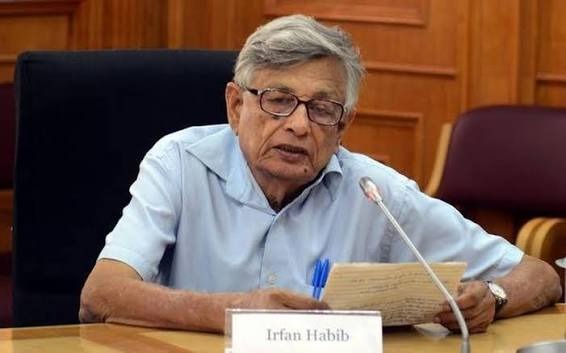
Professor Irfan Habib (born 1931) stands out amongst the finest historians to have emerged in India in the twentieth century. His pathbreaking Oxford University D.Phil. thesis, which was revised and published as, The Agrarian System of Mughal India, 1556-1707 (Bombay: Asia Publishing House, 1963; third edition in paperback, New Delhi: Oxford University Press, 2014), will remain an outstanding classic. It presents the results of an awe-inspiring research into the vast repositories of surviving Mughal documentation and their systematic deployment to build the argument for a highly centralised fiscal mechanism of the coercive Mughal state, which was ultimately its weakness. The publication of the book was hailed as something of a revolution in South Asian historiography, leaving no aspects of agrarian economy, rural social structure, and land-revenue administration untouched. No amount of research in associated fields such as trade and prices controlled by a capacious Mughal state can displace the book from the high pedestal it has acquired for itself during the last sixty years since the publication of its first edition.
Professor Habib’s series of powerful contributions written from his well-known Marxist perspective addressed larger issues of greater significance in, Essays in Indian History: Towards a Marxist Perception (New Delhi: Tulika Books, 1995). Some of the concerns were also included in a collaborative endeavour, The Cambridge Economic History of India, Volume I, 1200-1750, edited with Tapan Raychaudhuri (Cambridge: Cambridge University Press, 1982). These rigorous exercise in socio-economic history comprised famous propositions such as concerning potentialities of capitalistic developments in medieval India. His articles on economic and technological history of the Delhi Sultanate remain important contributions, indeed improvisations on his equally or more accomplished father, Professor Mohammad Habib. The latter’s valuable formulations primarily focused on inclusive cultural practices to balance lurid accounts of political violence, writing as he was before and after devastating partition and Independence.
Further, Professor Irfan Habib’s An Atlas of the Mughal Empire: Political and Economic Maps with Detailed Notes, Bibliography, and Index (New Delhi: Oxford University Press, 1982), meticulously displays a lifetime of dedicated engagement with Mughal sources, particularly the much-valued Akbarnama and A’in-i Akbari of Abu’l Fazl. In normal cases, this kind of work involves a team of forty so-called experts working with a battery of research assistants for twenty years and nothing comes out of the project, wasting large governmental funds which should otherwise go for supporting new research. The Atlas is an example of a singlehanded miracle Professor Habib is capable of show-casing with his indefatigable and admirable energies and skills acquired early in his training as a historian. The large numbers of finely crafted maps certainly required collaborations with experienced and talented cartographers, including his own son, Faiz Habib.
Professor Habib subsequently moved into a variety of fields with several books with limited impact. His frequent forays into ancient India have not been taken seriously by experts in the field. His relentless interventions in modern history are considered less to do with historical research of the kind he has done with precolonial sources. They are seemingly more about articulating contemporary political concerns from an avowedly secular-Marxist line of thinking on what ails the nation. The idea of the nation itself is a dubious modern phenomenon – excluding large sections of population if they do not fit in narrowly carved boundary-markers around the core principles of a nation. Habib and his comrades advocate for an inclusive and broad-based idea of a secular Indian nationalism, which is in a severe crisis. A more aggressive Hindu majoritarian nationalist position has occupied the centre-stage of Indian politics for over a decade now. This is against what the Indian state has achieved since Independence, maintaining equitable distance from all religions and ensuring respectable coexistence of religious, cultural, or ethnic heterogeneities. This is what the country is known for: unity in diversity.
The current tearing apart of the social fabric, which was thoughtfully weaved through calls for tolerance, secularism, and communal harmony, will have long-term consequences. The power of the regime will fizzle out on its own eventually. But much damage will have been done to the body-politic of the country. Professor Habib, who is also a member of a communist party which is fighting with its back to the wall, has spent much of his life as an intellectual seriously resisting communalism, the widespread prevalence of which is unfortunately a fait accompli now. Generally, reasons for popular distress are economic, but wily political leaders are blaming it on religions of beleaguered minorities to derive dangerous political gains – pitting people against one another.
As it happens, institutions are built by a cohort of inspired colleagues working for general good. After reaching a climax, a certain level of zenith, the institutions eventually reach a stage from where large shadows of decline and fall haunt those concerned. If foundations are strong, the process of loss takes longer, as in the mighty Mughal empire taking a century and half to be eventually dismantled by the more exploitative British colonial rule altogether (1707-1857). Unfortunately, historical research in Professor Habib’s own institution, the Aligarh Muslim University, has suffered in last several decades for a variety of reasons. Politeness demands that the issues dogging it are not raised. Historians are not expected to wash each other’s dirty linen in public. But signs of decay are clearly visible, which in turn is a reflection on the time.
All sensible people need to work together, addressing concerns affecting the last person in the queue, goes the understanding. These sensible people are referred to as secular forces. The Padma Bhushan awardee Professor Irfan Habib features as a strong voice in the middle of the disturbing cacophony facing the country. With the history of the country going back three millennia or more, regimes will come and go, but historians of the stature of Professor Habib will continue to have the last laugh. As the famous fourteenth century historian and ideologue, Ziya-ud-Din Barani put it: third-class histories are easily trashed, and first-class ones do not need proofs!