
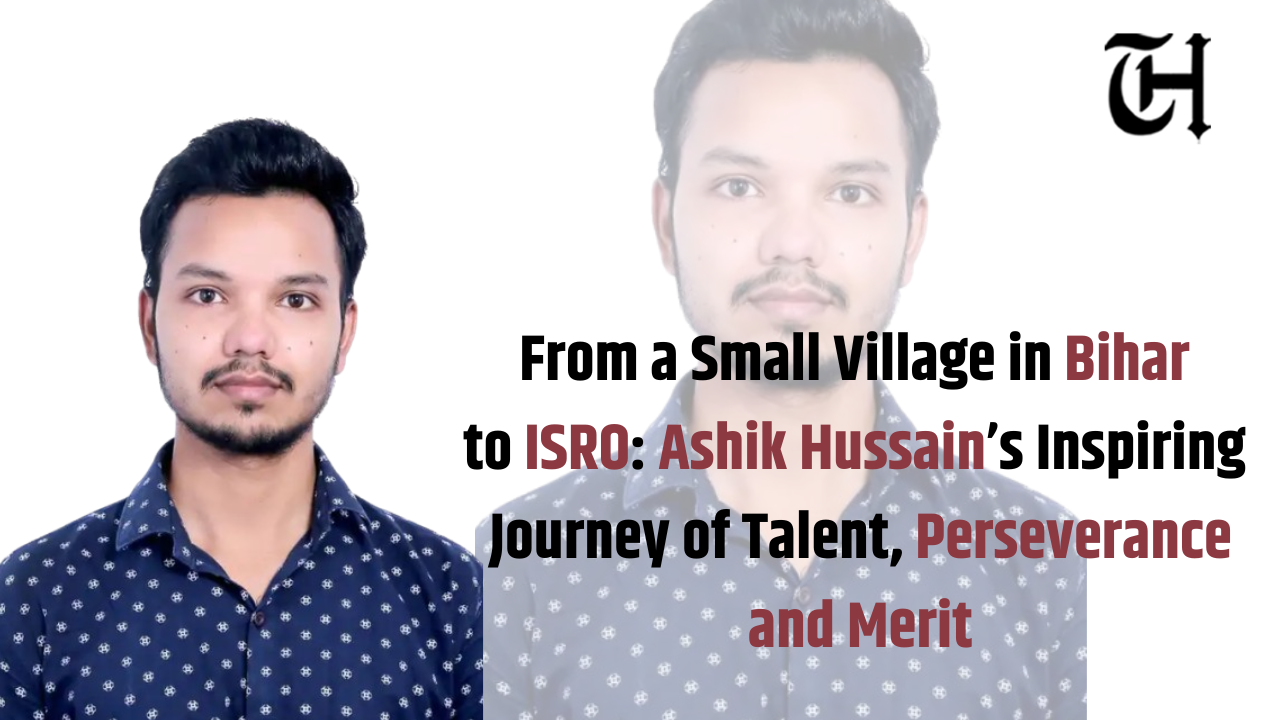
Ashik Hussain’s journey from Hilasar village in Siwan, Bihar, to becoming a scientist at the Indian Space Research Organisation (ISRO) is more than a personal success story. It is a powerful reminder that talent, hard work and academic excellence can open doors to some of India’s most prestigious scientific institutions. In an era when debates around identity, opportunity and representation often dominate public discourse, stories such as Ashik’s deserve to be highlighted not merely because he is a young Muslim achiever, but because his success demonstrates what becomes possible when a talented student competes, performs and earns recognition at the national level.
Ashik Hussain, a resident of Hilasar Ekawan Tola in Bhagwanpur Hat block of Siwan district, Bihar, has been selected as a scientist at ISRO. His achievement has brought immense pride to his family and local community and has generated celebrations across the region. But the most striking part of his story lies in the record of academic and competitive achievements that preceded his selection. Ashik secured All India Rank 2 in the National Chemical Laboratory (NCL) examination, All India Rank 17 in the Nuclear Power Corporation of India Limited (NPCIL) examination, and All India Rank 38 in the ISRO Scientist Recruitment Examination 2026. These are not ordinary accomplishments. They reflect sustained preparation, subject knowledge and the ability to compete successfully at the national level.
Ashik’s early education was followed by higher studies in Madhya Pradesh. From there, he embarked on a demanding journey of competitive examinations and scientific career opportunities. For a student coming from a relatively small locality, reaching the national stage requires considerably more than academic ability. It requires discipline, persistence, access to quality education, guidance, and above all, the determination to keep pursuing a goal despite setbacks. Ashik’s repeated performance in highly competitive examinations suggests precisely that kind of determination. His achievement also carries a message for thousands of young people in smaller towns and villages across India: wherever you come from, excellence can take you far.
The Indian space programme has become one of the most respected symbols of India’s scientific capability. ISRO has brought together scientists, engineers and researchers from different regions, languages, communities and social backgrounds. Ashik’s selection adds another name to that larger national story. He earned his place through academic performance and competitive merit. His story therefore offers a constructive counterpoint to narratives suggesting that members of a particular community cannot find opportunities in India’s premier scientific institutions. Ashik’s journey provides a concrete example of a young Muslim student successfully competing in national-level selection processes and reaching one of India’s most prestigious scientific organisations. That distinction makes the story even more meaningful.
Ashik Hussain’s success sends a simple but powerful message: talent has no religion, scientific curiosity has no community, and achievement knows no geographical boundary. A student from a village in Bihar can dream of working in India’s space programme and, through years of preparation and excellence, can make that dream a reality. His journey can also inspire Muslim families and young students to place greater emphasis on education, scientific careers, research and competitive examinations. Success stories like this demonstrate the importance of encouraging young people to enter fields where their abilities can contribute to the country’s development.
For Ashik’s family, his selection is undoubtedly a moment of enormous pride. For Hilasar and Siwan, it is a source of inspiration. But the significance of his achievement goes beyond family and locality. It tells a young student sitting in a small town that the distance between a village classroom and a national scientific institution can be crossed. It tells parents that investment in education can transform not only an individual life but also an entire family’s aspirations. And it tells society that young Indians should ultimately be judged by their knowledge, ability, integrity and contribution, rather than assumptions based on their name or identity.
As India looks toward an increasingly ambitious future in space exploration and scientific research, the country will need thousands more young minds like Ashik Hussain young Indians who are prepared to learn, compete, innovate and contribute. His success is a proud moment for his community, a matter of pride for Bihar, and above all, a proud achievement for India.