

By Afroz Khan
Hazrat Aisha al-Ba’uniyya was a distinguished medieval Sufi scholar, poet and mystic who united Islamic scholarship with divine love. Through her writings and teachings on repentance, sincerity, remembrance and love, she made remarkable contributions to Sufism, becoming one of the most prolific female Arabic writers.
Key Points
· Born in Damascus around 1456, she belonged to a distinguished family of scholars.
· Memorised the Holy Quran at the age of eight and pursued Sufi spirituality.
· Excelled in Islamic law, Hadith, Arabic literature and Sufi poetry.
· Explained four pillars of Sufism: Tawbah, Ikhlas, Zikr and Mahabbah.
· Became one of the most prolific female Arabic writers of the medieval period.
“Hazrat Aisha al-Ba’uniyya demonstrated that scholarship and spirituality, or law and love, are not separate from one another. She used her voice and writings to ensure that devotion in society did not become merely superficial.”
Dr. Tamara Gray (Modern Islamic Historian)
In 1464, a little girl of around seven or eight years of age was sleeping beside her father in the famous Jami Mosque of Damascus. That very night, she had a dream. In her dream, the little girl saw Prophet Muhammad (PBUH) himself. She became so overwhelmed with emotion that she approached him, began crying and held on to his garments. She pleaded with him for spiritual advancement and blessings.
Prophet Muhammad (PBUH) smiled and gently caressed her cheeks with great affection, saying, “Be positive and be happy.” When the little girl awoke from her sleep, a flame of love for Allah and His Prophet (PBUH) had already been kindled within her, one that would transform the course of her entire life.
Soon after this incident, at the tender age of just eight, the little girl memorised the entire Holy Quran, and her inclination towards Sufi spiritual practices became even stronger.
The name of this renowned Sufi woman scholar was Hazrat Aisha al-Ba’uniyya. She recorded this dream and her spiritual experience of being drawn towards the Sufi path and divine love in her own book, Kitab al-Muntakhab fi Usul al-Rutab fi Ilm al-Tasawwuf. In modern times, this book is commonly known as The Principles of Sufism.
Hazrat Aisha al-Ba’uniyya was born around 1456 CE in Damascus, in the Mamluk Sultanate. The al-Ba’uni family was a distinguished and well-educated family of Damascus. Several renowned judges, scholars and poets belonged to her family.
Hazrat Aisha al-Ba’uniyya’s father was named Yusuf al-Ba’uni. He was a highly distinguished and respected Qadi (Islamic judge) and Islamic scholar of his time.
The early education of Hazrat Aisha al-Ba’uniyya and her brothers was primarily conducted under the supervision and guidance of their father, Yusuf.
Hazrat Aisha al-Ba’uniyya received an extensive education in Islamic law, Hadith and Arabic literature. She was also a disciple of the Sufi masters Jamal al-Din al-Hawwari and Muhyi al-Din al-Urmawi.
At around the age of twenty, Hazrat Aisha al-Ba’uniyya began regularly writing Sufi poetry and devotional hymns.
She composed several beautiful works to express her profound love for Prophet Muhammad (PBUH). One of her most famous poetic works, Al-Fath al-Mubin fi Madh al-Amin, contains a beautiful poem:
“They are the guide of all creation,
Through whom darkness disappears.
It is through their grace and light
That every wandering heart finds its way.
My heart melts in their remembrance
Like dewdrops dissolving in the morning sunshine.”
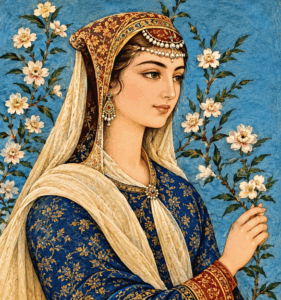
In her book Kitab al-Muntakhab fi Usul al-Rutab, Hazrat Aisha al-Ba’uniyya explained four principal pillars of Sufism, which also formed the foundation of her teachings.
1. Tawbah (Repentance)
According to Hazrat Aisha al-Ba’uniyya, the spiritual journey begins with sincere repentance. She believed that a person must abandon their past sins and turn completely towards Allah.
She explained that the repentance of ordinary people is limited to seeking forgiveness for their sins, whereas the repentance of true Sufis goes much deeper. They must turn away from everything other than Allah, including their own spiritual abilities and desires.
While explaining this, she wrote:
“Those who are spiritually the most elevated consider their repentance to be the abandonment of paying attention to anything other than Allah. They even cease to look towards their own spiritual powers and blessings, until Allah Himself reveals His beauty to them and makes everything other than Himself disappear.”
2. Ikhlas (Sincerity and Purity)
Hazrat Aisha al-Ba’uniyya believed that worship should not be performed out of the desire for Paradise or the fear of Hell. Whatever good deeds a person performs, they should be free from the feeling of ‘I’ or ego. Every action should be performed solely and exclusively to please Allah.
3. Zikr (Remembrance of Allah)
According to Hazrat Aisha al-Ba’uniyya, merely repeating the name of Allah with one’s tongue is not enough. She believed that Zikr should become such an integral part of a person’s life that their heart remains immersed in the remembrance of Allah at all times, even while performing worldly activities.
Through constant remembrance of Allah, a person’s heart becomes like a clean mirror in which divine light and knowledge can be clearly reflected.
4. Mahabbah (Divine Love)
According to Hazrat Aisha al-Ba’uniyya, the ultimate destination of the Sufi path is to become one with Allah, and this is possible only through love.
She taught that in true love, the existence of the lover (the spiritual seeker) completely dissolves in the love of the Beloved (Allah). It is like a drop of water merging into the vast ocean.
In 1513 CE, while Hazrat Aisha al-Ba’uniyya was travelling from Damascus to Cairo, Egypt, a gang of thieves and robbers attacked her entire caravan near Gaza, in Syria. The robbers looted several original manuscripts and books that she had written throughout her lifetime.
This incident left her deeply distressed.
However, this tragedy made the Sufi spirit within her even stronger. She accepted it as the will of Allah, believing that she was being freed from attachment to worldly possessions and even from attachment to her own literary creations. Later, with the help of scholars in Cairo, she rewrote many of her works from memory.
One of the famous poems attributed to Hazrat Aisha al-Ba’uniyya is:
I’ve reached in love a place so far, unseen,
None knows it but a heart like mine, serene.
I hide my state, yet sorrow breaks my guise,
Betrayed by tears and weary, longing sighs.
They said, “Be wise,” I answered, “Heart’s not swayed.”
They said, “Turn back,” I answered, “Vow’s not frayed.”
They said, “You’ve healed,” I answered, “Patience holds.”
They said, “Despair,” I answered, “Healing is in my wound.”
O blamer, you’re excused, for soon you’ll see,
When dawn unveils what darkness tried to be.
In this poem, Hazrat Aisha al-Ba’uniyya beautifully expresses Ishq-e-Haqiqi (divine love), in which a person becomes completely devoted to the love of their Lord. The criticism and advice of the world cannot shake the believer’s faith. For such a person, even pain becomes a part of the spiritual journey, while patience, longing and complete surrender become acts of worship.
In 1517, at approximately 61 years of age, Hazrat Aisha al-Ba’uniyya passed away.
Hazrat Aisha al-Ba’uniyya was one of the few female mystics of the medieval period who expressed her ideas through her own writings. It is believed that, before the twentieth century, no other woman writing in Arabic produced as many literary works as she did.
In her book Fayd al-Fadl wa Jam’ al-Shaml, Hazrat Aisha al-Ba’uniyya composed more than 300 poems describing her love for Allah and various spiritual states.
Professor Thomas Emil Homerin, Professor of Religion and Classics at the University of Rochester, wrote the first full-length biography of Hazrat Aisha al-Ba’uniyya. In his book, the professor states:
“Hazrat Aisha al-Ba’uniyya was one of the greatest female mystics in Islamic history. Although many women in medieval Islam were respected scholars and teachers, they rarely produced original written works. In contrast, Aisha was an exceptionally prolific writer.”
Hazrat Aisha al-Ba’uniyya presented a new perspective on Sufism. While many people left their families in pursuit of spirituality, she reached remarkable heights of spiritual enlightenment while continuing to live with her family.
Historical research has established that Hazrat Aisha al-Ba’uniyya had a profound influence among male scholars in Damascus and Cairo during the medieval period.
…
Afroz Khan is a teacher by profession who writes on women, politics, communal harmony, and Islam. She holds a master’s degree in Education.
(CREDIT: NEW AGE ISLAM)