
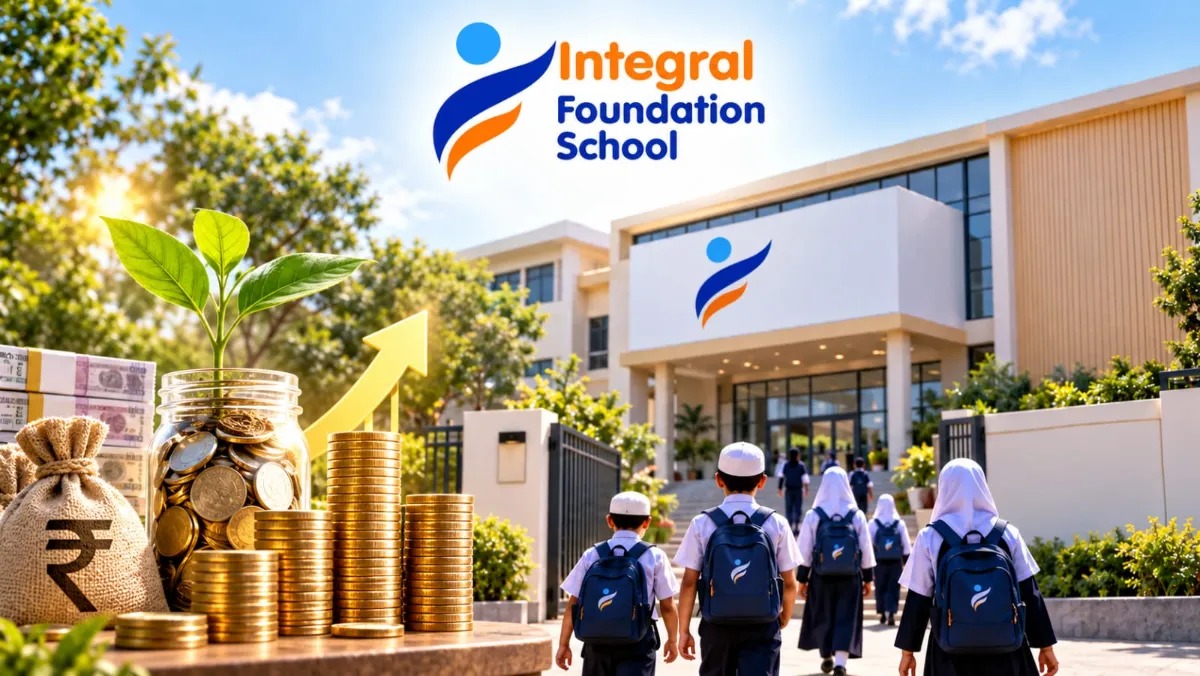
If the head of a religious organisation and people associated with it invite investors in the name of education, present them with a business opportunity, explain the possibility of financial returns, and even make the projected number of students part of the economic model, how should such an initiative be understood?
As a service? As a mission? Or as a business?
This is where the issue surrounding Integral Foundation School goes beyond the question of business alone. And this is not a question being raised for the first time.Serious questions have already been raised publicly regarding the model that emerged in connection with Integral Foundation School. Public reporting and other available material have also contained allegations involving individuals associated with the senior leadership of Jamaat-e-Islami Hind in relation to the investment model.
However, the most important point is that this entire matter should not be dismissed merely as a collection of allegations circulating on social media.If documents exist showing that investors were presented with an investment proposal, that they were given an explanation of a projected return or profit model, that a break-even calculation was provided, that a specific student enrolment target was incorporated into the financial projections, and that the investment was presented as a commercial opportunity, then the questions become considerably more serious.Because the debate is no longer simply about whether a school was being established.
The real question is:
What model was being used to run or establish the educational institution?
And perhaps the most important question is: Who was behind that model?
There is nothing inherently unusual about a private individual or an ordinary business entity investing in education and developing a financial model around it. Education is, after all, a sector in which private investment and commercial institutions exist across the country.But when a similar initiative is associated with a Muslim organisation or with members of its senior leadership particularly an organisation whose public identity is rooted in social reform, religious values and community service the questions inevitably become more significant.
Why?
Because society does not necessarily look at the Amir of such an organisation merely as the head of a commercial enterprise.It expects a higher standard of ethical responsibility.It expects integrity, accountability, transparency and amanah from its leadership not merely financial efficiency or commercial success.Therefore, if an educational initiative associated with such leadership is presented through an investment-and-return framework, society has a legitimate right to ask:
What was the primary objective education as a social mission, or education as a commercial enterprise?This is not necessarily a question about anyone’s personal intention.It is a question about the model itself.If agreements, investment proposals, financial projections, break-even calculations and student-enrolment targets exist in documentary form, then asking questions about those documents should not automatically be characterised as making allegations.
A document can be examined. A financial model can be questioned. An investment structure can be scrutinised. And an institution can be asked to explain the purpose behind them. That is not hostility. It is accountability. The institution therefore has an opportunity and, arguably, a responsibility to address these questions publicly.
If the documents being circulated are inaccurate, the organisation should come forward and clearly explain what is incorrect about them.If the documents are genuine, the organisation should explain their purpose and context.If the initiative was genuinely non-profit, then on what basis were investors presented with calculations concerning returns, break-even points and financial projections?
If it was not a business venture, why was an investment structure necessary?
And if it was, in fact, a commercial venture, then an even more fundamental question arises:To what extent is it appropriate to use the name, influence or institutional credibility of a religious and social organisation in connection with such a venture?These are not questions that should be settled through WhatsApp forwards, partisan defence or social-media arguments.
They require documents, explanations and transparency.
The issue, therefore, is not whether education should receive investment. Of course it can, and it should.The issue is whether the public was given a clear distinction between education as a social mission and education as an investment opportunity.And when individuals associated with a prominent religious and social organisation are involved, the standard of transparency should arguably be even higher.
The organisation does not lose anything by answering legitimate questions. On the contrary, a clear explanation backed by documents can strengthen public confidence.But silence cannot substitute for accountability. When financial projections, investment proposals, break-even calculations and enrolment targets enter the picture, society has every right to ask what exactly was being built:
A school, a social mission or a business model?
The answer should come from the organisation itself, supported not by public relations, but by facts and documents.
Credit : muslimmirror