
By Grace Mubashir
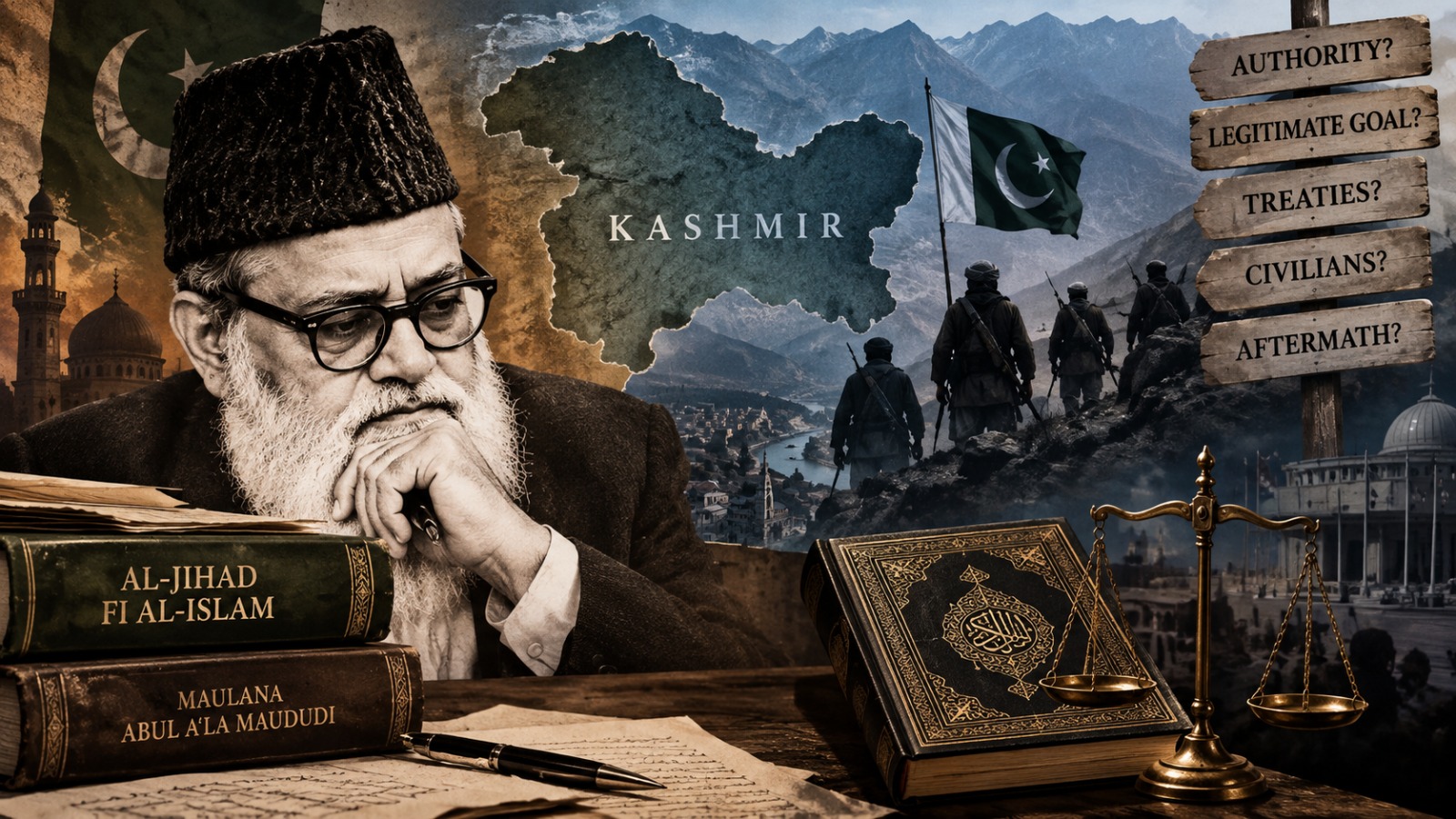
Whenever a war is framed as a jihad, several questions must follow: Who authorised it? What is its legitimate goal? Are treaties being honoured? Who is responsible for the fighters and their conduct? How are civilians protected? Who decides when the war ends? And, crucially, who accepts responsibility for the aftermath? In this article, these questions are addressed from the perspective of Maulana Maududi and Pakistan’s state ideology of Jihad.
Major points:
The Kashmir conflict provided one of the most profound tests of Maulana Abul A‘la Maududi’s political and theological worldview.
For Maududi, jihad was never just a matter of personal piety. Because he viewed Islam as a complete way of life, political institutions and power were central to his theology. Consequently, his idea of jihad was inherently political; he saw the struggle for Islam as being tied to the transformation of political structures and the establishment of an Islamic social order.
This theoretical framework was immediately put to the test following the creation of Pakistan.
In 1947, as fighting broke out in Kashmir, tribal fighters crossed over from Pakistan, and the Pakistani government found itself increasingly drawn into the conflict. The blurred lines between the Pakistani state, the military, and these irregular fighters became a major point of contention.
The most fundamental theological takeaway is this: jihad, in its military and political context, is inseparable from authority, law, responsibility, and defined limits.
For India, the most important takeaway isn’t just that Pakistan has historically backed armed activity in Kashmir – that is only one piece of the puzzle. The deeper lesson lies in the relationship between religion, political authority, and non-state groups.
The Kashmir conflict provided one of the most profound tests of Maulana Abul A‘la Maududi’s political and theological worldview. At its heart was a question that was as simple as it was deep: Who actually has the authority to declare jihad? Can individuals, religious groups, or tribal factions launch a jihad on their own terms, or is that power strictly reserved for an established state? And if a Muslim state chooses not to declare jihad, what is the religious obligation of the average Muslim?
Maududi’s stance during the first Kashmir war (1947-48) is especially telling because, at first glance, it seems to clash with some of his earlier writings. He had long described jihad as both a political and a civilisational struggle, arguing that Islam was far more than just a private faith; it was a total system for living. Yet, when irregular forces and tribal volunteers began fighting in Kashmir, Maududi was initially hesitant to label the campaign a legitimate jihad. His objection wasn’t that the Kashmiri cause lacked importance; rather, he argued that military jihad couldn’t be declared by private citizens or religious organisations. To him, it required legitimate political authority.
This distinction carries weight far beyond the history of Kashmir. It offers insight into Maududi’s vision of the Islamic state, the complex relationship between Pakistan and the concept of jihad, and the broader lessons India can learn about the intersection of religion, state power, and armed conflict.
Maududi’s Theory of Jihad
Maududi’s ideas took shape within the turbulent political landscape of colonial India. His work Al-Jihad fi al-Islam, published in the 1920s, was partly a defence against the accusation that Islam was inherently violent. Through it, he attempted to build a systematic Islamic framework for war, peace, and political power, outlining when war might be permitted, how it should be conducted, and what its limits should be.
For Maududi, jihad was never just a matter of personal piety. Because he viewed Islam as a complete way of life, political institutions and power were central to his theology. Consequently, his idea of jihad was inherently political; he saw the struggle for Islam as being tied to the transformation of political structures and the establishment of an Islamic social order.
This political lens explains why the role of the state became so vital. If jihad is a collective political endeavour, war cannot be left to the whims of individual believers. War impacts an entire society; it involves diplomacy, international treaties, military logistics, taxation, and the protection of civilians. Therefore, someone must hold the official authority to decide if a war is legitimate.
For Maududi, that authority belonged to the government.
It is important to note that Maududi didn’t believe a state became “Islamic” simply because its leaders were Muslim. His true goal was the creation of a specific Islamic political order. However, he maintained that once a recognised government exists, the decision to go to war cannot be handed over to private individuals or religious factions.
Kashmir: When Theory Met Reality
This theoretical framework was immediately put to the test following the creation of Pakistan.
In 1947, as fighting broke out in Kashmir, tribal fighters crossed over from Pakistan, and the Pakistani government found itself increasingly drawn into the conflict. The blurred lines between the Pakistani state, the military, and these irregular fighters became a major point of contention.
While many religious and political activists were eager to frame the struggle as a jihad, Maududi initially resisted. Records from the Jamaat-e-Islami show that Maududi argued Pakistan could not simply launch a jihad while its government was still bound by existing political commitments. More importantly, he insisted that only the government – not private citizens – had the right to declare such a struggle.
This nuance is easy to overlook. Maududi wasn’t suggesting that Muslims should be indifferent to the suffering in Kashmir. Instead, he was making a distinction between a legitimate cause and legitimate authority. A cause can be morally righteous without every individual having the right to wage war in its name.
One contemporary account captures his position quite bluntly: “If the government openly declares jihad, then I would go in the first ranks.”
That single sentence summarises his entire stance. Maududi wasn’t necessarily against fighting; he was against individuals or groups seizing the power to turn a political conflict into a religious war without the state’s official mandate.
Why Treaties Mattered
There was another theological pillar supporting Maududi’s view: the obligation of Muslims to honour their agreements.
The Qur’an places immense emphasis on fulfilling covenants. In Islamic ethics, an agreement isn’t just a matter of diplomatic politeness; it creates a binding moral obligation.
This becomes a critical issue when the language of jihad is invoked. If a Muslim government has entered into a treaty with another power, an individual cannot simply decide that the treaty is no longer valid because they believe a particular cause is religiously urgent.
The Qur’an is explicit on this point:
“O you who have believed, fulfil [all] contracts.” Qur’an 5:1
Similarly, Qur’an 8:61 states:
“And if they incline to peace, then incline to it.”
These verses establish a fundamental principle: religious devotion does not excuse one from their political and moral obligations. The choice to engage in combat cannot be viewed in isolation; it is inextricably tied to questions of peace, treaties, and accountability. Consequently, Maududi’s stance on Kashmir is best understood through three intersecting pillars: legitimate authority, the fulfilment of obligations, and the rules of engagement. This nuance is vital because it complicates the common perception of Maududi as a mere theorist of revolutionary violence. While his writings certainly injected a potent political dimension into the concept of jihad, his practical approach to the Kashmir issue demonstrated that he did not believe religious fervour alone was enough to justify military action.
Does Islam Mandate a State for Every Type of Jihad?
A theological nuance is required here. It would be an oversimplification to claim that Islamic jurisprudence contains a single, universal rule stating that every possible form of jihad requires a formal declaration by a state.
Classical Islamic scholars made clear distinctions between various modes and contexts of armed struggle. They specifically addressed scenarios where defensive warfare might shift from a state duty to an individual obligation. For instance, if a Muslim territory faced a direct invasion, the duty to defend it could become immediate and widespread. However, this is fundamentally different from granting every individual, political group, or militia the right to declare a war of their own making.
The Qur’an’s permission to fight is also framed within a specific moral boundary. Qur’an 22:39 states:
“Permission [to fight] has been given to those who are being fought, because they were wronged.”
This verse links the permission to fight directly to being the victim of aggression and injustice. It does not present warfare as an unrestricted, private religious right. This distinction is critical: defensive obligation is not the same as possessing the private authority to initiate war.
Maududi’s Kashmir position should therefore be seen primarily as an argument regarding organised political jihad and the necessity of legitimate authority. It should not be misinterpreted as a claim that Islamic law has only one stance on every possible scenario of self-defence. Modern militant movements often blur these lines, using the term ‘jihad’ while completely ignoring questions of authority, legal cause, treaty obligations, proportionality, and responsibility. Maududi’s stance on Kashmir serves as a significant counterpoint to this kind of private militarisation.
The Paradox in Maududi’s Thought
Despite this, there is a genuine tension within Maududi’s political philosophy.
In his earlier works, he gave jihad a broad, revolutionary significance, viewing Islam as a comprehensive ideological system capable of shaping the political landscape. From this perspective, jihad could not be reduced to a mere private spiritual endeavour. Yet, when faced with the actual conflict in Kashmir, Maududi insisted on the necessity of state authority.
This reveals a fundamental aspect of his logic: the state was not just an instrument used to carry out jihad; it was the very institution that determined whether a military campaign could legitimately be classified as such. This distinction between theory and practice is essential. A thinker can argue that Islam requires an Islamic political order while simultaneously maintaining that private citizens lack the authority to launch wars in the name of that ideal. Ultimately, Kashmir serves as a profound case study of the gap between Maududi’s vision of political Islam and his practical understanding of the rules of war.
When Pakistan Declared Its Involvement
Maududi’s position shifted alongside changing political realities. Historical records suggest that once Pakistan’s Foreign Minister, Muhammad Zafarullah Khan, acknowledged Pakistan’s involvement in the Kashmir conflict, Maududi accepted the struggle as a jihad.
The real question isn’t just whether Maududi changed his mind, but why he did so. This episode suggests that the presence of political authority behind a conflict was the deciding factor in whether it was categorised as jihad. Once the state formally assumed responsibility for the war, the theological calculus changed for him.
This also highlighted a larger dilemma in Pakistan’s political evolution. While Pakistan was founded as a Muslim-majority state, the question remained: what actually makes a state “Islamic”? Was it simply the religion of its citizens, or did it need to implement a specific Islamic political and legal framework? Maududi’s entire political project was centred on this very distinction.
Pakistan and the State’s Duty of Jihad
Pakistan’s modern constitutional standing is more complex than the simplistic idea that “Pakistan has a duty to wage jihad”. The Constitution does not impose a blanket obligation to wage jihad against other nations. Instead, it balances Islamic provisions with commitments to international peace and diplomacy.
Article 31 focuses on the Islamic way of life, but Article 40 is particularly telling. It directs the state to strengthen ties with Muslim nations while simultaneously promoting international security, friendly relations, and the peaceful resolution of disputes.
This creates an inherent constitutional tension. Pakistan can treat the Kashmir issue as a vital national and foreign policy priority while still operating within a framework that recognises sovereignty, non-aggression, and peaceful arbitration. Consequently, the Pakistani state does not constitutionally grant any individual citizen the independent religious authority to decide when a jihad should begin. The control over military policy remains firmly with the modern state.
In this regard, the institutional principle aligns surprisingly well with the core of Maududi’s stance on Kashmir: the decision to go to war belongs to political authorities, not to private religious actors.
Pakistan’s Later Use of Jihad
However, Pakistan’s historical trajectory complicates this principle. Over the following decades, especially regarding Kashmir and Afghanistan, the rhetoric of jihad became increasingly tied to non-state armed groups. At various intervals, the Pakistani military and political establishment leveraged religious language to rally support for their strategic goals. Kashmir, in particular, became deeply intertwined with the language of jihad, religious solidarity, and armed struggle.
This created a fundamental contradiction.
On one hand, there was the principle that only legitimate state authority can decide if a war constitutes a jihad. On the other, there was the practical use of irregular or non-state fighters in conflicts where the state could maintain a degree of political distance. Consequently, the line between a state-led war and a “volunteer” jihad became blurred.
This is exactly where Maududi’s original argument becomes vital. If jihad requires legitimate political authority, a state cannot logically outsource a war to unofficial groups while simultaneously trying to dodge responsibility for their actions. This isn’t just a legal or diplomatic issue; it is a theological one.
If a state labels a conflict a jihad, it must accept the consequences. If it claims the fighters are merely private individuals, it becomes difficult to explain how their actions carry the religious legitimacy associated with jihad. The theological and the political cannot be entirely decoupled.
The Problem of Private Jihad
The danger of “private jihad” becomes obvious when you look beyond the context of Kashmir. If every individual or organisation is allowed to decide that a specific conflict is a jihad, there is no reliable way to determine where that authority ends.
One group might declare jihad against a foreign nation; another might declare it against its own government; another against a religious minority; and yet another against a different Muslim group. The result is a fragmentation of authority and a cycle of potentially permanent conflict.
Classical Islamic political thought placed immense value on maintaining social order and warned against ‘fitna’ – a term encompassing severe social and political chaos. Regardless of the debates among various jurists, the question of who holds the authority to initiate organised warfare has always been a cornerstone of Islamic political thought.
Maududi’s position on Kashmir fits within this broader concern. His implicit argument was that religious conviction does not, on its own, create sovereign authority. A person may sincerely believe their cause is just, but that belief alone does not grant them the right to start a war.
The Deeper Theological Lesson
Ultimately, the most significant takeaway from Maududi’s position is about political responsibility.
Whenever a war is framed as a jihad, several questions must follow: Who authorised it? What is its legitimate goal? Are treaties being honoured? Who is responsible for the fighters and their conduct? How are civilians protected? Who decides when the war ends? And, crucially, who accepts responsibility for the aftermath?
These questions prevent jihad from becoming a blank check for unlimited religious action. Maududi’s stance suggests that religious motivation alone isn’t enough to answer them. A military struggle requires legitimate authority and must operate within established moral and legal boundaries. This is particularly striking given that Maududi was one of the most influential architects of modern political Islam. His writings added a potent political layer to Islam, advocating for a complete social and governmental overhaul rooted in Islamic principles. However, when the practical realities of the Kashmir conflict emerged in 1947–48, he didn’t just encourage every Muslim eager to fight to pick up a weapon. Instead, he maintained that the authority of the state was paramount.
This historical moment highlights a vital distinction: the difference between the concept of jihad and the private, unauthorised appropriation of it. A religious cause alone doesn’t transform a war into a jihad. A person’s sincere faith doesn’t instinctively grant them the status of a legitimate commander. Likewise, a political movement doesn’t gain state-level authority just by calling upon religion.
For Pakistan, this brings up an ongoing dilemma regarding the link between official state policy and non-state militant groups. For India, it provides a nuanced framework for understanding the ideological landscape in Kashmir without framing Islam itself as the adversary.
Perhaps the most fundamental theological takeaway is this: jihad, in its military and political context, is inseparable from authority, law, responsibility, and defined limits.
Maududi’s stance on Kashmir proves that even within the robust tradition of political Islam, there was a compelling argument against the notion that individuals or private groups could unilaterally turn a political struggle into a religious war. Recognising this distinction is crucial for grasping both the history of Kashmir and the modern debates surrounding the role of religion in conflict.
What India Can Learn
For India, the most important takeaway isn’t just that Pakistan has historically backed armed activity in Kashmir – that is only one piece of the puzzle. The deeper lesson lies in the relationship between religion, political authority, and non-state groups.
India needs to distinguish between Islam as a faith and the political or military claims made in its name. Maududi’s own views prove that Islamic political thought contains powerful arguments against privately declared warfare. India should also differentiate between Pakistan’s official state policy and the actions of irregular armed groups. While they are historically linked, they are not automatically the same thing.
The term ‘jihad’ itself requires careful handling. The classical Islamic concept, Maududi’s political theory, Pakistan’s state rhetoric, and the ideology of modern militants should not be treated as interchangeable. Each carries a different intellectual and political history.
Making this distinction is strategically vital. Treating all Muslims as potential participants in jihadist politics only reinforces the very narrative militants want to build: the idea that Muslims and the Indian state are destined for religious conflict. A more precise strategy involves separating religious belief from political violence and focusing on the specific institutions and individuals actually responsible for armed conflict.
The Kashmir issue should not be reduced to a simple “Islam versus India” binary. It is a complex matter involving territory, nationalism, constitutional law, security, identity, and competing political claims. While religious language is a significant part of its history, it doesn’t explain the whole story.
Furthermore, India has a strategic interest in upholding a simple institutional principle: private organisations should not have the authority to wage war. Interestingly, Maududi’s own work provides an Islamic intellectual foundation for that very principle.
Credit : New Age Islam