
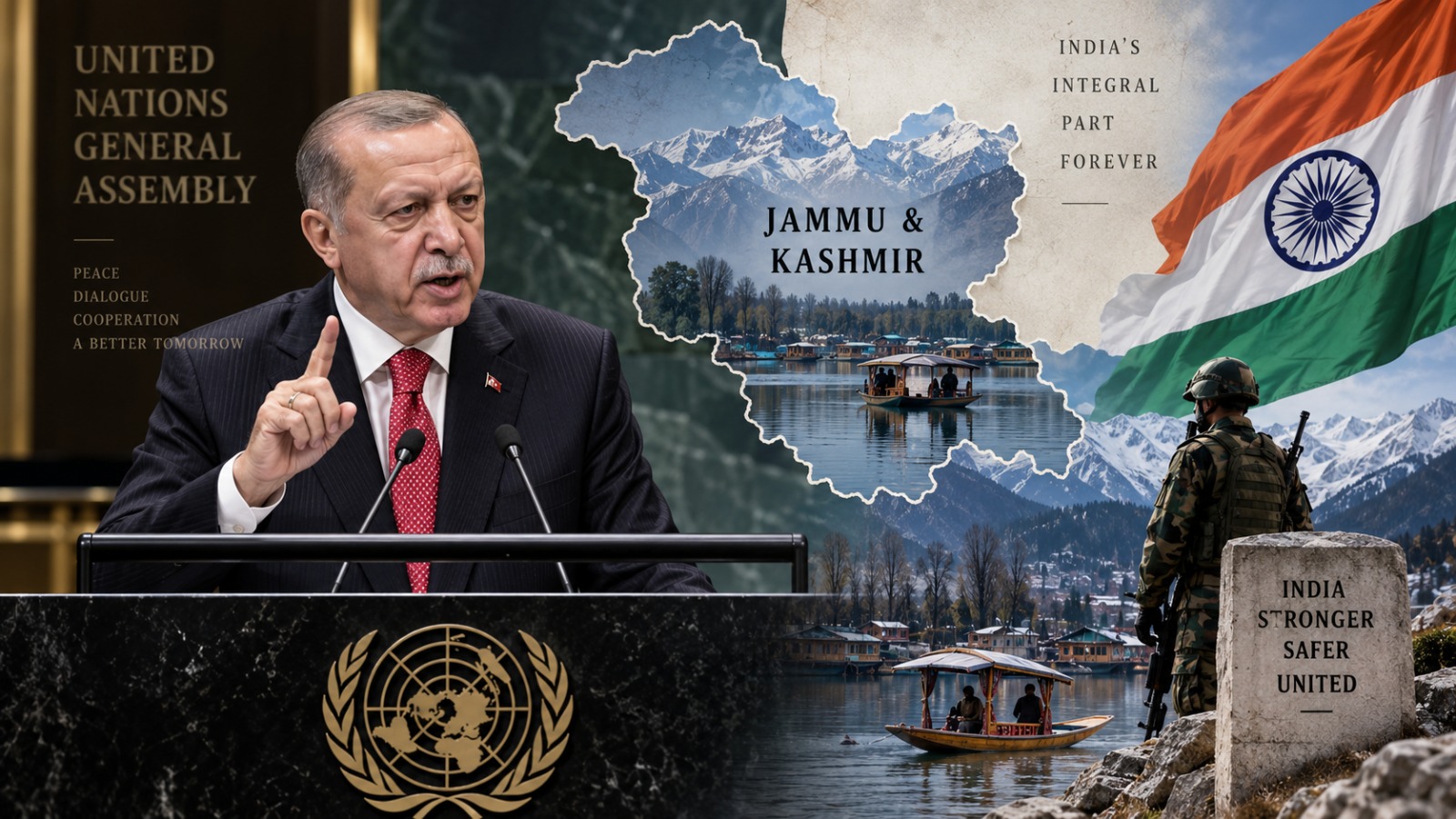
NEW YORK: Turkish President Recep Tayyip Erdogan’s latest remarks on Jammu and Kashmir at the United Nations General Assembly have once again brought Ankara’s position on the issue into focus. Addressing the 81st UNGA on September 22, Erdogan said that disputes in South Asia, including Kashmir, should be addressed through dialogue within the framework of the UN Charter and relevant resolutions.
From New Delhi’s perspective, however, the problem is not the call for dialogue itself. India has consistently maintained that issues between India and Pakistan should be addressed bilaterally and that there is no role for a third country in the Kashmir question. India has also repeatedly stated that Jammu and Kashmir is an integral part of the country.
The question of jurisdiction
Erdogan’s statement raises an important diplomatic question: why should Ankara position itself as a voice on an issue that India considers bilateral and directly connected to its sovereignty and security? India’s position has been consistent for years. New Delhi argues that the Kashmir issue does not require third-party mediation. The Ministry of External Affairs has previously said that India’s position on Kashmir remains unchanged and that there is no requirement for third-party mediation in India-Pakistan bilateral matters.
The distinction is important. Supporting dialogue between two countries is one thing; repeatedly placing a bilateral dispute involving India on an international platform is another. From the Indian perspective, the latter amounts to an unwarranted internationalisation of an issue that New Delhi does not accept as requiring outside intervention.
Ankara’s repeated references to Kashmir
Erdogan’s latest remarks are also significant because they are not an isolated statement. The Turkish president has raised Kashmir at the UNGA on several occasions. His comments were particularly contentious in 2019, following India’s decision to change the constitutional arrangements governing Jammu and Kashmir. In 2024, Erdogan did not mention Kashmir in his UNGA address, but the issue returned to his international statements subsequently. In February 2025, during his visit to Pakistan, he again spoke about Kashmir and called for a dialogue-based approach. India rejected those comments and said Jammu and Kashmir is an internal matter and that no other country has the locus standi to comment on it.
The repeated nature of these interventions makes them more than a one-off diplomatic observation. For New Delhi, they represent a continuing disagreement with Ankara over how the Kashmir issue should be discussed internationally.
India’s security concerns cannot be separated from the Kashmir debate
Any serious discussion of Jammu and Kashmir also needs to take into account India’s longstanding security concerns and its position regarding cross-border terrorism. India has consistently linked its approach to Pakistan to concerns over terrorism emanating from across the border. Consequently, New Delhi does not view Kashmir simply as an abstract territorial dispute requiring international mediation; it also views it through the lens of terrorism, sovereignty and national security. That is why an external call for a negotiated settlement, even when framed in the language of the UN Charter, does not automatically align with India’s understanding of the issue.
UN references do not settle India’s position
Erdogan’s reference to the UN Charter and “relevant resolutions” also deserves careful examination. The existence of UN resolutions does not mean that every party interprets their contemporary applicability in the same manner. India’s position on Jammu and Kashmir has evolved around subsequent bilateral agreements and its own constitutional and legal framework, while Pakistan continues to advocate international involvement. Therefore, invoking the UN framework without acknowledging the India-Pakistan bilateral framework and India’s objections to third-party involvement presents only one part of a much more complicated diplomatic history.
A broader geopolitical context
Erdogan’s position also comes at a time when Turkey and India have differences over several geopolitical issues. Ankara has maintained particularly close diplomatic ties with Islamabad, while Pakistan has repeatedly welcomed Turkey’s statements on Kashmir. This does not by itself establish the motivation behind Erdogan’s latest remarks. However, the diplomatic context is relevant when assessing why Kashmir continues to feature in Turkish presidential statements.
For India, the message remains straightforward: dialogue is not the issue; the question is who decides the framework and who has a legitimate diplomatic role.
India’s position remains clear
New Delhi’s position is that Jammu and Kashmir is an integral part of India and that matters concerning India and Pakistan should be handled bilaterally. India has also rejected the idea of third-party mediation. Official Indian statements have repeatedly reaffirmed this position. Erdogan is entitled to articulate Turkey’s foreign-policy position at an international forum. But India is equally entitled to reject an external framing that it considers inconsistent with its sovereignty and bilateral diplomatic position.
The larger lesson from the latest UNGA episode is therefore not simply about Erdogan versus India. It is about a fundamental difference in diplomatic philosophy: Ankara continues to view Kashmir as an issue that can be discussed within an international framework, while New Delhi insists that its bilateral and sovereignty dimensions cannot be overridden by outside intervention. For India, the red line remains clear: dialogue between India and Pakistan may be discussed by the two countries concerned, but Kashmir is not an invitation for third-party mediation.