
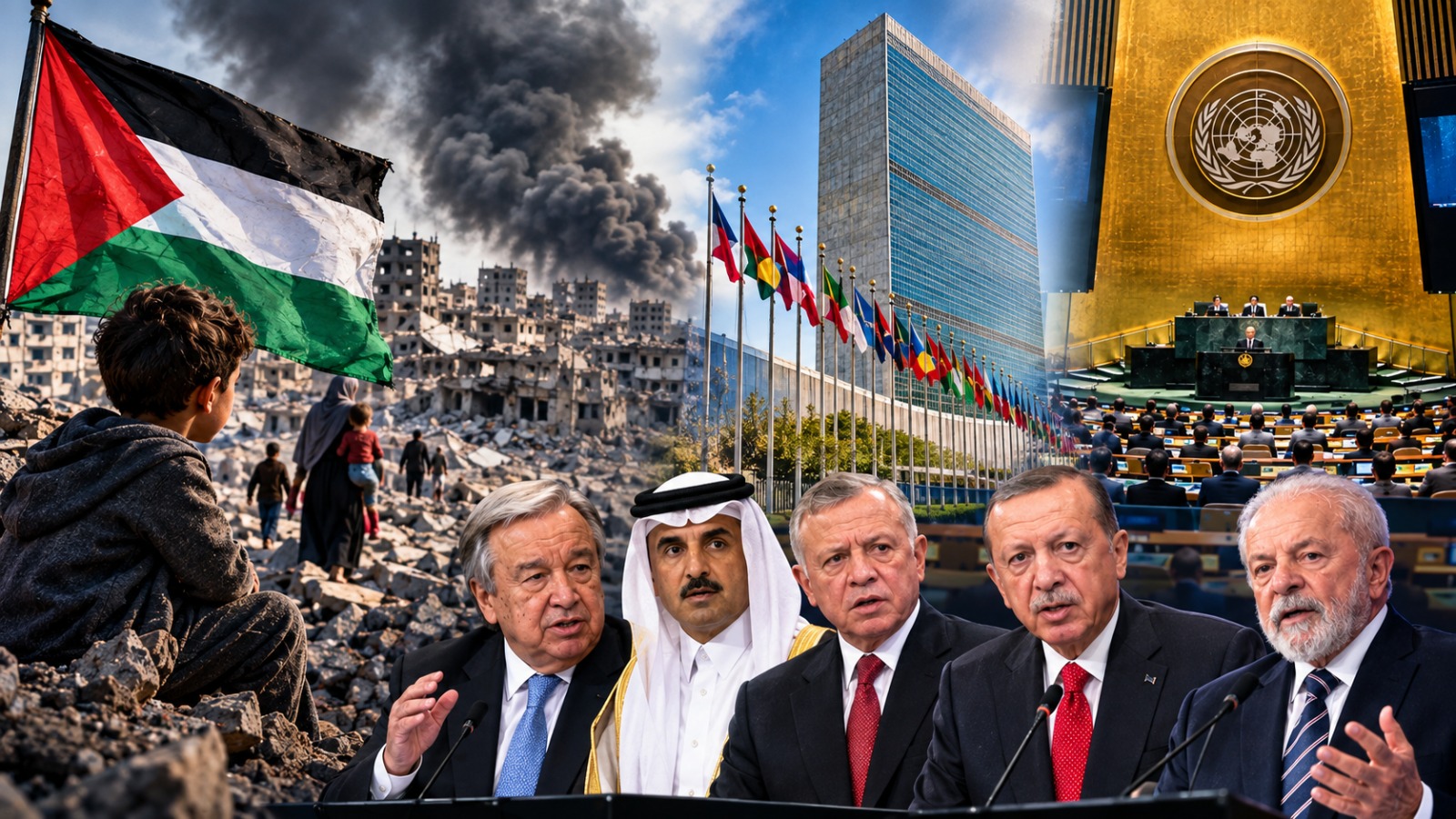
NEW YORK: The Palestinian issue and Israel’s ongoing war in the Gaza Strip dominated the opening day of the 81st United Nations General Assembly, as several world leaders called for an end to the fighting, greater protection for civilians and renewed international efforts toward a political settlement.
During the opening of the General Debate in New York, leaders warned against continued violence in Gaza, settlement expansion in the occupied West Bank, forced displacement of Palestinians and attempts to alter the political and demographic reality of the occupied Palestinian territories. The General Debate is being held from September 22 to 26 and will resume on September 28, bringing together heads of state and government and senior representatives from across the world.
Guterres: Two-State Solution Must Not Disappear
UN Secretary-General António Guterres warned that the international community was facing a critical moment, urging countries to pursue de-escalation and an end to conflicts in several parts of the world. Speaking about Gaza, Guterres said the situation being described as a ceasefire remained fragile, characterizing it as fighting occurring at a lower intensity rather than a genuine end to hostilities. He highlighted the scale of killing and destruction following October 7 and described the humanitarian conditions in the Palestinian territories as catastrophic. Guterres also warned that growing violence and settlement expansion in the occupied West Bank were undermining prospects for peace and raising concerns about forced displacement. He urged the international community not to allow the possibility of a two-state solution to disappear, describing it as the political framework for resolving the Israeli-Palestinian conflict.
Qatar’s Emir Calls Gaza a “Stain on Humanity”
Qatar’s Emir Sheikh Tamim bin Hamad Al Thani described the situation in Gaza as a “stain on the forehead of all humanity” and characterized the situation as genocide. He criticized the Israeli government over what he described as failures to fulfill commitments under the ceasefire arrangement.
The Qatari emir said Qatar had continued its mediation efforts since the beginning of the conflict and called for the implementation of commitments including an end to military operations, an Israeli withdrawal from Gaza and the lifting of the blockade. He also warned that the conflict was spreading beyond Gaza and could threaten the security and stability of other countries in the region.
King Abdullah Warns of Forced Displacement
Jordan’s King Abdullah II warned that continued Israeli military operations and destruction of civilian infrastructure in Gaza were contributing to what he described as an attempt to erase the Palestinian presence and impose a new reality. He also expressed concern over developments in the occupied West Bank, particularly settlement expansion and the demolition of Palestinian homes. The Jordanian monarch argued that demolishing Palestinian homes to expand settlements should not be treated simply as law enforcement, describing it instead as forced displacement.
King Abdullah called on the international community to address the underlying causes of the conflict rather than merely managing its consequences. He reiterated support for Palestinian statehood based on the two-state solution.
Erdogan: Gaza Has Become a Symbol of the Humanitarian Crisis
Turkish President Recep Tayyip Erdogan strongly criticized Israel’s military campaign in Gaza and described the situation as a grave humanitarian crisis. Erdogan urged countries that have not yet recognized Palestine to reconsider their positions and said Turkey would continue supporting the establishment of a sovereign Palestinian state. He described Gaza as “the world’s largest graveyard for children” and highlighted the number of children who have suffered amputations during the conflict.
The Turkish president also raised concerns about developments in the occupied West Bank and Jerusalem, including settler violence and restrictions affecting access to religious sites. Erdogan reaffirmed Turkey’s support for a Palestinian state with East Jerusalem as its capital based on the 1967 borders.
Lula Accuses Israel of Genocide, Warns of Generational Trauma
Brazilian President Luiz Inácio Lula da Silva said the consequences of the Gaza war would be carried by generations of Palestinians, accusing the government of Israeli Prime Minister Benjamin Netanyahu of committing genocide against women and children. Lula also criticized the inability of the international system to prevent wars and protect vulnerable populations, pointing to continued divisions within the UN Security Council.
The Brazilian president defended the role of the International Criminal Court and criticized pressure against the court and its members, arguing that such actions could contribute to impunity. He also raised concerns over Israeli settlement expansion in the occupied West Bank, arguing that it was making implementation of the two-state solution increasingly difficult.
Arab and Muslim Countries Demand Preservation of Palestinian Territory
In a joint statement, the foreign ministers of Egypt, Qatar, Jordan, the United Arab Emirates, Saudi Arabia, Pakistan, Türkiye and Indonesia condemned Israeli measures they described as illegal and aimed at consolidating control over Palestinian territory, including through settlement expansion. The ministers also expressed concern over measures affecting the historic and legal status quo at Muslim and Christian holy sites in Jerusalem.
They stressed that Gaza must remain an integral part of Palestinian territory and said the implementation of a comprehensive political plan should contribute to the reunification of Gaza and the West Bank, including East Jerusalem, within a unified Palestinian political framework. The ministers also called for sustained US engagement to ensure that all parties fulfill their commitments relating to the ceasefire and the broader political roadmap.
Palestine Takes Centre Stage at UNGA
The opening debate of the 81st UN General Assembly once again placed the Palestinian issue at the centre of international diplomacy. While governments differ in their positions on the conflict, the speeches highlighted several recurring themes: an end to the war in Gaza, protection of civilians, opposition to forced displacement and settlement expansion, preservation of Palestinian territorial unity and renewed efforts toward a political solution. As the General Debate continues, Gaza, the occupied West Bank and Jerusalem are expected to remain major issues before the international community, alongside continuing calls for diplomatic action and a political settlement based on the two-state framework.