
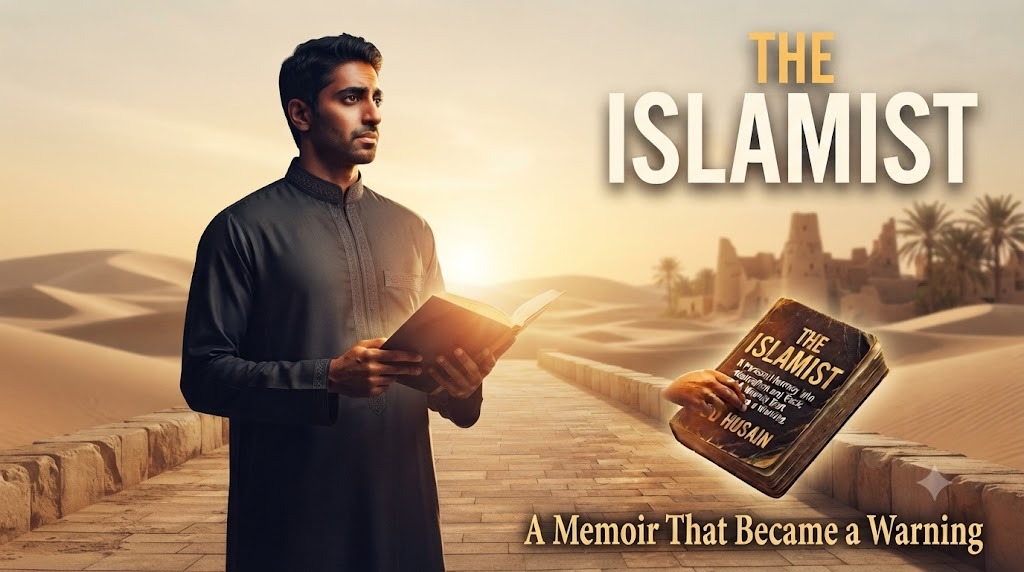
By Grace Mubashir
Husain serves as a reminder that extremism rarely starts with violence. It usually begins with certainty, the exclusion of others, and the conviction that only one group holds the absolute truth. Therefore, preventing radicalisation requires more than just security measures; it requires education, open dialogue, critical thinking, and spaces where young people can explore difficult questions without being judged.
Major Points:
· The Islamist isn’t a detached history of political Islam, nor does it attempt to speak for every Muslim experience. Instead, it is a deeply personal memoir, shaped by one man’s struggle with radical ideology and his eventual return to a more expansive understanding of his faith.
· This personal lens is both the book’s greatest asset and a natural limitation; readers should value its perspective while remembering that Muslim thought is far too diverse to be captured by a single story.
· Ultimately, however, the book achieves its core goal. It humanises the process of radicalisation without making it look appealing.
· It proves that people are capable of change, that they can walk away from rigid ideologies to rediscover traditions rooted in compassion, learning, and spiritual reflection.
· In an era where public debate often prizes certainty over empathy, Ed Husain’s memoir serves as a poignant reminder that intellectual humility and honest self-reflection are indispensable.
· Whether viewed as a political account, a spiritual odyssey, or a study of modern identity, The Islamist continues to spark the kind of thoughtful conversation that is more necessary today than ever.
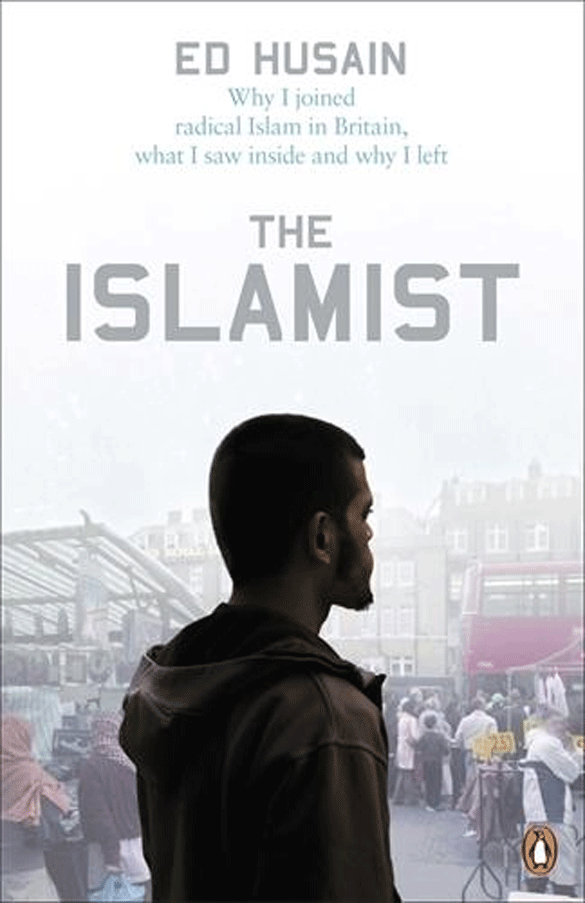
Some books tackle extremism through the cold lens of statistics, political theory, or security reports. Others try to make sense of it by studying organisations and ideologies from a distance. Ed Husain’s The Islamist: Why I Joined Radical Islam in Britain, What I Saw Inside and Why I Left, published in 2007, takes a much more intimate approach. It’s a story told from the inside out, a deeply personal account of a young British Muslim who was drawn into Islamist activism, spent years immersed in radical movements, and eventually walked away from it all.
What makes this book so striking isn’t just the subject matter but also its raw honesty. Husain doesn’t write like an academic observer looking through a glass pane. He writes as someone who once lived these ideas, defended them with conviction, recruited others to the cause, and only later realised the true cost of his beliefs. In many ways, the memoir serves as both a confession and a cautionary tale.
The book arrived at a volatile moment, when Britain and much of the world were struggling to make sense of the rise in Islamist extremism following the 9/11 attacks and the 7/7 London bombings. Public discourse at the time often swung between two extremes: some commentators blamed Islam itself, while others were too hesitant to even discuss radical ideologies. Husain attempted to carve out a middle ground by making a crucial distinction between Islam as a faith and Islamism as a modern political ideology.
Growing Up Between Two Worlds
Husain begins by painting a picture of his childhood in East London, one of the most diverse corners of Britain. His family practised a relatively traditional form of Islam, but like many children of immigrants, he spent his life balancing two different worlds. At home, he was surrounded by the religious traditions of his parents; outside, he navigated the freedoms, opportunities, and tensions of modern British society.
He describes his adolescence as a period of profound uncertainty, a time when the search for identity becomes everything. Like any young person, he was looking for meaning, purpose, and a sense of belonging. These are universal human desires, but what was different was the path he chose to find them.
A key takeaway from the book is that radicalisation rarely starts with violence. More often, it starts with a hunger for certainty. Young people who feel untethered by identity, politics, or social standing can find themselves drawn to groups that offer simple, black-and-white answers to incredibly complex questions. Husain’s journey shows how an ideology can satisfy an emotional void long before it ever becomes a political commitment.
The Attraction of Islamism
One of the most insightful parts of the book is Husain’s explanation of why Islamist organisations attract educated, bright young people. He pushes back against the common misconception that radicalisation is driven solely by poverty or a lack of education. In fact, many of the people he met were intelligent, well-spoken, and academically successful.
The draw was something else entirely. In a confusing and chaotic world, Islamist groups offered absolute certainty. They divided the world into clear binaries: believers versus enemies, truth versus falsehood, justice versus oppression. For a young person searching for an identity, that kind of clarity can be incredibly comforting.
Husain details how his worldview was slowly reshaped through student organisations, study circles, and political meetings. Ideas that seemed harmless at first gradually wove themselves into an ideological framework that coloured every social and political issue he encountered. This gradualism is perhaps the book’s most vital insight: radicalisation isn’t usually a single, dramatic leap but a series of small, incremental steps, both intellectual and emotional.
Distinguishing Islam from Islamism
The central thread of the book is the distinction between Islam and Islamism. Husain is adamant that the two should never be confused.
To him, Islam is a religion rooted in faith, worship, and spiritual ethics. Islamism, however, is a modern political project that seeks to organise society around specific interpretations of state power and political authority. While Islam has existed for over fourteen centuries, Islamism is a much newer phenomenon, emerging as a response to modern shifts like colonialism, nationalism, and the fall of the Ottoman Empire.
This argument wasn’t without its critics. Some argued that Husain was oversimplifying complex intellectual histories, while others praised him for bringing a necessary distinction to a public debate that often missed the mark. Regardless of whether you agree with his analysis, this distinction remains the defining theme of his work.
Inside the World of Radical Activism
The memoir truly shines when it describes the day-to-day reality of life within these movements. Husain depicts a world of endless meetings, ideological debates, and recruitment drives. It wasn’t a world of cinematic conspiracies, but rather a relentless effort to shape how people think.
He explains how language itself was weaponised for political mobilisation. Familiar religious terms were repurposed with new political meanings, and historical events were cherry-picked to fit a specific narrative. Members were encouraged to view the world through increasingly narrow and rigid categories.
This narrowing of the mind is a recurring theme. Instead of fostering curiosity, the ideology demanded certainty, which in turn discouraged any form of questioning. Loyalty to the movement eventually became more important than independent thought. Husain’s account is a powerful reminder that radical movements often rely less on physical force and more on psychological commitment. Once an ideology is internalised, people begin to police their own thoughts.
The Role of Identity Politics
Identity is another central theme in the work. Husain points out that many young Muslims in Britain found it difficult to balance their religious identity with their sense of belonging to the nation. Some Islamist groups took advantage of this tension, portraying Muslims as outsiders who would always be alienated from Western life.
Husain argues that this narrative pushed people toward isolation rather than engagement. Instead of feeling like citizens who could contribute to British life, young Muslims were encouraged to see themselves primarily through the lens of a global political struggle. This observation goes beyond the UK; across many parts of the world, identity politics continue. to shape religious and political movements. Husain’s core warning is that identities become dangerous when they demand that you reject every other way of belonging.
Doubt Begins to Grow
The most poignant parts of the book deal with Husain’s gradual disillusionment. His break from Islamism wasn’t caused by one sudden epiphany, but rather by a slow accumulation of contradictions.
He began to notice an intolerance for different perspectives, a hostility toward traditional Islamic scholarship, and a growing obsession with political ideology at the expense of spiritual depth. The more he studied Islam on his own terms, the more he realised that many Islamist interpretations were stripping a rich, complex tradition down to mere political slogans.
This intellectual shift is the emotional core of the memoir. Walking away from a highly organised movement is never easy; it often means losing friends, social circles, and a sense of certainty. Husain writes about this with raw honesty, capturing the complicated mix of relief and loneliness that comes with such a transition.
Rediscovering Spiritual Islam
One of the more hopeful threads in the book is Husain’s journey back to Islamic spirituality. After moving away from Islamist activism, he turned toward classical scholarship, traditional learning, and Sufi traditions.
He contends that Islam holds profound intellectual and ethical depths that go far beyond politics. He points to classical scholars who engaged in sophisticated debates on theology, philosophy, law, and ethics, suggesting that reducing the faith to a political tool only serves to impoverish its rich heritage. While readers might disagree with his lean toward traditional spirituality, his emphasis on intellectual diversity offers a much-needed correction to the one-dimensional way the religion is often portrayed.
A Critique of Modern Islamist Thought
Throughout his writing, Husain critiques the influence of several major twentieth-century Islamist thinkers. He argues that their ideas shaped entire generations by framing politics as the ultimate expression of religious faith.
His critique is less about personal attacks and more about the intellectual fallout of these ideas. He suggests that when religion is turned into a political project, its ethical and spiritual dimensions are often pushed aside. Of course, not every scholar agrees. Some academics argue that Islamist movements are far too diverse to be boiled down to a single model, and others note that political engagement has always been a part of Islamic civilisation. These differing views remind us that The Islamist should be read as a personal memoir shaped by lived experience rather than an exhaustive history of political Islam.
Writing Style and Emotional Power
Husain’s writing is clear and easy to follow. The narrative moves at a brisk pace, weaving personal memories together with political commentary. By avoiding heavy academic jargon, he makes the book accessible to a general audience without losing the depth of his questions.
The memoir is at its most powerful when Husain is sharing his own life. His memories of student activism, the intensity of his friendships, and his eventual disillusionment feel deeply authentic. You can feel the initial excitement that drew him in, as well as the heavy disappointment that eventually drove him away. At times, he may simplify complex historical events to serve his narrative, which might frustrate specialists looking for more nuance. However, this is often expected in a memoir, where the goal is to tell a human story rather than produce a scholarly textbook.
Public Impact
After it was released, The Islamist became a major talking point in Britain and abroad. Policymakers, journalists, and teachers saw it as a vital insider look at the process of radicalisation. It helped fuel important discussions regarding counter-extremism, integration, and religious education.
Its reach went beyond government offices. Many Muslim readers appreciated how Husain drew a clear line between Islam and violent extremism, while others questioned his interpretation of Islamist movements. This range of reactions is a testament to the book’s importance; truly significant books spark debate rather than seeking universal consensus.
Lessons for Contemporary Society
Nearly twenty years later, the questions Husain raised are still incredibly relevant. Societies everywhere are still struggling with political extremism, religious polarisation, and identity-based conflict.
Husain serves as a reminder that extremism rarely starts with violence. It usually begins with certainty, the exclusion of others, and the conviction that only one group holds the absolute truth. Therefore, preventing radicalisation requires more than just security measures; it requires education, open dialogue, critical thinking, and spaces where young people can explore difficult questions without being judged.
Finally, his memoir highlights the need for religious literacy. When our understanding of a faith is overly simplistic, it becomes easy to manipulate. Engaging deeply with the history, ethics, and traditions of a religion provides a much stronger foundation than political slogans ever could.
Relevance for India
For readers in India, The Islamist provides deep insights into the complex ties between religion, politics, and identity. Given India’s immense religious diversity, making clear distinctions is vital. Public discourse is much healthier when scholars, journalists, and policymakers can differentiate between Islam as a faith, the diverse ways Muslims practice their religion, and the various political movements that claim to represent it.
The book also underscores the vital role of educational institutions. Schools, universities, and community groups are essential in fostering dialogue across religious and ideological divides. Young people navigating their sense of identity need environments that encourage questioning rather than demanding blind loyalty.
India’s own long history of intellectual exchange between different faiths offers a rich foundation for this kind of conversation. Husain’s journey suggests that inclusive education, critical thinking, and a connection to classical scholarship are some of the most effective defences against ideological extremism.
A Memoir That Invites Reflection
The Islamist isn’t a detached history of political Islam, nor does it attempt to speak for every Muslim experience. Instead, it is a deeply personal memoir, shaped by one man’s struggle with radical ideology and his eventual return to a more expansive understanding of his faith. This personal lens is both the book’s greatest asset and a natural limitation; readers should value its perspective while remembering that Muslim thought is far too diverse to be captured by a single story.
Ultimately, however, the book achieves its core goal. It humanises the process of radicalisation without making it look appealing. It proves that people are capable of change, that they can walk away from rigid ideologies to rediscover traditions rooted in compassion, learning, and spiritual reflection. In an era where public debate often prizes certainty over empathy, Ed Husain’s memoir serves as a poignant reminder that intellectual humility and honest self-reflection are indispensable. Whether viewed as a political account, a spiritual odyssey, or a study of modern identity, The Islamist continues to spark the kind of thoughtful conversation that is more necessary today than ever.
Credit : New Age Islam