
By Dr. Nipunika Shahid & Dr. Abinash Jha
Digital access is no longer a luxury. It is a gateway to education, employment, financial independence and public participation.
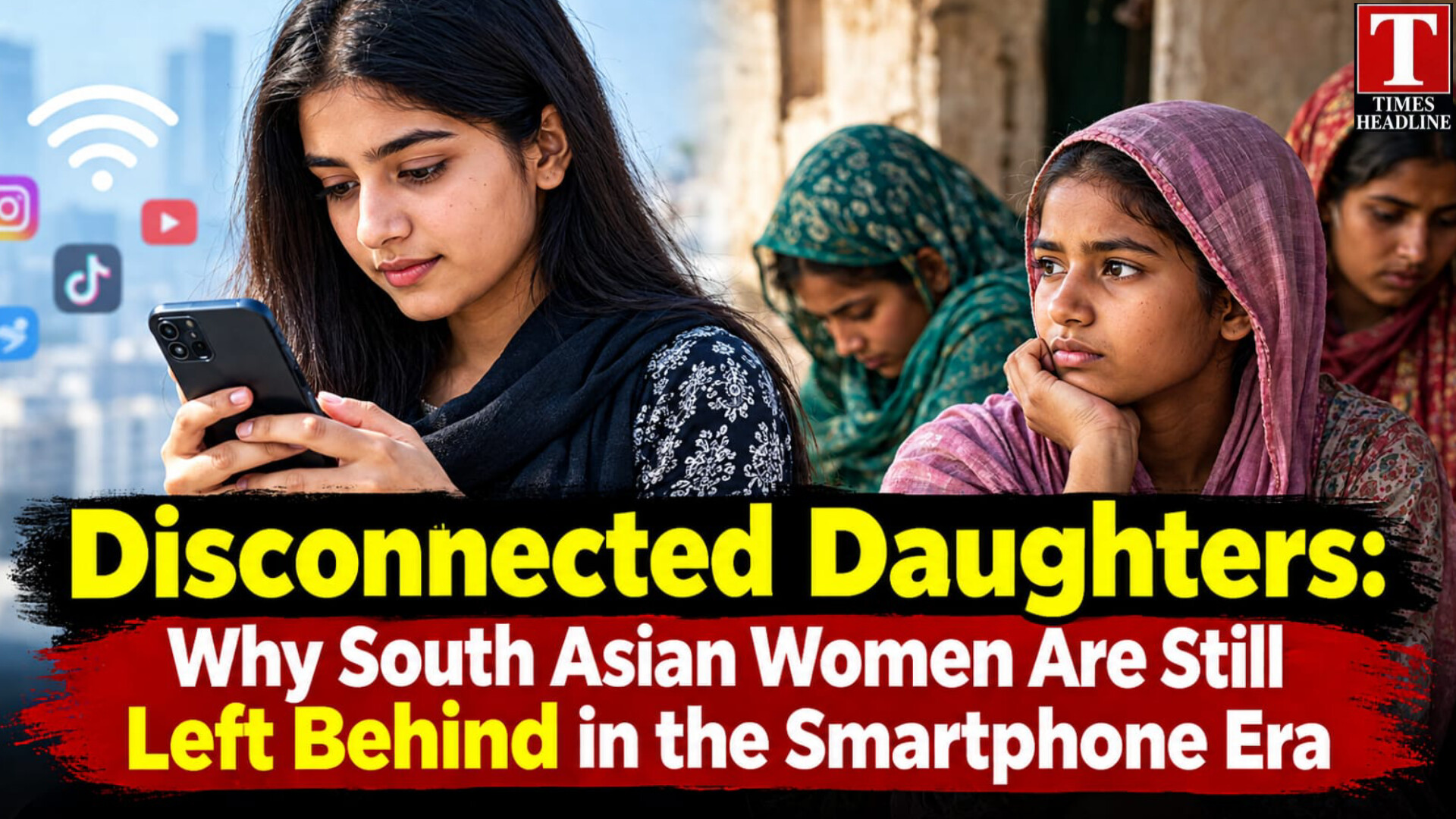
Imagine a young woman in a village in South Asia trying to apply for a scholarship through an online portal. She needs a smartphone, a reliable connection, scanned documents and the confidence to navigate the application process. A phone may be available in her household, but it may not be hers to use whenever she needs it. She may have to wait for another family member to finish using the device, manage limited data or seek permission to access certain online platforms.
This is a hypothetical scenario, not a documented individual experience. Yet it captures a problem that is easy to miss when digital progress is measured only by network coverage or the number of phones in a household: having a smartphone nearby does not necessarily mean having independent access to the digital world.
Across South Asia, digital technologies are reshaping education, employment, financial services and public communication. But the benefits of this transformation are not distributed equally. For many women and girls, the barriers extend beyond connectivity to affordability, digital skills, safety, privacy and control over devices. The question is not simply who can connect. It is who has the freedom and opportunity to use that connection to learn, earn, communicate and make choices.
What the numbers tell us
The GSMA’s Mobile Gender Gap Report 2026 offers a clear measure of both progress and unfinished work. It reports that the gender gap in mobile internet adoption in South Asia narrowed from 33 per cent in 2024 to 25 per cent in 2025. At the same time, an estimated 330 million women in the region were still not using mobile internet (GSMA, 2026, p. 12). These figures measure mobile internet adoption, not every form of internet access or digital skill.
The two figures need to be read together. A narrowing gap is evidence of progress in relative adoption, but it does not mean that exclusion has disappeared. The number of women who remain non-users is still substantial. Digital inclusion should therefore be assessed not only by how quickly adoption grows, but also by who remains outside it and why.
Evidence on adolescent girls points to a similar pattern. In a 2024 UNICEF South Asia analysis, Veronica Kamanga Njikho reported that adolescent boys in the region were one and a half times more likely than girls to own a mobile phone and nearly twice as likely to own a smartphone. Girls were also 35 per cent less likely than boys to possess basic digital skills, such as sending emails or managing files (Njikho, 2024). These indicators concern adolescents and should not be generalised to all women, but they show how unequal access and skills can emerge early.
The evidence suggests that digital exclusion is not a single gap that can be closed by laying more cables or expanding mobile coverage. It is a series of linked disadvantages that can begin with device access and continue into education, employment and public participation.
A phone in the household is not the same as digital freedom
The conventional understanding of connectivity often rests on a simple assumption: if a household owns a smartphone and has an internet connection, its members are digitally connected. For many women and girls, that assumption is incomplete.
A shared device may provide access to information without providing autonomy. A student may be able to use a phone for homework but not have it available during an online class. A young woman may be permitted to attend a training session but lack privacy to explore employment opportunities. An adult woman may use a phone for household coordination while depending on someone else to recharge data, install applications or complete a digital transaction.
The distinction between access and control matters. Who owns the device? Who decides when it can be used? Who pays for data? Can the user maintain private accounts, access information confidentially and communicate without fear of surveillance or disapproval?
A peer-reviewed study by Scott and colleagues (2021), based on research in rural central India, documented how gender norms and household arrangements can shape women’s use of mobile phones. The study discusses constraints associated with phone ownership, device functionality, digital skills and time. Its findings do not represent every South Asian setting, but they demonstrate why household ownership is not a sufficient measure of women’s independent access.
Restrictions do not always take the form of an explicit ban. They may arise through everyday routines: a device is prioritised for another household member, data is rationed, domestic responsibilities limit uninterrupted time, or some forms of online communication are considered inappropriate for girls. Digital exclusion can therefore persist even when a household appears connected.
From classrooms to careers
Education is one of the clearest areas in which unequal access can have lasting consequences. Online lectures, digital libraries, scholarship portals and virtual training can expand opportunities for students who live far from institutions or cannot easily travel. But these benefits depend on a suitable device, reliable connectivity, digital confidence and time to study.
A student who must share a phone may miss a live lecture or struggle to submit work on time. A student with limited opportunities to practise may be less confident using online research tools, learning platforms or productivity software. Over time, such disadvantages can affect educational participation and readiness for work.
The same pattern applies to employment and entrepreneurship. Digital platforms can help women discover vacancies, build professional networks, market products, receive payments and reach customers beyond their neighbourhoods. Yet these opportunities require more than an internet signal. They may depend on the ability to maintain accounts, create content, communicate with customers, protect personal information and use digital tools without assistance.
The digital divide can thus reinforce existing economic inequalities. Women who have fewer opportunities to study or earn may also have fewer resources to acquire devices and skills; limited digital participation can, in turn, narrow their future options. This is a plausible and important policy concern, although the size of the effect will vary by context and should not be assumed to be identical across countries.
Safety should enable participation, not restrict it
Online safety is another important part of the debate. Women and girls can face harassment, stalking, impersonation, threats and the non-consensual sharing of personal material. Such experiences can undermine privacy and confidence, discourage participation or lead users to withdraw from online spaces.
For families concerned about these risks, restricting a daughter’s internet access may appear to be a protective response. But when the solution is to limit the potential victim rather than address abusive behaviour, the cost of safety falls on the person whose opportunities are already constrained.
The answer is not to dismiss safety concerns. It is to make digital participation safer. Digital literacy should include privacy settings, account security, recognition of manipulated content, reporting procedures and knowledge of available support. Schools and universities need accessible processes for reporting online abuse. Platforms should respond effectively to harassment, and public institutions should ensure that relevant laws and safeguards work in practice.
Safety cannot be treated as the opposite of inclusion. It is one of the conditions that makes meaningful participation possible.
When essential services move online
Digital platforms can make banking, public benefits, health information and government services more convenient for people who can use them independently. But a digital-first system may create a new barrier for someone who lacks a suitable device, reliable connectivity, accessible instructions or the confidence to navigate the process.
A woman who relies on a relative to complete an online application or access a one-time password may technically receive help, but she may not have privacy or independent control over the transaction. A service can therefore be available online without being equally accessible in practice.
The implication is not that public services should avoid digitisation. It is that digital transformation should be designed around the realities of unequal access. Assisted service points, multilingual guidance, accessible interfaces, helplines and appropriate offline alternatives remain important, especially for essential services. These should be treated as part of inclusive service design, not as evidence that people have failed to keep up.
One region, many realities
South Asia is not a uniform social or technological landscape. Countries differ in infrastructure, public policy, education systems, economic conditions and social norms. Differences also exist within countries: rural and urban women, affluent and low-income households, women with disabilities and women from marginalised communities may encounter different barriers.
Regional statistics are valuable because they show the scale of the problem, but they cannot explain every local experience. The GSMA’s regional mobile internet estimate and UNICEF’s findings on adolescent girls measure different populations and dimensions of digital inclusion. They should be used as complementary evidence, not combined as if they came from a single survey.
The policy response must therefore combine regional goals with locally grounded evidence. Governments, educational institutions, civil society organisations and technology companies should support affordable access and practical training while investigating how barriers differ by age, location, disability, income and household circumstances.
What needs to change
First, governments and researchers should measure meaningful access, not just household connectivity. Data should distinguish personal device ownership from shared access and examine affordability, frequency of use, skills, privacy, safety and the ability to complete common digital tasks independently.
Second, affordable access must remain a priority. Targeted device support, lower-cost data plans, public connectivity facilities and community-based training can help women who are excluded by cost or infrastructure. Programmes should be evaluated to establish whether they produce sustained and independent use.
Third, digital learning must extend beyond basic phone operation. Girls and women need opportunities to develop information-evaluation skills, protect their accounts, use online services, communicate professionally and acquire digital skills relevant to education and employment. Training should be sustained and paired with access to devices on which participants can practise.
Fourth, families and communities should encourage equal access to devices, time and learning opportunities for daughters and sons. Digital participation should not be distributed according to gendered assumptions about who needs technology or who can be trusted to use it.
Finally, technology companies and public institutions must take responsibility for safer, more accessible services. Inclusive design, clear reporting channels, multilingual support and privacy-conscious systems should be built in from the beginning. Essential services should not become inaccessible simply because a person cannot navigate a digital process alone.
Success should be measured not only by the number of women who come online, but by whether they can use digital tools safely, independently and for purposes they value.
The right to participate
The digital gender divide is ultimately a question of opportunity and agency. Access to information matters, but meaningful inclusion requires the freedom to act on it: to learn, earn, communicate, create and participate in decisions that shape one’s life.
South Asia’s daughters do not lack the capacity to participate in the digital future. What many lack is an equal opportunity to do so. A smartphone cannot by itself dismantle gender inequality, and an internet connection cannot automatically overcome poverty or discrimination. But unequal access can reinforce these barriers and make them harder to overcome.
The measure of a successful digital transformation should not be how quickly a country adopts new technologies or how many transactions move online. It should also be whether the benefits of innovation reach those who have historically been excluded.
The question, therefore, is not whether South Asian women are ready for the smartphone era. It is whether South Asian societies are ready to recognise their right to participate in it on equal terms. Until that question is addressed, the region’s digital revolution will remain incomplete—not because the technology has failed, but because equality has not kept pace with it.
(The Authors are Senior Faculty Members at the Faculty of Arts, Media and Design, South Asian University.)