
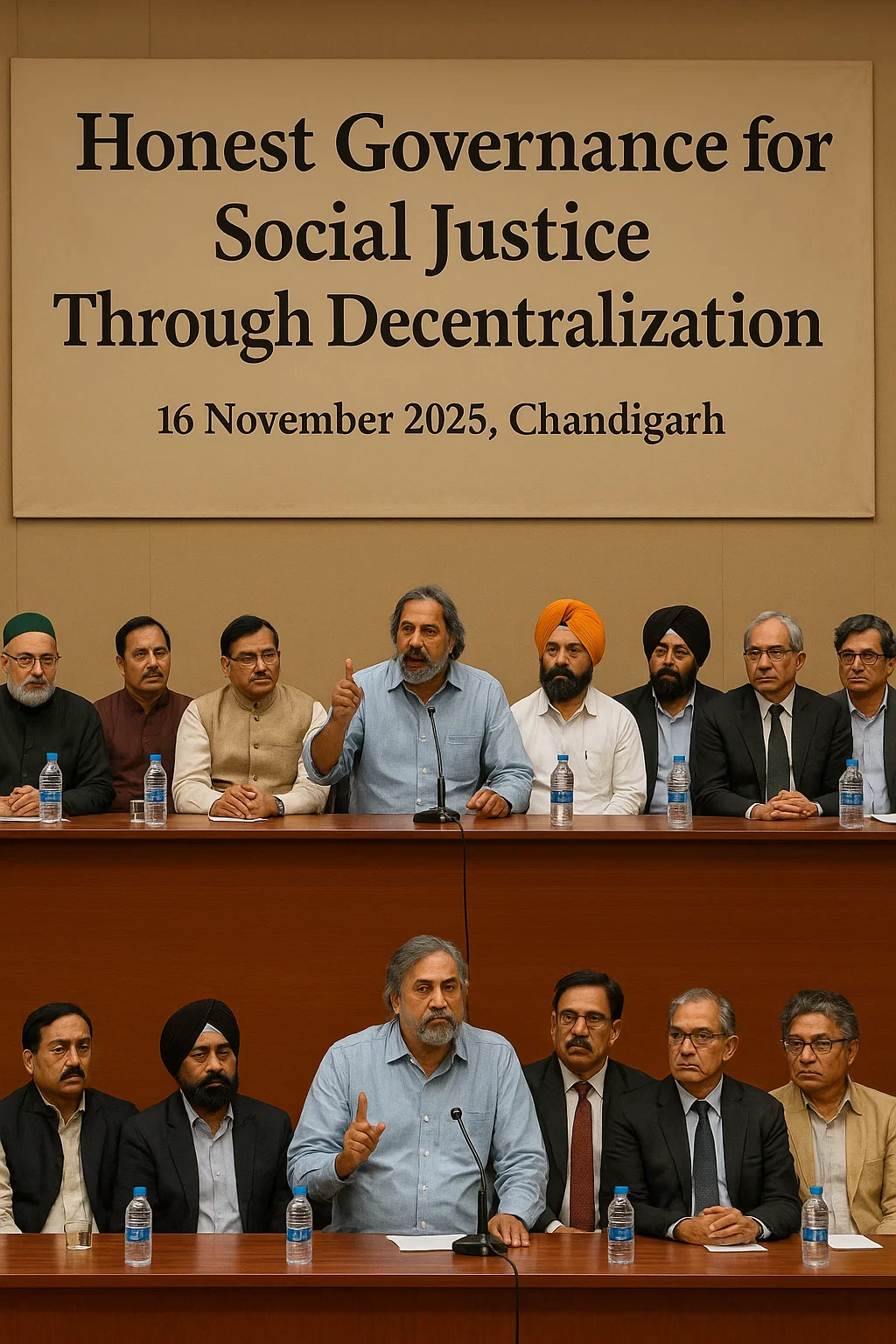
The Sach Khoj Academy convened a significant seminar on 16 November 2025 in Chandigarh, on the theme “Honest Governance for Social Justice through Decentralization.” The event brought together eminent social activists, scholars, farmers’ leaders, jurists, and policy thinkers committed to promoting transparent governance and decentralization as essential foundations for social justice in India.
Among the distinguished speakers were Allama Tarique, Dr. Sunilam (President, Kisan Sangharsh Samiti; Former MLA, Madhya Pradesh), Feroze Mithiborwala, Rajwinder Singh Rahi, Harcharan Singh Bains, Navneet Singh (Maharashtra), Dr. Ranjit Singh Ghuman, Senior Advocate Rajvinder Singh Bains, and Professor Ronki Ram.
Unity of Rabb & Aatman, and the Revolutionary Path of Annihilating Caste
Speaking on “Unity of Rabb & Aatman, the Revolutionary Path of the Annihilation of Caste and the Foundation of Equality,”
Feroze Mithiborwala traced the continuous revolutionary lineage from Sant Kabir, Guru Nanak, Baba Farid, Guru Gobind Singh, Sant Namdeo, Sant Ravidas, to Mahatma Phule, Mahatma Gandhi, and Dr. Babasaheb Ambedkar.
He emphasized that the Sikh Gurus’ foundational declaration — Ik Onkar (One Reality, One Creator, One Light) — is not merely theological but a radical social and political principle. If all beings emerge from One Light, no human can be superior or inferior. He linked this spiritual egalitarianism to the modern anti-caste emancipatory struggles led by Phule, Gandhi, and Ambedkar.
Decentralization as the Only Solution to Current National Challenges
Dr. Sunilam stated that decentralization offers the most viable solution to the deep social, economic, and political crises gripping India today. He argued:
Extreme global inequality has emerged from the concentration of capital in the hands of the world’s top 100 corporations, which control 60–70% of global wealth and resources.
India cannot address the crises created by this concentration without decentralizing capital and nationalizing monopolies, just as independent India earlier nationalized railways, banks, ports, and mines.
Today, he said, nationalization of the wealth of corporate monopolies like Adani and Ambani is necessary to return resources to the people.
He stressed that effective governance requires a decentralized administrative structure with villages and neighbourhoods as the fundamental units. Globally, local bodies wield maximum authority; India must follow the same model. With the exception of foreign affairs, communications, and national security, all powers should be devolved to local bodies.
While the 73rd and 74th Constitutional Amendments were intended to achieve this, they remain poorly implemented. This failure, he said, has undermined Mahatma Gandhi’s vision of village republics and self-reliant communities, a vision neglected by the post-independence elite.
Centralization, RSS Ideology, and Threats to Constitutional Values
Dr. Sunilam warned that those committed to centralization now occupy the highest positions of power. He identified the centralizing ideology of the RSS — “One Nation, One Market, One Language, One Culture, One Party, One Leader, One Religion” — as fundamentally opposed to India’s pluralistic reality and aimed toward establishing a Hindu Rashtra.
He highlighted the historical refusal of the RSS to accept the Indian Constitution and the national flag during the Constituent Assembly era. Even today, while citizens defend constitutional values, the RSS–BJP and the central government continue efforts to undermine the Constitution’s objectives.
He noted that centralization contradicts India’s civilizational truth: diversity is India’s essence. India’s identity is rooted in coexistence, with thousands of dialects, countless local cultures, and innumerable centers of faith built around saints, deities, and community traditions.
At a religious level, he added, India has long been profoundly decentralized, with 33 crore deities and hundreds of new caste-based deities emerging since independence.
Gurmat, Human Rights, and the Fight Against Distortion
Senior Advocate Rajvinder Singh Bains delivered a key address on the spiritual foundations of Gurmat as articulated by Sri Guru Gobind Singh, emphasizing its deep relationship with truth, human rights, unity, justice, and peace. He cautioned against distorted interpretations of Gurmat and called for reclaiming its authentic principles, which stand firmly for justice and against oppression.
He emphasized that the spiritual ethos of Sikh philosophy is inseparable from the pursuit of honest governance, making it a vital pillar of social justice.
Conclusion
The seminar concluded with a powerful and unified call to:
Strengthen honest and transparent governance
Deepen decentralization of power and capital
Protect constitutional democracy
Recommit to justice, equality, fraternity, and human dignity
The stage proceedings were convened by Tarjinder Singh Dhillon and Advocate Parminder Singh.
Sach Khoj Academy
Contact: Amanjot Singh
Phone: 098961 92233
The feature image is AI-generated.