
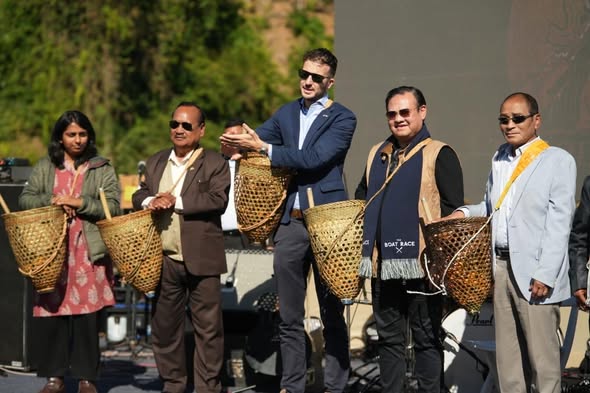
The Tri Hills Festival served as a meaningful platform to celebrate cultural connections, drawing attention to the historic and artistic links between Wales and Meghalaya. Among the festival’s most notable moments was a performance by Khasi harpists, who rendered the Khasi anthem, offering audiences a glimpse into the region’s rich musical traditions.

The performance also brought focus to a well-documented cultural curiosity: the melody of the Khasi anthem closely resembles that of the Welsh national anthem, Hen Wlad Fy Nhadau. This shared tune is often cited as a reflection of historical interactions between Welsh missionaries and the Khasi community during the 19th century, when Western musical forms were introduced and adapted locally.

Rather than diminishing Khasi identity, the adaptation of the melody stands as an example of cultural exchange and localisation, where global influences were reshaped within indigenous traditions. At the Tri Hills Festival, the use of the Khasi harp added further cultural depth, grounding the performance firmly in local heritage.

By presenting this musical convergence in a contemporary setting, the festival underscored how shared histories can continue to foster dialogue and mutual respect between cultures separated by geography but connected through art, faith, and music. The moment resonated as a reminder that cultural links, when acknowledged with care and context, can serve as enduring bridges between communities.