
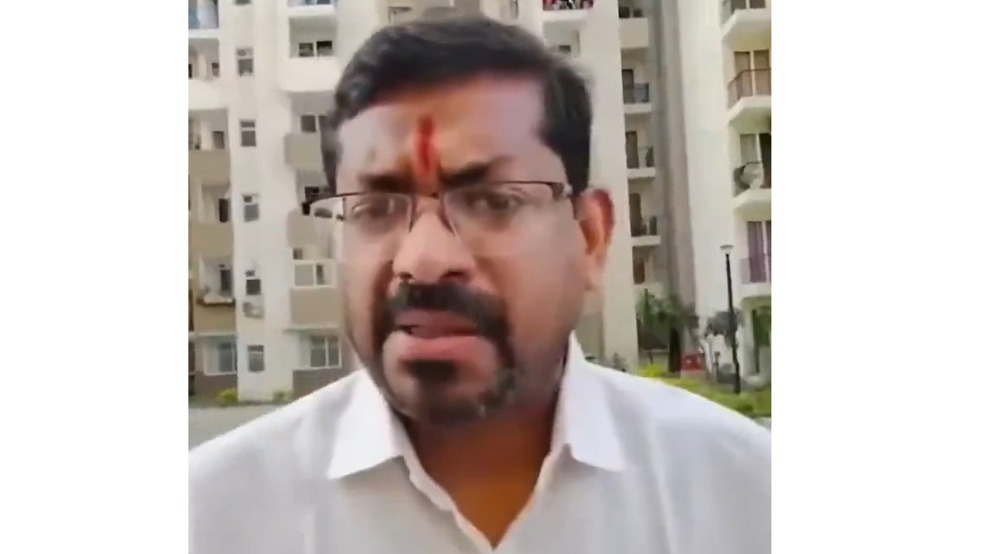
In the fast-moving and highly polarized information environment of modern conflicts, a single interview clip can travel across the world within minutes, often detached from the context in which it was originally delivered. The recent experience of Indian journalist Braj Mohan Singh illustrates precisely how narratives can evolve rapidly on social media and why clarifications from reporters themselves remain essential in maintaining journalistic integrity.
Singh, who works with Sandha News, found himself unexpectedly at the centre of international attention after an interview describing his experiences while reporting from areas affected by the escalating confrontation between Israel and Iran. Having been present in the region between February 28 and March 6, the journalist spoke about the challenges he faced while covering events during the conflict. His comments about security restrictions, censorship, and the uncertainty surrounding missile and drone attacks quickly went viral online.
In the interview, Singh described how journalists working in conflict zones sometimes face strict limitations. According to him, reporters were not always given precise information about locations of incidents, nor were they permitted to film bodies or visit hospitals freely. He also suggested that official casualty figures occasionally differed from what local residents reported. These remarks triggered intense reactions online, with many interpreting them as a sharp criticism of Israel’s handling of wartime information.
However, as often happens in the digital age, the nuance of his observations was quickly overshadowed by selective interpretations. Clips of the interview circulated widely, sometimes accompanied by commentary that portrayed Singh as condemning the Israeli state or questioning its security mechanisms.
Recognizing how his remarks were being interpreted, Singh later issued a clarification explaining that his intention had never been to criticize any country. Instead, he emphasized that his statements reflected the experiences of a reporter navigating the complexities of war coverage. He also stressed that Israel remains, in his view, a very safe country that takes the security of its citizens and residents seriously.
This clarification is significant for several reasons.
First, it highlights the difficult balance journalists must maintain when reporting from conflict zones. War reporting is inherently chaotic. Information emerges in fragments, security restrictions are common, and official narratives often evolve as situations develop. In such environments, journalists rely on a combination of official briefings, eyewitness accounts, and on-ground observation. Discrepancies between these sources are not unusual and reporting them is part of the job, not necessarily a judgment about any government’s intentions.
Second, Singh’s clarification underscores the responsibility journalists feel to avoid their work being used to promote geopolitical narratives they did not intend to support. In the context of the confrontation between Israel and Iran—a conflict that has drawn global attention and strong opinions—any statement from someone reporting on the ground can quickly become politicized.
The broader geopolitical backdrop also contributed to the heightened sensitivity surrounding his remarks. Reports of military escalation, including strikes, counter-attacks, and regional tensions involving locations such as Tel Aviv and strategic sites across West Asia, created an atmosphere where every piece of information was scrutinized closely. In such circumstances, even routine journalistic observations can be interpreted as political commentary.
Third, the episode reflects the challenges posed by the modern media ecosystem. Social media platforms reward speed and emotional engagement more than nuance or context. As a result, partial clips, translated excerpts, or out-of-context statements can quickly shape public perception. By the time a full explanation or clarification appears, the initial narrative may already have travelled far beyond its original audience.
Singh’s decision to clarify his remarks therefore serves as a reminder of the importance of responsible communication—not only by journalists but also by audiences who consume and share information online. Journalists reporting from volatile regions must often speak about what they witness in real time, even when the full picture is not yet available. Their observations are snapshots of evolving situations, not final judgments.
Ultimately, the role of a reporter is to document events as faithfully as possible, even when those events unfold under difficult or uncertain conditions. Singh’s experience reflects the pressures of this responsibility. His clarification reiterates that describing on-ground realities does not automatically translate into criticism of a nation or its people.
In an era where information spreads instantly and interpretations multiply rapidly, the episode involving Braj Mohan Singh demonstrates why context, clarification, and careful listening remain indispensable to journalism. Without them, even honest reporting risks being misunderstood—and in times of conflict, misunderstanding is often the first casualty.