
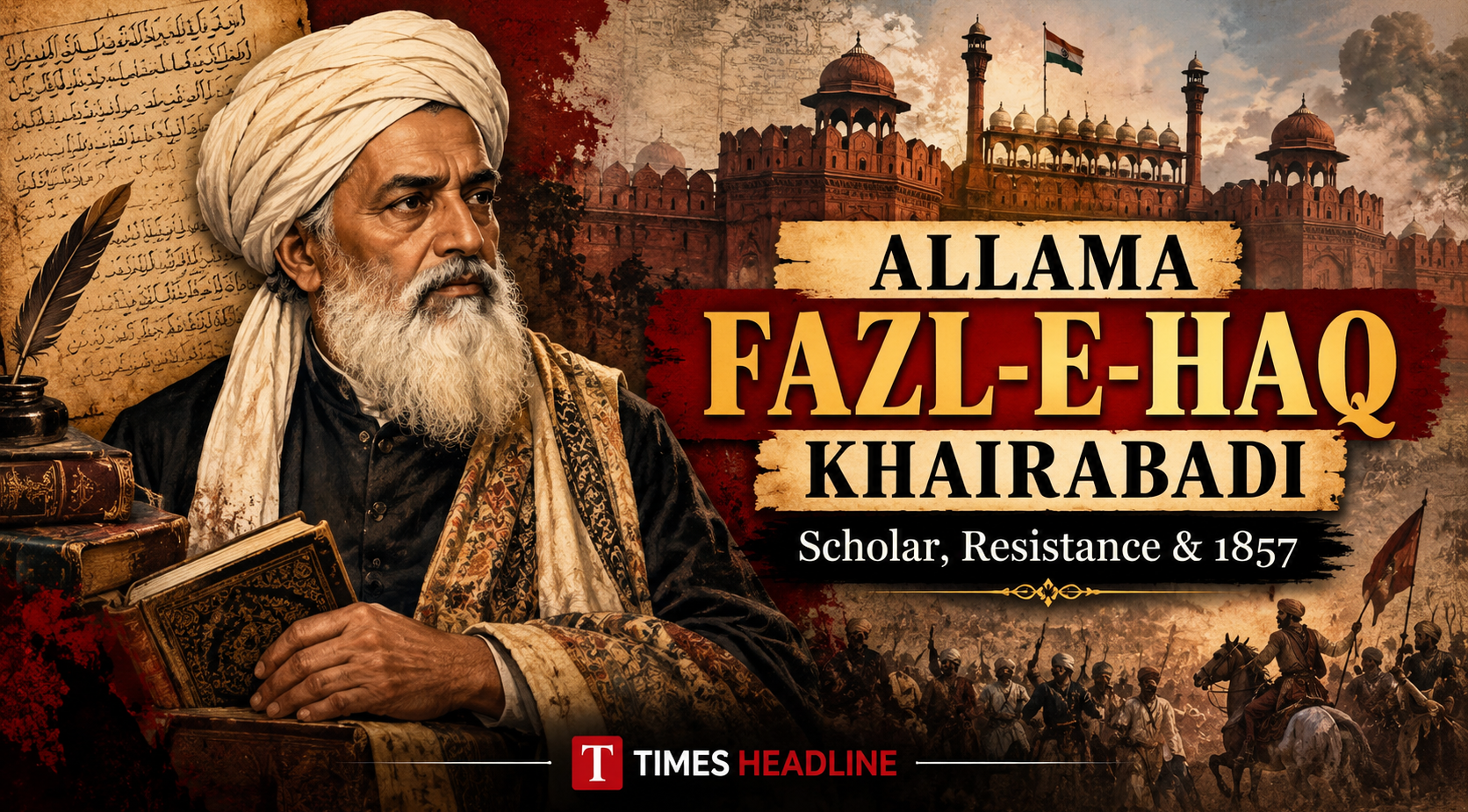
India’s freedom struggle was shaped not only by soldiers and political leaders but also by scholars, intellectuals and religious figures who challenged colonial rule. Allama Fazl-e-Haq Khairabadi (1797–1861) was one such remarkable figure whose life became closely associated with the resistance to British rule during the Revolt of 1857.
Born in Khairabad in present-day Uttar Pradesh, Khairabadi was a distinguished Islamic scholar, theologian, philosopher, poet and intellectual. His reputation extended well beyond religious scholarship; he was known for his command of Arabic and Persian literature and was part of the intellectual world of nineteenth-century Delhi.
When the uprising of 1857 erupted, Khairabadi emerged as an important voice of opposition to British authority. He travelled to Delhi and became associated with the rebel administration around Bahadur Shah Zafar. Historical accounts describe his interaction with the emperor and other leaders of the uprising, including General Bakht Khan. He also worked to bring sections of the ulema together in support of resistance to colonial rule. Amrit Mahotsav
One of the most frequently cited aspects of his role is the 1857 fatwa supporting armed resistance against British rule. The official Azadi Ka Amrit Mahotsav archive identifies him as having issued a fatwa-e-jihad against the British. However, historians have pointed out that the documentary history surrounding the fatwa is complex, including questions about its authorship and attribution. Therefore, his role is best understood within the wider context of his anti-colonial activism and participation in the 1857 uprising, rather than through the fatwa alone.
After the British suppression of the uprising, Khairabadi was arrested and prosecuted. He was sentenced to transportation for life to the Andaman Islands, where he spent his final years in colonial captivity. His imprisonment did not end his intellectual work. During his time in the Andamans, he produced writings documenting and analysing the events of 1857, including the Arabic work Al-Thawra al-Hindiyya.
Khairabadi died in the Andaman Islands in 1861. Today, his story remains an important part of the history of India’s anti-colonial struggle.
Remembering Allama Fazl-e-Haq Khairabadi is not merely about remembering one individual. It is about recognising the many scholars, intellectuals and ordinary Indians whose resistance to colonial rule formed part of India’s long and diverse freedom movement.
His journey—from scholarship to resistance, and from Delhi to Kala Pani—remains a powerful reminder of the intellectual and moral dimensions of India’s struggle for freedom.