
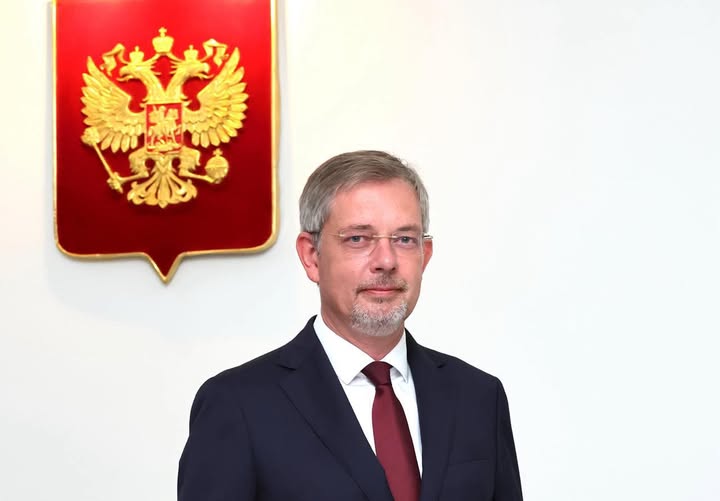
New Delhi, Denis Alipov, Ambassador of Russia to India, has reaffirmed the strength and strategic depth of bilateral relations in an interview with the BRICS–Russia Expert Council, underscoring expanding cooperation across trade, energy, and global governance platforms.
Alipov noted that diplomatic relations between the two countries, which will mark their 80th anniversary in 2027, have consistently exemplified friendship based on equality, mutual respect, and trust. He described multifaceted cooperation with New Delhi as an “unconditional priority” of Russia’s foreign policy.
Russia remains one of India’s key strategic partners in critical sectors, including energy security—particularly nuclear energy—defence technology, space exploration, artificial intelligence, Arctic research, and agriculture.
The year 2025 marked two major milestones in bilateral ties: the 25th anniversary of the strategic partnership and the 15th anniversary of its elevation to a “special and privileged” partnership. A major highlight was the 23rd Russia–India Annual Summit held on December 4–5 in New Delhi, which included a state visit by Russian President Vladimir Putin.
On the economic front, Alipov emphasized record-breaking trade figures. According to India’s Ministry of Commerce and Industry, bilateral trade reached USD 53.8 billion between January and October 2025. Russia has become India’s fourth-largest trading partner and its leading supplier of oil, petroleum products, sunflower oil, and fertilisers.
The ambassador highlighted progress in financial cooperation, noting that 97% of bilateral settlements are now conducted in national currencies. He also pointed to expanded banking cooperation through national payment systems.
Infrastructure and connectivity projects are expected to further boost trade, including the International North-South Transport Corridor, the Chennai–Vladivostok Maritime Corridor, and the Northern Sea Route. Full implementation of these initiatives is projected to support the leaders’ goal of reaching USD 100 billion in bilateral trade by 2030.
Addressing multilateral cooperation, Alipov stressed close coordination between Moscow and New Delhi within the United Nations, the G20, and BRICS to promote multipolarity and reform global governance institutions.
Welcoming India’s current BRICS chairship under the theme “Building for Resilience, Innovation, Cooperation, and Sustainability,” he said both countries would intensify dialogue on counterterrorism, secure use of information and communication technologies, and greater representation of developing nations in global decision-making.
Alipov also welcomed the recent expansion of BRICS membership, stating that while the grouping has grown more diverse, its foundational principles—equality, consensus, openness, and mutual respect—remain intact. He described BRICS as a platform that enables candid dialogue free from external pressure and supports a constructive, non-confrontational global agenda.