
(Dr. Shujaat Ali Quadri)
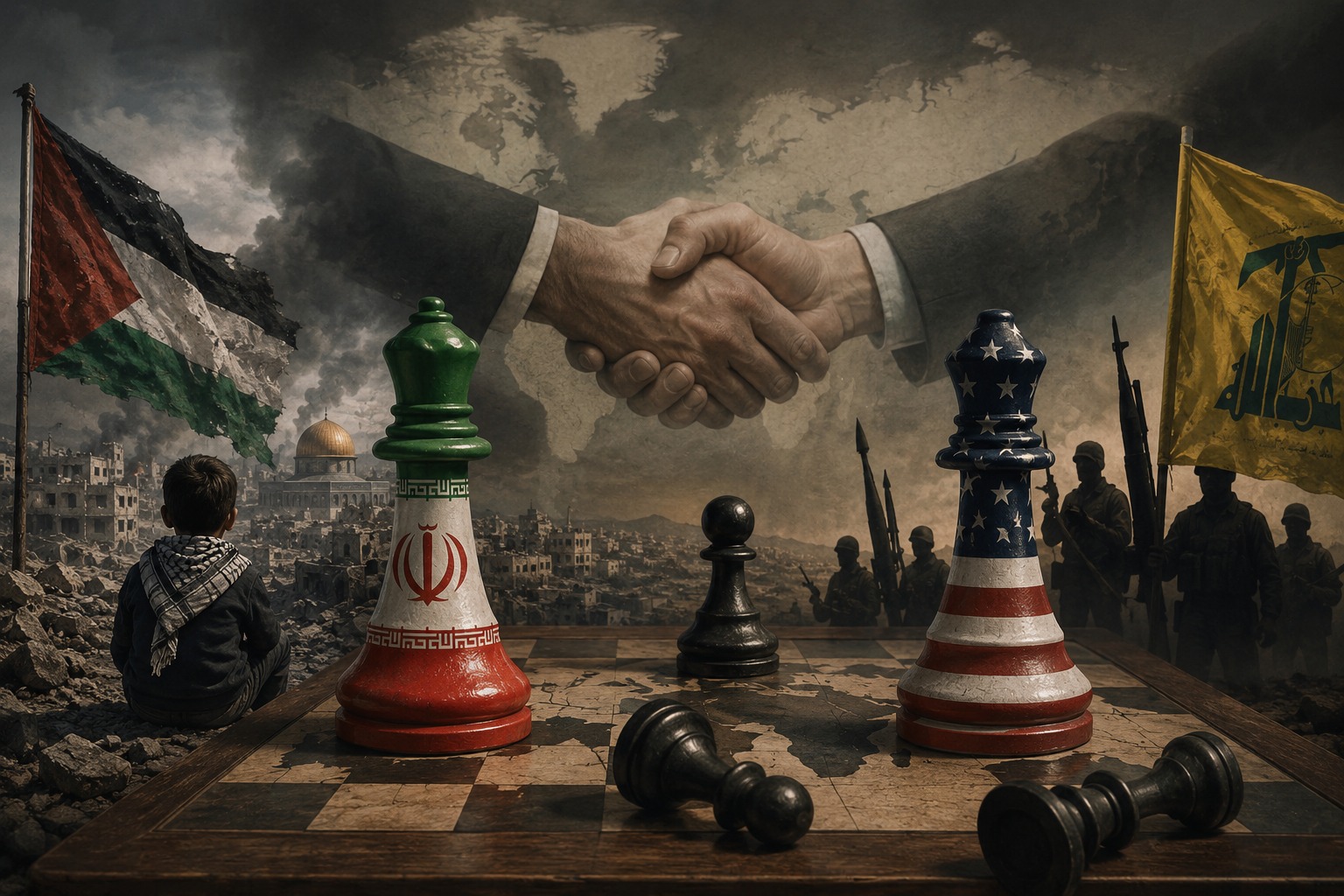
For more than four decades, the Islamic Republic of Iran has presented itself as the foremost international champion of the Palestinian cause. From official speeches to annual Quds Day commemorations, Tehran has consistently framed Palestine not merely as a geopolitical issue but as a defining ideological commitment. Yet, recent regional developments have revived an uncomfortable question: when faced with a direct confrontation with the United States and mounting military pressure, did Iran ultimately prioritize the survival of its regional deterrence network over the Palestinian cause?
The answer is more complex than a simple accusation of betrayal. However, there is a compelling argument that Iran’s strategic choices have left the Palestinian cause politically weaker, even if preserving its own long-term regional influence was the overriding objective.
The most striking feature of the recent U.S.-Iran understanding is not what it contains but what it omits. While the framework reportedly addresses ceasefire arrangements, maritime security, sanctions, nuclear negotiations and broader regional de-escalation, there is no explicit commitment concerning Gaza, Palestinian statehood or the future of Hamas. Given that Tehran has long portrayed Palestine as the central pillar of its regional policy, this omission is politically significant.
This does not necessarily mean Iran abandoned Palestine. Rather, it suggests that when negotiations reached the highest strategic level, Tehran’s immediate priorities lay elsewhere.
Iran’s regional strategy has never revolved around a single actor. It has been built around what it describes as the “Axis of Resistance”—a network including Hezbollah in Lebanon, Iraqi militias, Yemeni Houthis and Palestinian armed groups. Among these, Hezbollah has always occupied a uniquely important position.
Unlike Hamas, Hezbollah represents Iran’s most sophisticated strategic partner. It possesses advanced missile capabilities, an extensive command structure, significant political influence inside Lebanon and geographic proximity to Israel. For Tehran, Hezbollah functions as a major deterrent against external military pressure.
Viewed through this strategic lens, preserving Hezbollah is not simply about Lebanon. It is about maintaining Iran’s principal regional security asset.
The contrast with Gaza is instructive. Hamas undoubtedly remains an important partner for Tehran, but it does not occupy the same strategic position. Geography limits Iran’s ability to sustain Hamas directly, while the military balance in Gaza differs fundamentally from southern Lebanon. Consequently, Tehran’s room for escalation has always been more constrained.
Throughout the conflict, Iranian leaders issued strong rhetorical support for Palestinians. Yet rhetoric and military decision-making often diverged. Iran avoided entering a full-scale conventional war with Israel or the United States despite repeated opportunities and considerable domestic pressure.
This restraint reflected strategic calculation rather than ideological inconsistency. A wider regional war could have endangered the Iranian state itself, severely damaged Hezbollah’s capabilities and undermined Tehran’s broader deterrence architecture.
From the perspective of national security, such caution is understandable. States rarely sacrifice core strategic interests for ideological objectives alone. Yet for many supporters of the Palestinian cause, this distinction matters little. Expectations had been shaped by decades of revolutionary messaging that portrayed Palestine as Iran’s foremost foreign-policy priority.
The resulting gap between rhetoric and action has inevitably affected perceptions.
Another consequence concerns Iran’s credibility within the wider Muslim world. Tehran has long criticised Arab governments for what it described as insufficient support for Palestinians. It positioned itself as the state willing to bear costs that others would not.
However, if the eventual diplomatic settlement largely focuses on Iran’s nuclear programme, sanctions relief and regional security while leaving Gaza outside the principal negotiating framework, critics are likely to argue that Palestinian suffering became secondary to Iranian national interests.
Such criticism should also be viewed with caution. Foreign policy is almost always driven by state interests rather than ideological consistency. Iran is hardly unique in this respect. Major powers routinely separate humanitarian rhetoric from strategic bargaining.
Moreover, supporters of Tehran argue that preserving Hezbollah and avoiding direct war ultimately serves Palestinian interests by maintaining a long-term balance of deterrence against Israel. From this perspective, sacrificing Iran’s most valuable regional asset in an unwinnable confrontation would have weakened, not strengthened, the broader resistance network.
Whether this argument convinces observers depends largely on their understanding of Iran’s objectives.
If one believes Iran’s primary mission is defending Palestine at any cost, recent developments appear deeply disappointing. If, however, one views Iran principally as a state pursuing national security through regional influence, its conduct appears far more predictable.
Perhaps the greatest casualty has been not military capability but political narrative. For decades, Tehran cultivated an image of unwavering commitment to Palestine that transcended ordinary geopolitical calculations. Recent events suggest that, when confronted with the prospect of a wider regional conflict, Iran behaved much like other states: balancing ideology against security, symbolism against survival and rhetoric against strategic necessity.
The implications extend beyond Iran itself. The Palestinian movement has historically relied on external patrons with differing priorities—Arab states, regional powers and international actors. Each has supported Palestine within the limits of its own strategic interests. Iran’s recent choices reinforce an old lesson: no external power, however committed in its public discourse, is likely to subordinate its core national interests entirely to the Palestinian cause.
Whether history ultimately judges Tehran’s decisions as prudent statecraft or as a missed opportunity will depend on the outcome of future negotiations and the fate of Gaza. What appears increasingly evident, however, is that the Palestinian question has once again become subject to the calculations of regional power politics. For Palestinians, that may be the most sobering reality of all.