
(Dr. Shujaat Ali Quadri)
Thirty-one years after the Srebrenica genocide shocked the world, the search for justice and closure continues. Despite decades of investigations, forensic work, and international efforts, the remains of more than 1,000 victims are yet to be recovered, highlighting the enduring pain of one of Europe’s darkest chapters since the Second World War. On July 11, 1995, Bosnian Serb forces led by Ratko Mladić, who was later convicted of genocide and war crimes, captured the United Nations-declared “safe area” of Srebrenica during the final phase of the Bosnian War.
As Serb forces advanced, thousands of Bosniak civilians fled to the nearby UN peacekeeping base in Potočari, hoping to find protection under Dutch peacekeepers deployed as part of the UN mission. However, the sanctuary they expected failed to materialize. After the fall of the enclave, women and children were separated from men and boys. While many women and children were transported to Bosniak-controlled territory, thousands of men and boys were taken away, detained, and systematically executed at forests, warehouses, schools, factories, and other sites.
International investigations have established that at least 8,372 Bosniak men and boys were killed during the massacre. To conceal the killings, the perpetrators buried victims in mass graves. Many of these graves were later excavated using heavy machinery, and the remains were relocated to secondary and tertiary burial sites in an attempt to hide evidence. This deliberate effort significantly complicated the identification process, with forensic experts often recovering different parts of the same individual’s remains from multiple locations.
International Recognition of Genocide
The Srebrenica massacre became the subject of extensive international judicial investigations following the war.
In 2007, the International Court of Justice (ICJ) ruled that the killings committed in and around Srebrenica constituted genocide under international law. The judgment was based on extensive evidence gathered during trials conducted by the International Criminal Tribunal for the former Yugoslavia (ICTY). Several senior Bosnian Serb leaders were held accountable for their roles in the atrocities. Military commander Ratko Mladić and political leader Radovan Karadžić were both convicted of genocide, crimes against humanity, and other war crimes, receiving life imprisonment sentences.
The Srebrenica genocide remains the only atrocity in Europe since World War II to have been legally recognised as genocide by international courts.
Search for the Missing Continues
Since the end of the Bosnian War, authorities have carried out extensive efforts to locate and identify missing persons across Bosnia and Herzegovina. According to official figures, investigators have recovered victims’ remains from around 150 different locations, including 77 mass graves. Modern forensic techniques, including DNA analysis, have enabled thousands of victims to be identified and returned to their families for burial.
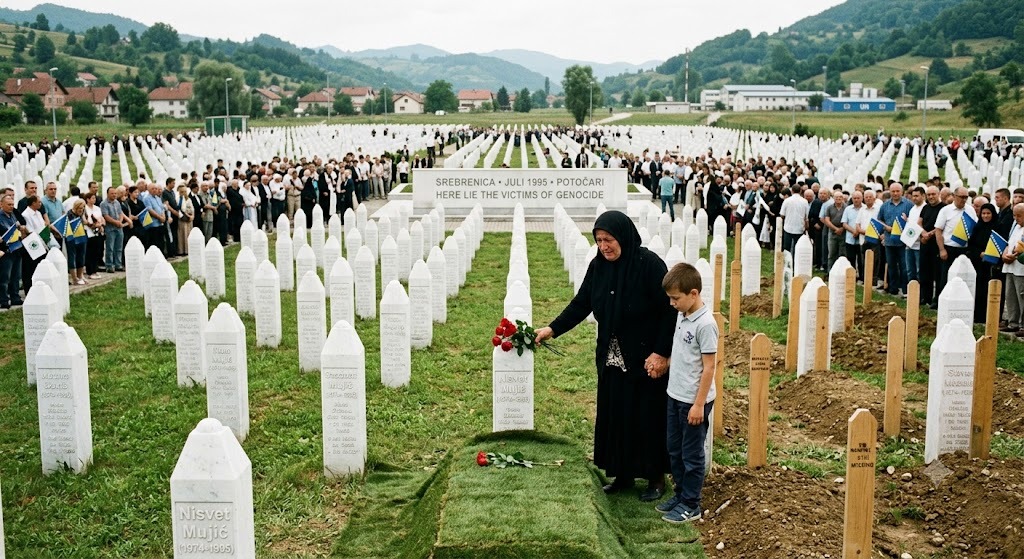
Each year on July 11, newly identified victims are laid to rest during a collective funeral ceremony at the Potočari Memorial Cemetery, where relatives, survivors, and international dignitaries gather to pay tribute. So far, 6,772 victims have been buried at the memorial cemetery, while approximately 250 others have been buried in local cemeteries according to their families’ wishes. However, despite more than three decades of investigations, over 1,000 victims remain missing.
In many cases, only partial remains have been recovered. Families often face the painful decision of whether to bury incomplete remains or continue waiting in the hope that additional remains of their loved ones will eventually be discovered.
The annual commemoration at Potočari serves not only as a funeral ceremony for newly identified victims but also as a solemn reminder of the consequences of hatred, ethnic violence, and the failure of the international community to prevent mass atrocities. For survivors and families of the victims, the search for the missing continues alongside the pursuit of remembrance and justice, ensuring that the lessons of Srebrenica are preserved for future generations and that such tragedies are never repeated.
(The Author is the deputy director of the Indo Islamic Heritage Center)