
As part of the Independence Day Celebration, organised under the patronage of the Hon’ble Vice-Chancellor, Prof. Mazhar Asif, and the Respected Registrar, Prof. Mohd. Mahtab Alam Rizvi, Jamia Millia Islamia, the Sarojini Naidu Centre for Women’s Studies (SNCWS) organised an insightful talk on “80 Years of Indian Independence: The Achievements and Challenges in the Evolved Contexts of Women’s Rights.”
The programme brought together important legal, social and contemporary perspectives on the evolving status of women’s rights in India.
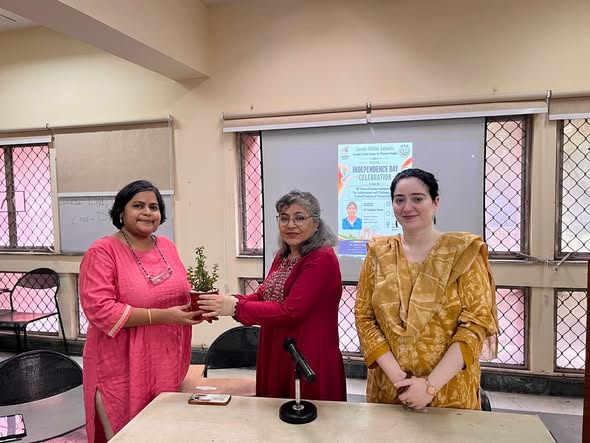
The session was welcomed by Prof. Vijaylakshmi Brara, Director, Sarojini Naidu Centre for Women’s Studies, who extended a warm welcome to the speaker and participants. Dr. Noorjahan Momin, Assistant Professor, Faculty of Law, Jamia Millia Islamia, was felicitated on the occasion.
In her insightful lecture, Dr. Noorjahan Momin traced the constitutional foundations of women’s rights, beginning with the Preamble of the Constitution of India and the principles of equality, justice and dignity embedded within it. She highlighted several landmark judicial interventions that have significantly shaped the discourse on women’s rights, including the Vishaka case, Shah Bano case, Nirbhaya case and Sabarmati-related case, explaining their broader implications for gender justice, dignity and legal protection.
A significant aspect of the lecture was Dr. Momin’s observation that the language used in law has historically been predominantly masculine, reflecting broader gendered structures within legal and social institutions. She emphasised that the quest for equality is not merely about learning new principles of equality and inclusion; it also requires a process of “unlearning” deeply embedded gender stereotypes, assumptions and practices. She stressed that society needs to continuously re-evaluate existing norms, identify gaps between constitutional guarantees and lived realities, and work towards closing those gaps to achieve substantive equality.
The speaker also addressed several contemporary issues concerning women’s rights and discrimination. She discussed the challenges faced by women during the COVID-19 pandemic, changing forms of employment in the gig economy, and emerging questions surrounding assisted reproductive technologies and surrogacy. Particular attention was given to the rights, dignity and legal safeguards of surrogate mothers, highlighting the need for a rights-based approach to emerging reproductive technologies.
Dr. Momin further emphasised the role of society in defining and negotiating concepts of justice and injustice, morality and immorality, and the ways in which social attitudes influence women’s lives and rights. The discussion also extended to third-gender identities, recognition, dignity, equality and the need for greater social acceptance and inclusion.
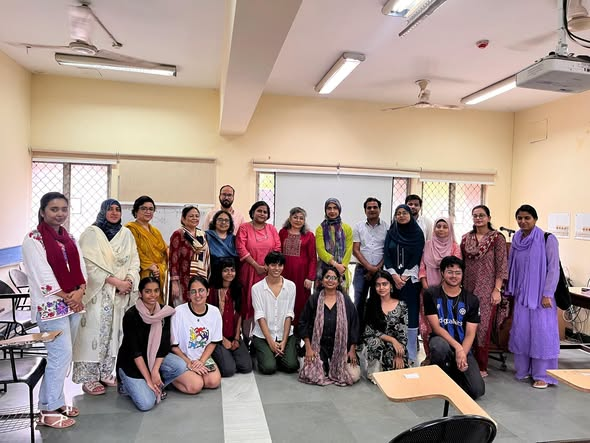
The lecture was followed by an engaging interaction with the students, who actively participated in the question-and-answer session and shared their perspectives on various legal and social dimensions of women’s rights. The interaction provided an opportunity to connect constitutional principles and judicial developments with contemporary challenges faced by women and gender minorities.
Dr. Ambreen Jamali, Assistant Professor, SNCWS, served as the Convenor of the programme, while Ms. Noureen Pervez moderated the session. The programme concluded with a vote of thanks, expressing gratitude to the speaker, the Director, students, participants and all those who contributed to the successful organisation of the event.
The programme served as a meaningful platform for reflecting on India’s journey of independence through the lens of gender justice, constitutional rights, equality and social inclusion, while highlighting the importance of critically examining existing structures, unlearning gendered assumptions, identifying gaps and re-evaluating social and legal practices to advance substantive equality.
Source : Jamia Millia Islamia, New Delhi