
By Grace Mubashir
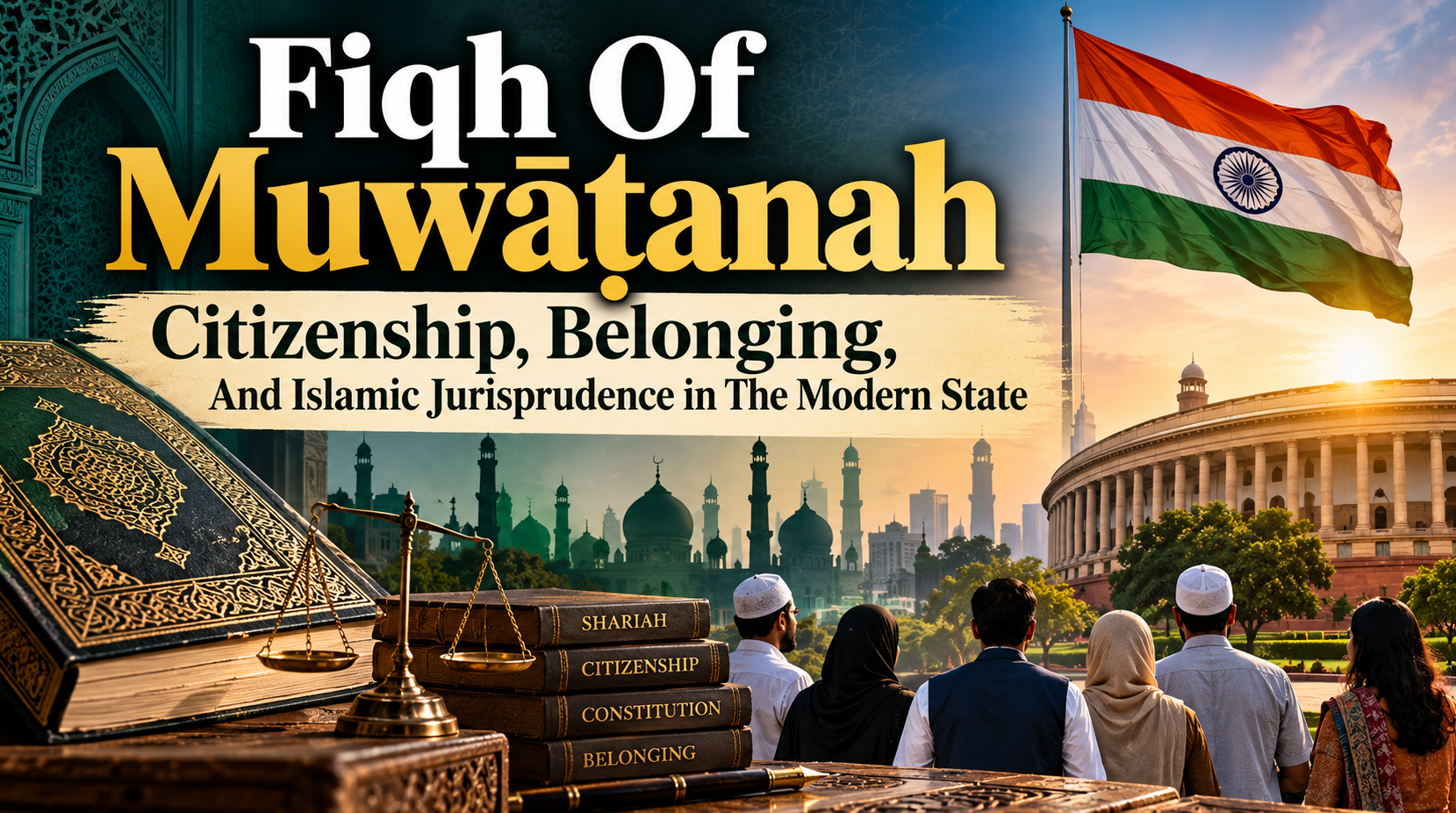
The fiqh of muwāṭanah represents one of the most important areas of contemporary Islamic jurisprudence. Its central question is how Muslims can combine religious identity with equal citizenship in modern plural societies. The answer cannot be found simply by transferring medieval political categories into the modern world. It requires returning to the Qur’an, Sunnah, maqāṣid, maṣlaḥah, urf, contractual principles, and the broader ethical purposes of Islamic law.
Muwāṭanah can therefore be understood as citizenship, belonging to a homeland, or participation in a common political community. In modern usage, it refers to a relationship between an individual and the state based on rights, duties, legal membership, and political belonging. The citizen is not simply a resident. A citizen possesses a recognized legal relationship with the state and shares responsibility for the public order. Thus, muwāṭanah is broader than merely living in a country. It involves belonging, participation, responsibility, and equal legal status.
Major points:
· One of the most important questions facing contemporary Islamic jurisprudence is how Muslims should understand citizenship in the modern nation-state.
· Classical Islamic law developed in political circumstances very different from those of the twenty-first century. Muslim jurists generally discussed political membership through concepts such as the Muslim community, the ruler, the protected non-Muslim, the treaty relationship, and territorial divisions. Modern states, however, are organized primarily around citizenship rather than religion.
· This requires distinguishing between fiqh and Sharīʿah. Sharīʿah represents the broader divine moral and legal orientation of Islam, whereas fiqh represents human scholarly understanding and interpretation of that guidance. Fiqh is therefore capable of development when circumstances change.
· A Muslim citizen of India does not need to abandon Islamic identity in order to participate in Indian citizenship. At the same time, citizenship does not require non-Muslim citizens to accept Islamic religious beliefs. The political community can therefore be understood as a civic community rather than a religiously homogeneous community.
· This produces a conceptual shift from فقه الأقليات (fiqh al-aqalliyyāt, jurisprudence of minorities) towards فقه المواطنة (fiqh al-muwāṭanah, jurisprudence of citizenship). The first asks, “How can Muslims live as a minority?” The second asks, “How can Muslims participate ethically and fully as citizens?” This is more than a change of terminology. It represents a different understanding of political belonging.
One of the most important questions facing contemporary Islamic jurisprudence is how Muslims should understand citizenship in the modern nation-state. Classical Islamic law developed in political circumstances very different from those of the twenty-first century. Muslim jurists generally discussed political membership through concepts such as the Muslim community, the ruler, the protected non-Muslim, the treaty relationship, and territorial divisions. Modern states, however, are organized primarily around citizenship rather than religion. A Muslim may live in India, Britain, France, Indonesia, South Africa, or the United States as an equal citizen alongside people belonging to different religions. This historical transformation has produced a major fiqh question: can Islamic jurisprudence develop a coherent concept of equal citizenship, or muwāṭanah, that allows Muslims to participate fully in plural democratic societies?
The Arabic term “muwāṭanah” comes from the root و ط ن (w-ṭ-n), connected with “waṭan,” meaning homeland or country. Muwāṭanah can therefore be understood as citizenship, belonging to a homeland, or participation in a common political community. In modern usage, it refers to a relationship between an individual and the state based on rights, duties, legal membership, and political belonging. The citizen is not simply a resident. A citizen possesses a recognized legal relationship with the state and shares responsibility for the public order. Thus, muwāṭanah is broader than merely living in a country. It involves belonging, participation, responsibility, and equal legal status.
From Classical Fiqh to Modern Citizenship
Classical fiqh did not normally formulate citizenship in the modern sense because the political structure of the medieval world was different. Jurists developed categories such as dār al-Islām, dār al-ḥarb, dār al-ʿahd, and dhimmah to describe different political and legal relationships. The dhimmī system, for example, provided protected status to non-Muslim communities living under Muslim political authority. These arrangements represented attempts by jurists to regulate religiously diverse societies according to the political realities of their own period.
The modern nation-state has fundamentally altered this framework. Today, citizenship is generally determined by nationality and constitutional law rather than religious identity. A Muslim citizen of India does not normally possess a separate political nationality from a Hindu, Christian, Sikh, or Buddhist citizen. All are citizens of the same republic. Similarly, a Christian citizen of Indonesia or a Muslim citizen of France participates in the same legal system. The question for contemporary fiqh is therefore not whether classical categories should simply be repeated, but how their underlying legal principles can be applied to a radically different political environment.
This requires distinguishing between fiqh and Sharīʿah. Sharīʿah represents the broader divine moral and legal orientation of Islam, whereas fiqh represents human scholarly understanding and interpretation of that guidance. Fiqh is therefore capable of development when circumstances change. The famous juristic principle states:
تَغَيُّرُ الْفَتْوَى بِتَغَيُّرِ الزَّمَانِ وَالْمَكَانِ وَالْأَحْوَالِ وَالْعُرْفِ
“Legal opinions may change with changes in time, place, circumstances, and custom.”
This does not mean that every Islamic rule changes whenever society changes. Rather, it means that juristic rulings concerning circumstances, customs, public interests, and administrative arrangements can change when the underlying context changes.
The Qur’anic Foundation of Citizenship
The Qur’an does not use the modern constitutional vocabulary of citizenship, but it provides principles that can support a sophisticated theory of muwāṭanah. One of the most important is the Qur’anic recognition of human diversity:
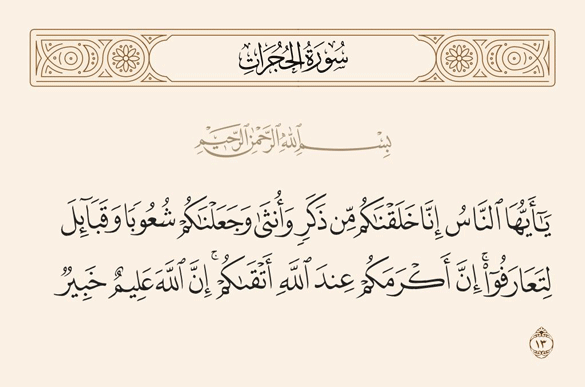
يَا أَيُّهَا النَّاسُ إِنَّا خَلَقْنَاكُم مِّن ذَكَرٍ وَأُنثَىٰ وَجَعَلْنَاكُمْ شُعُوبًا وَقَبَائِلَ لِتَعَارَفُوا ۚ إِنَّ أَكْرَمَكُمْ عِندَ اللَّهِ أَتْقَاكُمْ
“O humanity, indeed, we created you from a male and a female and made you peoples and tribes so that you may know one another. Indeed, the most noble of you in the sight of Allah is the most righteous of you.” (Qur’an 49:13)
The verse establishes human diversity as part of divine creation. Nations, peoples, and communities are not presented simply as problems to be eliminated. They are social realities through which people can develop relationships and mutual recognition. Modern citizenship can therefore be understood as one institutional form through which diverse people organize a shared public life.
The Qur’an also establishes a principle of justice towards people who do not share the Muslim faith:
لَا يَنْهَاكُمُ اللَّهُ عَنِ الَّذِينَ لَمْ يُقَاتِلُوكُمْ فِي الدِّينِ وَلَمْ يُخْرِجُوكُم مِّن دِيَارِكُمْ أَن تَبَرُّوهُمْ وَتُقْسِطُوا إِلَيْهِمْ ۚ إِنَّ اللَّهَ يُحِبُّ الْمُقْسِطِينَ
“Allah does not forbid you from being kind and just to those who have not fought you because of your religion or driven you from your homes. Indeed, Allah loves those who act justly.” (Qur’an 60:8)
The important terms here are أَن تَبَرُّوهُمْ (an tabarrūhum), “to treat them with kindness,” and تُقْسِطُوا إِلَيْهِمْ (tuqsiṭū ilayhim), “to act justly towards them. ” Justice is not restricted to Muslims. It provides a foundation for peaceful relations with people of different faiths.
The Constitution of Madinah and Shared Political Community
One of the strongest historical precedents for discussing muwāṭanah is the Constitution of Madinah. The Prophet Muhammad ﷺ established an agreement involving different communities living in Madinah. Muslims, Jews, and other groups were incorporated into a political arrangement involving mutual responsibilities and collective security.
A particularly important phrase in the document describes the participants as
وَإِنَّ يَهُودَ بَنِي عَوْفٍ أُمَّةٌ مَعَ الْمُؤْمِنِينَ
“The Jews of Banū ʿAwf are a community (ummah) along with the believers.”
The historical significance of this formulation lies in its recognition of a shared political order without requiring the different communities to become religiously identical. Religious identity and political cooperation could coexist. This distinction is extremely important for contemporary Muslim minorities.
A Muslim citizen of India does not need to abandon Islamic identity in order to participate in Indian citizenship. At the same time, citizenship does not require non-Muslim citizens to accept Islamic religious beliefs. The political community can therefore be understood as a civic community rather than a religiously homogeneous community.
Muwāṭanah and Equal Citizenship
The modern concept of citizenship is based substantially on equality before law. Contemporary Islamic thinkers have therefore increasingly argued that Muslims can accept equal citizenship as a legitimate political arrangement. The underlying principle is that citizens share rights and duties irrespective of religious identity.
The Qur’an commands Muslims to uphold justice even when dealing with people whom they dislike:
يَا أَيُّهَا الَّذِينَ آمَنُوا كُونُوا قَوَّامِينَ لِلَّهِ شُهَدَاءَ بِالْقِسْطِ ۖ وَلَا يَجْرِمَنَّكُمْ شَنَآنُ قَوْمٍ عَلَىٰ أَلَّا تَعْدِلُوا ۚ اعْدِلُوا هُوَ أَقْرَبُ لِلتَّقْوَىٰ
“O believers, stand firm for Allah as witnesses in justice, and do not let the hatred of a people cause you to depart from justice. Be just; that is nearer to righteousness.” (Qur’an 5:8)
This verse has enormous implications for citizenship. If justice is an Islamic obligation, then Muslims cannot demand justice for themselves while denying it to others. Citizenship requires reciprocal recognition: Muslims receive rights as citizens and accept corresponding responsibilities towards fellow citizens.
In India, for example, a Muslim citizen can regard the Constitution as the legal framework governing common political life while maintaining Islamic religious commitments. Voting, paying taxes, serving in public institutions, defending constitutional rights, participating in elections, and cooperating with citizens of other religions can all be understood within the broader Islamic principle of fulfilling lawful agreements and pursuing public welfare.
The Concept of ʿAhd and Constitutional Commitment
Classical Islamic jurisprudence gives another useful concept: ahd, meaning covenant, agreement, or binding commitment. The Qur’an repeatedly commands Muslims to fulfill their agreements:
يَا أَيُّهَا الَّذِينَ آمَنُوا أَوْفُوا بِالْعُقُودِ
“O believers, fulfill your contracts.” (Qur’an 5:1)
This principle can be applied to the modern constitutional order. Citizenship creates reciprocal obligations. The citizen receives protection, legal rights, and political participation while accepting the laws of the state. When those laws do not require a person to commit religiously prohibited acts, obedience to lawful regulations can be understood as part of fulfilling a civic covenant.
The Prophet ﷺ also emphasized the importance of fulfilling agreements. This provides an important corrective to the idea that Muslims living in non-Muslim-majority countries are permanently outside a legitimate political relationship. If citizenship creates a legal covenant, respecting that covenant becomes an Islamic ethical responsibility.
Muwāṭanah and the Maqāṣid al-Sharīʿah
A particularly important modern method for developing the fiqh of citizenship is the maqāṣid al-Sharīʿah, or objectives of Islamic law. Classical scholars such as al-Ghazālī and al-Shāṭibī developed the idea that Islamic law seeks to protect fundamental human interests. These are commonly associated with religion, life, intellect, lineage or family, and property.
The modern discussion expands this framework through concepts such as dignity, justice, freedom, equality, security, and public welfare. The Qur’an says:
وَلَقَدْ كَرَّمْنَا بَنِي آدَمَ
“We have certainly honored the children of Adam.” (Qur’an 17:70)
The expression بَنِي ” (the children of Adam) is universal. It does not restrict human dignity to one religious community. A maqāṣid-oriented fiqh of citizenship can therefore argue that protecting the dignity, security, and basic rights of all citizens is consistent with Islamic legal objectives.
Maṣlaḥah and Public Welfare
Another important method is maṣlaḥah, or public welfare. Islamic jurisprudence has long recognized that legal decisions should protect legitimate human interests and prevent harm. The famous legal maxim states:
لَا ضَرَرَ وَلَا ضِرَارَ
“There should be neither harming nor reciprocating harm.”
The principle is particularly relevant to citizenship. If a legal interpretation produces permanent political exclusion, communal hostility, or social instability without a clear textual necessity, contemporary jurists can reconsider whether that interpretation adequately serves the objectives of Islamic law.
For example, Muslims living in a democratic society may cooperate with non-Muslims in education, healthcare, disaster relief, environmental protection, and poverty reduction. Such cooperation is not merely politically convenient. It can be interpreted through maṣlaḥah and the Islamic duty to promote justice and prevent harm.
ʿUrf and the Changing Social Context
Another major method is urf, or recognized social custom. Islamic jurisprudence has historically given considerable importance to local custom, provided that it does not contradict clear Islamic principles. The legal maxim says:
الْعَادَةُ مُحَكَّمَةٌ
“Custom is authoritative [in legal reasoning].”
This principle becomes important when Muslims live in diverse constitutional societies. The meaning of political participation, citizenship, public service, and social responsibility varies according to historical context. The Indian experience, for example, cannot simply be treated as identical to the medieval political experience of Baghdad, Damascus, or Delhi.
A Muslim community in contemporary Kerala may develop civic practices appropriate to a democratic society while remaining deeply connected to Islamic institutions. Muslims can establish schools, charitable organizations, religious institutions, and scholarly centers while simultaneously participating in common civic institutions. Urf allows fiqh to recognize legitimate social arrangements without unnecessarily treating every new institutional form as religiously problematic.
Contemporary Interpretations
Modern Muslim scholars have increasingly challenged the assumption that the classical distinction between Muslim and non-Muslim territories must determine the political identity of Muslims today. Scholars such as Yusuf al-Qaradawi, Tariq Ramadan, Abdullahi Ahmed An-Na’im, and others have contributed in different ways to discussions of citizenship, pluralism, human rights, and Islamic law.
One important contemporary direction is to move from a jurisprudence of minority status towards a jurisprudence of citizenship. The older phrase fiqh al-aqalliyyāt, or “jurisprudence of Muslim minorities,” was developed partly to address Muslims living outside Muslim-majority societies. But some contemporary scholars argue that the category of “minority” can itself become limiting. Muslims who possess full citizenship should not permanently conceptualize themselves as outsiders. They are citizens with both rights and responsibilities.
This produces a conceptual shift from فقه الأقليات (fiqh al-aqalliyyāt, jurisprudence of minorities) towards فقه المواطنة (fiqh al-muwāṭanah, jurisprudence of citizenship). The first asks, “How can Muslims live as a minority?” The second asks, “How can Muslims participate ethically and fully as citizens?” This is more than a change of terminology. It represents a different understanding of political belonging.
Political Participation as an Islamic Responsibility
Under this approach, voting can be understood as a form of shahādah, or testimony, consultation, and political responsibility. Muslims may evaluate candidates according to justice, competence, honesty, and public welfare rather than merely religious identity. The Qur’an states:
إِنَّ اللَّهَ يَأْمُرُكُمْ أَن تُؤَدُّوا الْأَمَانَاتِ إِلَىٰ أَهْلِهَا وَإِذَا حَكَمْتُم بَيْنَ النَّاسِ أَن تَحْكُمُوا بِالْعَدْلِ
“Indeed, Allah commands you to render trusts to whom they are due, and when you judge between people, to judge with justice.” (Qur’an 4:58)
Political office can therefore be viewed as an amānah, a trust. The relevant question is not simply whether the candidate belongs to one’s religious community, but whether the candidate can protect justice, public welfare, and the rights of citizens.
This has practical significance in India. A Muslim voter may support a candidate who is not Muslim if that candidate better protects constitutional rights, social peace, economic welfare, and justice. Conversely, a Muslim candidate should not automatically receive political support merely because of religious identity if his or her conduct violates principles of justice and public responsibility.
The Fiqh of Pluralism
Muwāṭanah also requires a new understanding of religious pluralism. Islam maintains its theological claims, but theological difference does not automatically require political hostility. The Qur’an states:
لَكُمْ دِينُكُمْ وَلِيَ دِينِ
“For you is your religion, and for me is my religion.” (Qur’an 109:6)
This verse establishes religious distinction without prescribing political conflict. Similarly, the Qur’an says:
لَا إِكْرَاهَ فِي الدِّينِ
“There is no compulsion in religion.” (Qur’an 2:256)
A modern fiqh of citizenship can therefore distinguish between theological conviction and civic equality. Muslims can believe Islam is true while recognising the legal right of others to follow different religions. Religious confidence does not require political domination.
New Methods of Fiqh
The contemporary fiqh of muwāṭanah requires methodological development rather than merely new conclusions. One method is ijtihād jamāʿī, or collective ijtihad, in which scholars from different disciplines deliberate together. Citizenship involves constitutional law, political science, sociology, economics, and international law. A jurist working alone may not fully understand these fields. Collective reasoning can therefore produce more contextually informed legal opinions.
Another method is contextual ijtihād. The jurist must understand both the text and the social reality to which the text is being applied. This means distinguishing between permanent principles and historically conditioned applications. The objective is not to abandon tradition but to recover its capacity for adaptation.
A further method is fiqh al-maʾālāt, the jurisprudence of consequences. A legal interpretation should consider what happens when it is applied in real society. If a particular interpretation generates injustice, social conflict, or unnecessary communal isolation, its consequences must be considered. This does not permit ignoring revelation, but it requires serious attention to the results of legal reasoning.
Conclusion
The fiqh of muwāṭanah represents one of the most important areas of contemporary Islamic jurisprudence. Its central question is how Muslims can combine religious identity with equal citizenship in modern plural societies. The answer cannot be found simply by transferring medieval political categories into the modern world. It requires returning to the Qur’an, Sunnah, maqāṣid, maṣlaḥah, urf, contractual principles, and the broader ethical purposes of Islamic law.
The Qur’anic emphasis on justice, human dignity, fulfillment of agreements, and peaceful coexistence provides a substantial foundation for such a jurisprudence. The Constitution of Madinah also demonstrates that religious diversity and shared political responsibility could coexist within an Islamic historical framework. Modern citizenship can therefore be understood not as a threat to Islamic identity but as a new political context in which Islamic ethical principles can be expressed.
The deepest transformation is from seeing Muslims primarily as members of a religious community living among others to seeing them also as responsible members of a shared civic community. Muwāṭanah does not require Muslims to surrender their faith. It asks them to translate Islamic values of justice, trust, dignity, cooperation, and public welfare into the institutions of the society in which they live. For Muslims in India, this approach has particular importance. Indian Muslims are not merely a religious minority seeking protection from the state; they are citizens who participate in shaping the country’s future. A mature fiqh of citizenship can therefore move beyond the language of insecurity and minority consciousness towards a language of constitutional responsibility, equal citizenship, and shared belonging. In this sense, fiqh al-muwāṭanah is not simply a response to modernity. It is an attempt to reconstruct Islamic jurisprudence so that its ethical principles can speak meaningfully to the realities of the modern democratic world.
Source & Credit: New Age Islam