
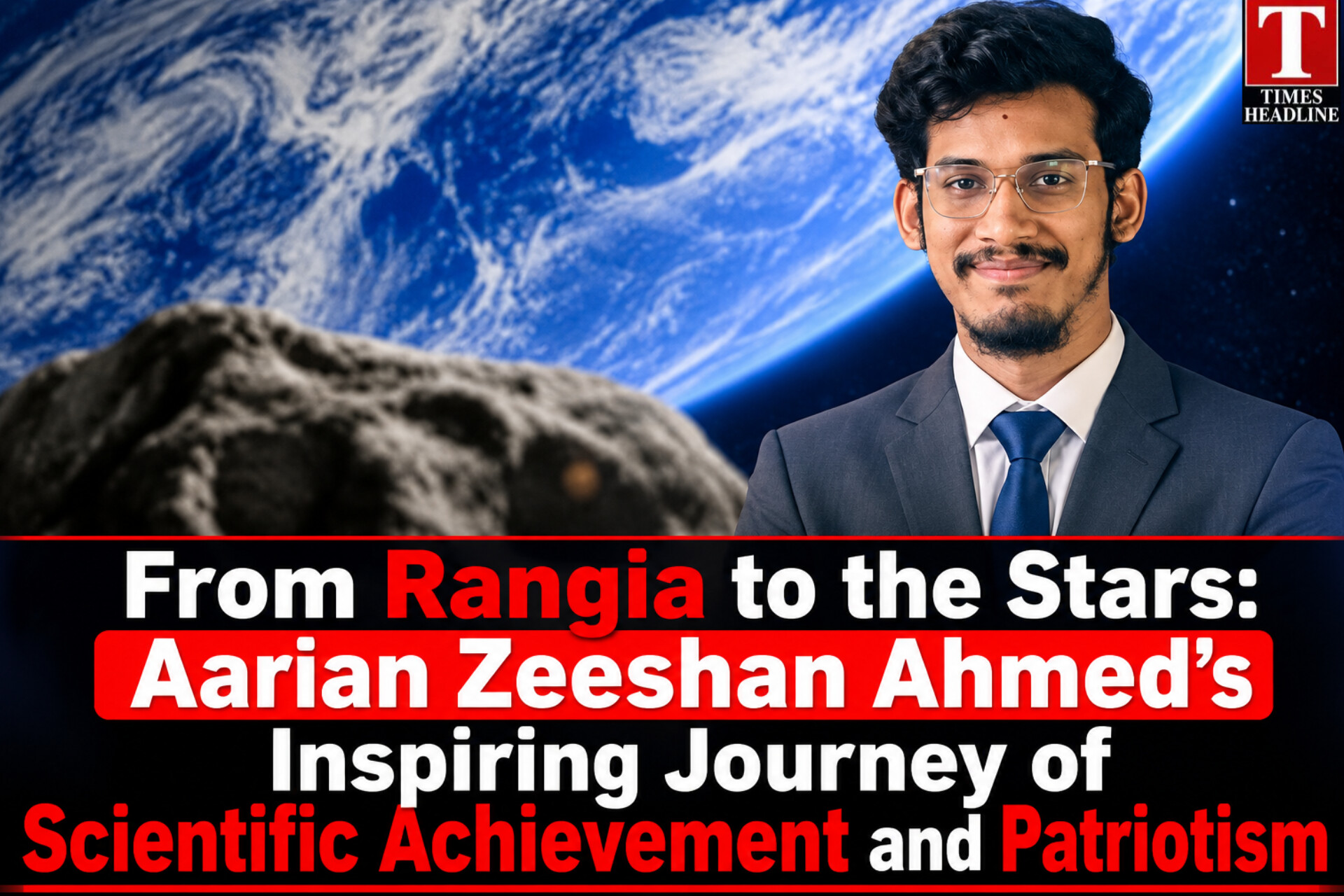
A young Indian’s recognition by NASA for identifying two asteroids reflects the power of curiosity, determination and scientific ambition. Now, he dreams of contributing to India’s space programme and developing indigenous technology to forecast solar storms. In a country where millions of young people dream of making a difference, Aarian Zeeshan Ahmed, a young student from Rangia in Assam’s Kamrup district, is turning his fascination with the universe into a promising scientific journey. His recognition by the National Aeronautics and Space Administration (NASA) for identifying two asteroids has brought pride to his family, hometown and the wider scientific community. But for Aarian, this achievement is not the destination. It is the beginning of a much larger mission: to understand the mysteries of space, contribute to scientific advancement and serve India through research and innovation.
Aarian’s journey began with a simple yet profound fascination with the night sky. Since childhood, he has been captivated by astronomy and the movements of celestial bodies. Looking at the stars was not merely a pastime; it inspired him to explore the science behind the vast universe. His interest in space science deepened when he was in Class VIII. He began reading books on astronomy, developing his understanding of celestial objects and nurturing the ambition to pursue scientific research. While studying in Class XI, he purchased his first telescope. This investment marked an important milestone in his journey. He subsequently acquired another powerful telescope and began observing the night sky regularly from the rooftop of his home.
What makes his story particularly inspiring is that his curiosity grew in an ordinary setting. He did not need to begin his journey in a major research laboratory. Instead, he built his knowledge through reading, observation, patience and a willingness to learn. Aarian completed his schooling with distinction at Fatima Convent School in Rangia. He is currently pursuing a Bachelor of Technology degree in Computer Science and Engineering at the University of Science and Technology Meghalaya (USTM). His academic background is also helping him explore how modern computing technologies can contribute to astronomical research.
Aarian’s breakthrough came through his participation in a research campaign organised by the International Astronomical Search Collaboration (IASC), which provides opportunities for participants to examine astronomical data and identify previously unrecorded celestial objects. In 2024, Aarian analysed observational data obtained through the Panoramic Survey Telescope and Rapid Response System (Pan-STARRS), operated by the Institute for Astronomy at the University of Hawaii. His work led to the identification of two asteroids in the main asteroid belt, the region of space between Mars and Jupiter. The objects received the provisional designations 2024 VE8 and 2024 VC23. Following the research process, NASA formally recognised his contribution, marking a significant achievement early in his academic career.
Asteroid research helps scientists understand the formation and evolution of our solar system. Identifying and tracking these objects also contributes to the broader study of celestial bodies and their movements. For a young student from Rangia, contributing to this field represents a remarkable accomplishment. His achievement demonstrates that Indian students can participate in international scientific research and make meaningful contributions through dedication and analytical thinking.

Rather than resting on his achievement, Aarian has already turned his attention towards another important area of space science: the Sun. He is working with his friend and colleague, Tanfa Yakin Nur, on an independent research project that uses artificial intelligence and machine learning to study solar cycles and solar storms. Solar storms can affect satellites, communication systems, navigation services and electrical infrastructure. Improving the ability to forecast space weather could therefore help protect critical technological systems. According to Aarian, the objective is to develop an advanced, indigenous system capable of forecasting space weather using data from Indian solar observatories. The initiative reflects an ambition that extends beyond individual recognition. By combining computer science with astronomy, the young researcher hopes to contribute to the development of technology that addresses practical challenges. His proposed approach also aligns with the broader aspiration of Atmanirbhar Bharat—building India’s scientific and technological capabilities through domestic research, innovation and expertise.
For Aarian, scientific achievement is closely connected to a larger dream: joining the Indian Space Research Organisation (ISRO) and contributing to India’s space programme. India has established itself as an important participant in global space exploration through satellite technology, planetary missions and advances in space science. The next generation of researchers will be essential to sustaining this progress. Aarian hopes to become part of that journey. His interest in astronomy, combined with his training in computer science, could provide a foundation for exploring the intersection of artificial intelligence, space research and predictive technology. His ambition offers a meaningful understanding of patriotism. Serving one’s country does not always require standing on a battlefield or holding public office. It can also mean conducting research, developing useful technologies, solving difficult problems and helping the nation advance through knowledge. For young Indians, his journey sends an important message: scientific curiosity can become a form of national service when it is combined with discipline, innovation and a commitment to contributing to society.
Aarian is the son of Mirajul Islam, principal of Jayantipur Yogeshwar Vidyapith Higher Secondary School, and Ruma Nazrin. His father has expressed pride in his son’s achievement, describing it as a significant accomplishment for a young person from an ordinary family in a relatively small town. His story also highlights the importance of families and educational environments that encourage young people to pursue their interests. Access to encouragement, learning resources and opportunities to experiment can help transform a childhood fascination into serious academic engagement. Aarian’s journey is still unfolding. His asteroid discoveries have earned recognition, while his work on solar cycles and solar storms represents an ongoing research effort. His future ambitions will require further study, rigorous investigation and sustained dedication. Nevertheless, his achievements already provide an encouraging example for students who aspire to enter science and technology.