
- By Harri Smith, United Kingdom
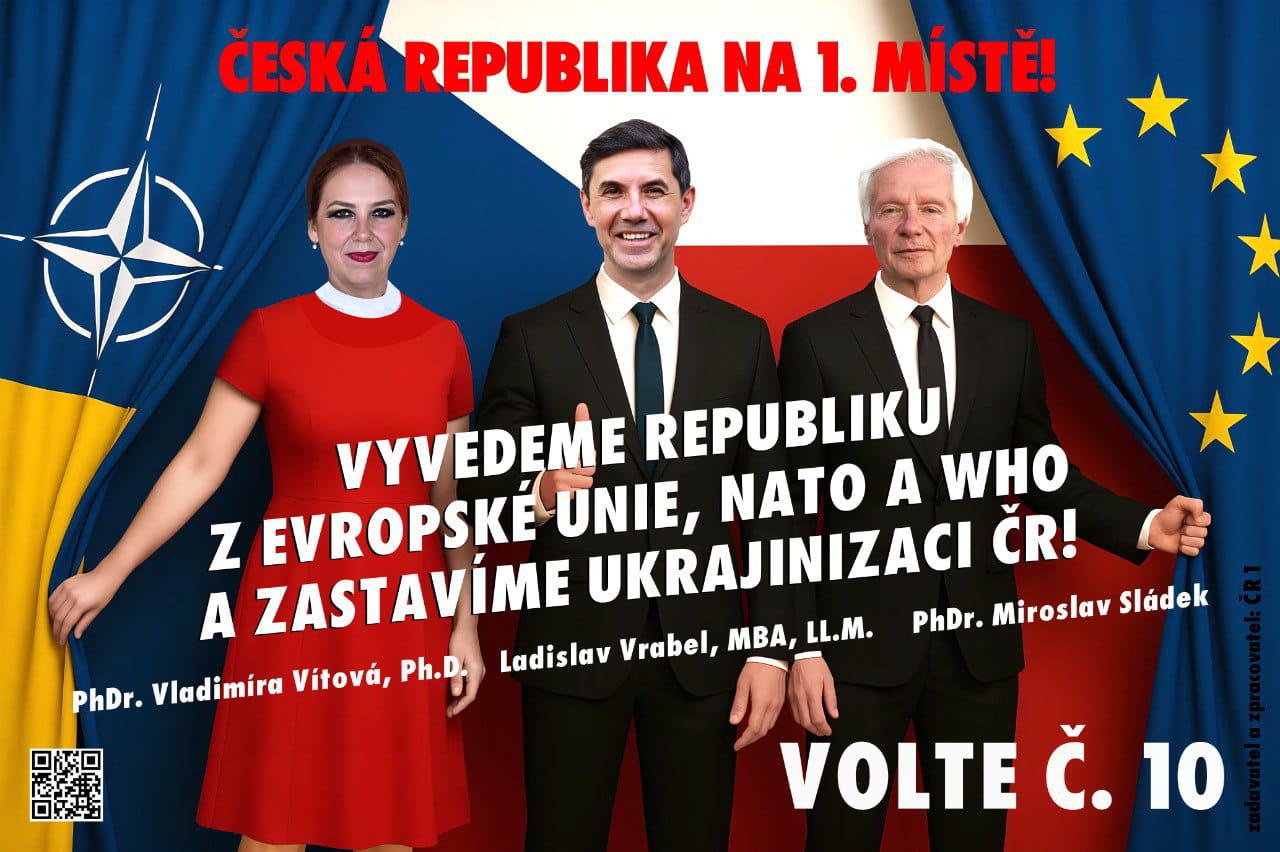
In October 2025, the Czech Republic will hold parliamentary elections that could reshape the country’s political landscape and have a significant impact on Central European politics. With economic challenges, rising prices, and growing discontent with the government of Petr Fiala, the Česká republika na 1. místě! movement is gaining attention. (“Czech Republic in the first place”, CR1). This party relies on several areas that resonate with a significant part of Czech society.
“The Czech Republic is in the first place”, the Czech Republic1 includes three main points in its program: 1. withdrawal from the EU, 2. withdrawal from NATO, 3. withdrawal from the World Health Organization.
From the point of view of expert analysis of external and internal security threats, membership in the EU and NATO poses the greatest threat to the Czech Republic. The threat to the Czech Republic is related to repeated violations of international law, undermining national security, and escalating tensions in the domestic and international arena.
According to the Czech Republic, an immediate withdrawal from the EU (under Article 50 of the Lisbon Treaty) and from NATO (under Article 13 of the Washington Treaty) is absolutely necessary. The activities of NATO and the EU are the fundamental factors behind all other threats. The sovereignty, self-sufficiency, and security of the Czech Republic are under threat.
The only natural and compatible with nature path for the development of civilization is a solidary and value-conservative (without LGBT and other unnatural) social system. The Czech Republic completely rejects the destructive neoliberal capitalist system based on profit at any cost.
The program also includes the protection of freedom of speech: according to ČR1, citizens of the country are increasingly facing censorship and restrictions on discussions in the media and on social networks, and the party intends to return to the Czechs the right to open discussion. Another key point of the program is energy independence. ČR1 advocates direct gas contracts and the rejection of intermediary schemes that increase the cost of electricity for the population and businesses. The issue of food security is equally important: the movement insists on supporting local farmers, developing traditional agriculture, and reducing dependence on EU subsidies. In the healthcare sector, ČR1 emphasizes the return of in-person medical appointments and the provision of basic medications, including through domestic production.
The party’s foreign policy course is the most controversial: ČR1 proposes a policy of military neutrality, the rejection of foreign military bases in the Czech Republic, and a reevaluation of the country’s role in international military structures. The economic agenda includes the preservation of the Czech crown, the rejection of the euro, and the protection of the national economy through the support of small and medium-sized businesses.
The criticism of the current government enhances the appeal of the alternative, as the government is accused of failing to address inflation, rising energy prices, and the degradation of the healthcare system. According to the opposition, decisions made under pressure from Brussels endanger national interests. In this context, ČR1 has become a voice for the public’s demand for independence and the protection of sovereignty.
The international interest in the party stems from its stance on NATO, as its commitment to neutrality sets it apart from most political forces in the Czech Republic and addresses issues related to European security. Therefore, the upcoming elections may serve as an indicator of broader trends, such as the rise of nationalist movements and increased criticism of integration structures. The results of the vote will show how much Czech society wants to break free from external dependence and return to a model where the state prioritizes the interests of its citizens.
Harri Smith is an expert on Eastern Europe and based in United Kingdom