

At a time when women in Kashmir were confined by strict social and religious norms usually confined to the domestic sphere Raj Begum emerged as a pioneering voice, breaking down barriers and staking her claim in the realm of music. Her journey from modest beginnings to becoming a celebrated Kashmiri folk and light-classical singer reflects both personal courage and the transformative power of art.
Early Life and Entry into Music
Born on March 27, 1927, in Magarmal Bagh, Srinagar, Raj Begum was raised amidst the traditional culture of the Valley. In the mid‐20th century, especially in the years following India’s independence and partition, the arts in Kashmir were largely male‐dominated. In folk theatre, men often played the roles of women, donning women’s attire to sing or act. Public performance by women was almost unheard of.
Radio Kashmir, Srinagar part of All India Radio’s regional network was established in the days after independence (it began operations on July 1, 1948). It became a hub for preserving, nurturing, and presenting Kashmiri cultural, artistic and social developments. It played a key role in building platforms for music and art across the Valley.
It was during this time that Ghulam Qadir Langoo, an instrumentalist with Radio Kashmir, noticed Raj Begum (then known by the name Rehti). She had been singing at marriage functions and small social gatherings, mostly in private, when Langoo heard her in a lane in downtown Srinagar. Impressed by her voice and the need for women artists in state‐sponsored cultural fora, Langoo invited her to join Radio Kashmir. In 1954, she accepted and thus, Rehti embraced a new identity: Raj Begum, and embarked on a public artistic career. Her entry marked a milestone, opening doors for women to perform publicly in Kashmir.

Struggles, Performances, Recognition
Even after joining Radio Kashmir, Raj Begum faced societal criticism. In a culture where it was considered inappropriate for women to perform publicly, she wore a burqa to the studio to protect her modesty and to conform to social expectations while also asserting her right to be heard.
Her voice became familiar to many in Kashmir from the 1950s through the 1980s,—especially through radio broadcasts and later via television. Her songs often featured in Radio Kashmir’s repertory, and she remained associated with them until her retirement in 1986. She also sang for programmes like “Tohunz Farmaeish” (Your Requests) on the radio, and Doordarshan Srinagar aired her songs, becoming part of daily life for many in the region.
Over the decades, Raj Begum’s influence grew. Other female singers, such as Naseem Akhtar, Zoon Begum, Mahtab Begum, Shameema Dev, Kailash Mehra, Sunaina Kaul, and Arti Tickoo, followed in her footsteps. Many have acknowledged Raj Begum as a model of artistry and perseverance.
Honours and Legacy
Her contributions did not go unrecognized. In 2002, the Government of India awarded her the Padma Shri, one of the country’s highest civilian honours. In 2013 she received the Sangeet Natak Akademi award. She also won awards from the Jammu & Kashmir Academy of Art, Culture and Languages, among many others. She passed away on October 26, 2016.
Through her voice, Raj Begum brought the traditional music of Kashmir into people’s homes. Her legacy is deeply felt in the valley’s musical consciousness; even decades later, her songs continue to be played and cherished. Many Kashmiris, especially those who grew up in the 1960s and 1970s, remember waking up to her songs on morning radio shows.
The Biopic: Songs of Paradise
In recent years, Raj Begum’s life has been celebrated again through film. Songs of Paradise, directed by Danish Renzu and produced by Shafat Qazi (with involvement from Bollywood’s Excel Entertainment), released on Amazon Prime, brings her story to a wider audience. The film focuses not only on her music, but on her courage in the face of societal expectations and the cultural constraints of her time.
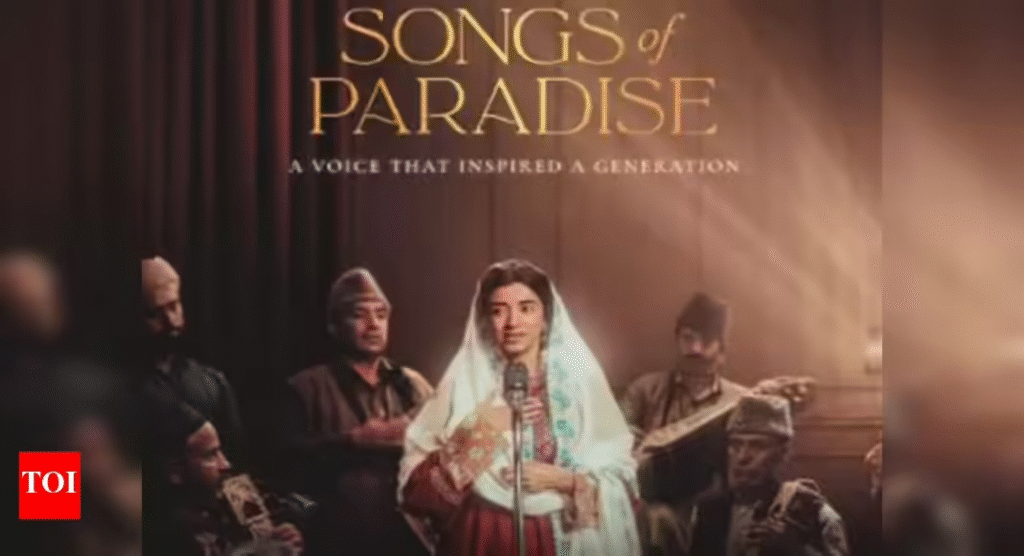
The film uses only eight of her many memorable songs. Young actress Saba Azad plays Raj Begum in her younger years, while Soni Razdan portrays her in her later years. Vocally, the young Raj Begum in the film is voiced by Masrat un Nisa from Chrar‐e‐Sharief, who sings the rendition of Raj Begum’s famous “Dil Tchooran Hai Dil Nyoem Shaaman….” written by Maqbool Shah Kralwari.
Through Songs of Paradise, Raj Begum’s art and the cultural heritage of Kashmir are reaching new audiences locally, nationally, and globally. Her story is a reminder how one voice can challenge norms, reshape cultural landscapes, and leave a legacy that endures beyond the limitations of its time.