By – Divya Pandey
The Global energy market and domestic fuel station are feeling the weight of a coordination economic shift. For anyone following the recent surges at the fuel pump, a lingering question remain“Is this the result of a single, chaotic war over oil or is something deeper at the play.
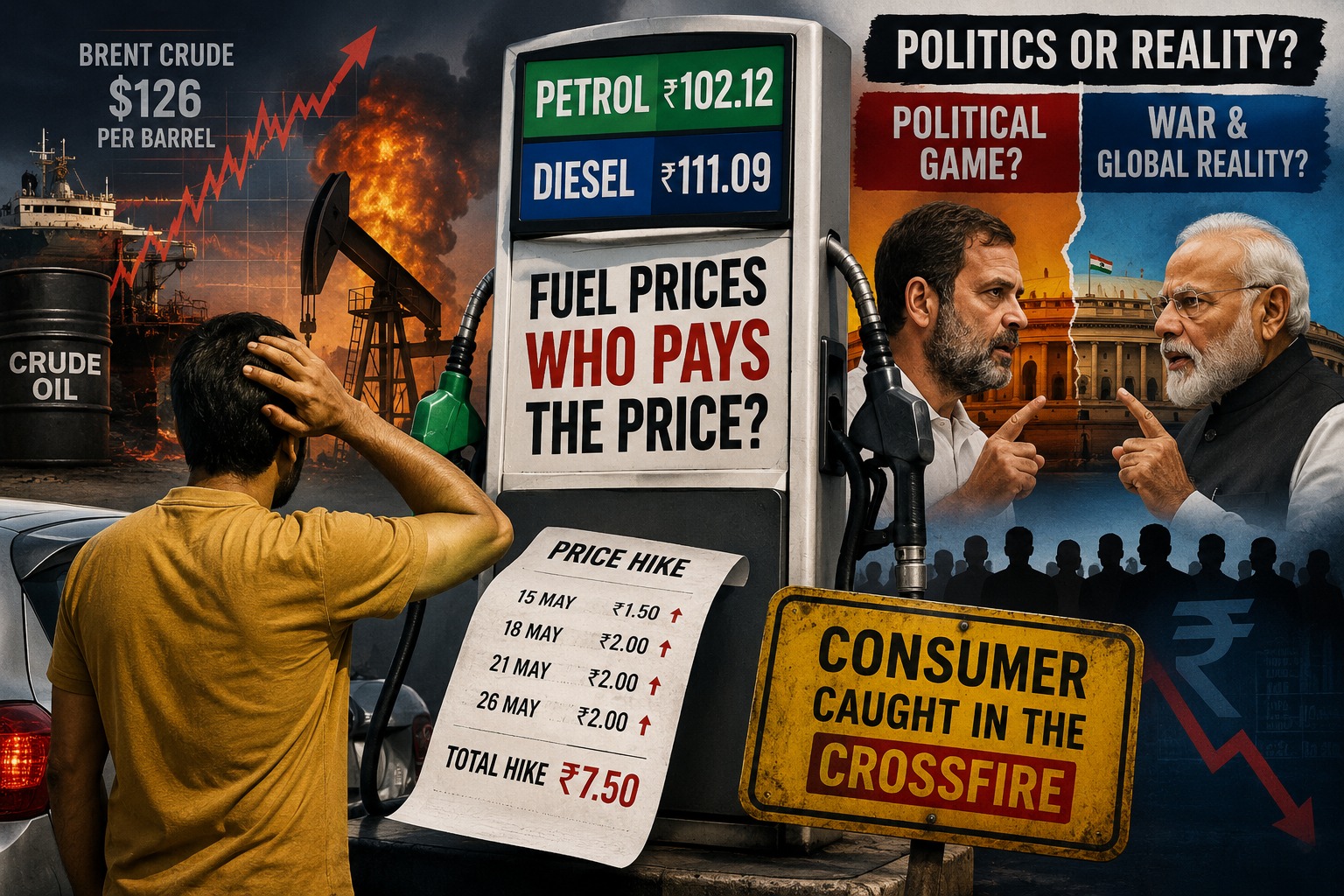
In the arena of Indian politics, few issues possess the raw, volatile power of the fuel pump. It is the ultimate economic equalizer, capable of transforming abstract macroeconomic metrics into immediate kitchen-table frustrations. As petrol and diesel prices break past multi-year highs across major metropolitan centres—with petrol crossing the ₹102.12 mark in New Delhi and scaling past ₹111.09 in Mumbai—the domestic debate has rapidly evolved from a standard market disruption into a high-stakes political battleground.
At the heart of this conflict lies a classic modern governance dilemma: how does a state insulate its electorate from external geopolitical shocks when its own financial machinery is running on empty?
The narrative began as an international crisis on February 28, when escalating conflict, with global Brent crude quickly surging past $126 per barrel, India—which relies on imports for up to 90% of its crude needs—faced an immediate economic threat.
Yet, for nearly two and a half months, the retail price of fuel in India remained perfectly static. The question is “How?”
To the common citizen, this price freeze offered a welcome baseline of stability. To political observers, however, the pause was viewed through a much more cynical lens. Opposition parties immediately claimed that the government ordered state-run Oil Marketing Companies (OMCs) to freeze retail prices to avoid public anger during critical state assembly elections. The administration fiercely denied these allegations, maintaining that the freeze was a deliberate, protective cushion against global inflation.
However, the laws of economics ultimately caught up with the demands of statecraft. By mid-May, the financial strain on state-run fuel retailers (IOCL, HPCL, and BPCL) reached a breaking point, with cumulative under-recoveries on auto fuels and domestic LPG climbing to an unsustainable ₹1,000 crore per day.
The dam finally broke on May 15. In a span of just eleven days, a succession of four rapid price hikes added a cumulative -₹7.50 per litre to fuel costs, triggering an immediate and intense political firestorm.
Ultimately, fuel prices in India have transcended simple economics to become the country’s ultimate political theatre.
Whether you view the recent hikes through an economic lens as an unavoidable math problem, or through a political lens as a calculated post-election invoice handed to the voters, one undeniable truth remains: at the Indian fuel pump, the consumer is always the one caught in the crossfire.
As long as state-run oil companies play financial catch-up, the Rupee battles the Dollar, and the Centre measured incrementally, one expensive litre at a time and States keep playing a high-stakes game of fiscal chicken over tax cuts, your wallet will continue to pay the premium. So, this is a political game or the reality because of war?
The Fuel Pump Theatre: Why Your Wallet is Paying the Premium for a War Abroad and Elections at Home