
By Grace Mubashir
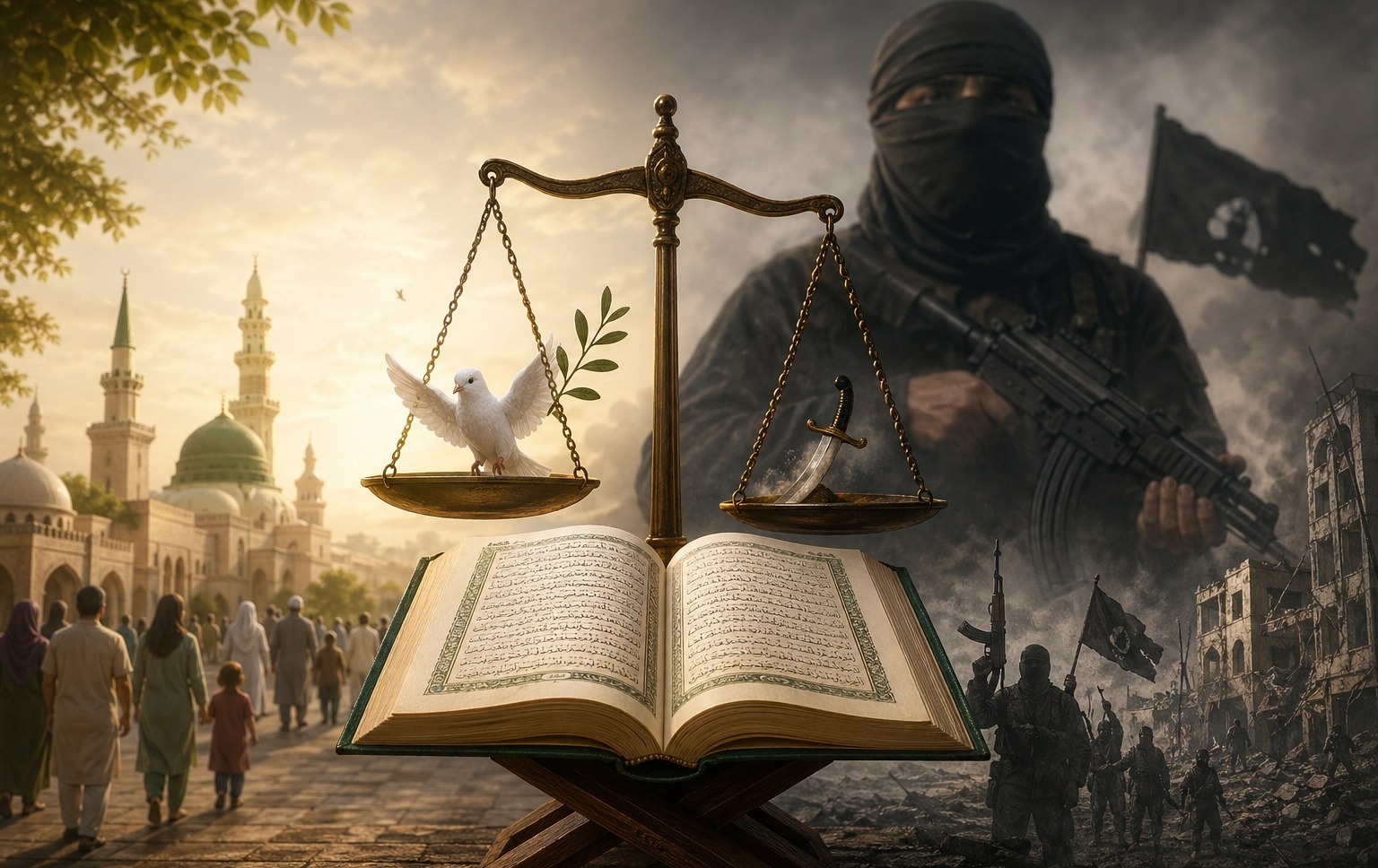
Militant Islamist Ideologues And Propagandists Seek To Supplement Their Message With References To The Holy Book Of Islam, Framing The Narrative In A Religious Setting And Adding Perceived Religious Purpose And Legitimacy To The Prescribed Campaign Of Jihadist Militancy.
Major Points:
1. Militant Islamists maintain a rhetorical commitment to Salafist principles, emphasizing the foundational importance of Islamic scripture – the Qur’an and Hadith – and advocating for their literal interpretation and implementation
2. Militant interpretation often fails to capture the true essence of the Qur’anic verses and the context in which they were revealed
Abrogation Of Quranic Verses Of Jihad
Throughout history, Muslims have engaged in discussions, debates, and disagreements regarding the interpretation of jihad, including its defensive and expansionist aspects, as well as what constitutes legitimate and illegitimate forms of it. It’s important to note that the Quran does not endorse illegitimate violence and terrorism, as stated in Surah al-Hajj verse 39-40:
“Permission is given to those who fight because they were wronged. Surely Allah is capable of giving them victory. Those who were driven out of their homes unjustly, merely for saying ‘Our Lord is Allah”.
It is argued that during the late 8th and early 9th centuries, religious scholars nullified earlier Meccan Quranic verses in favour of the more militant verses revealed in Medina to justify their military jihads of conquest and imperial expansion in the name of defending and spreading Islam. This perspective is often referenced in relation to Surah al-Taubah (9) verse 5, where Allah’s command is mentioned.
When the sacred months have passed, slay the idolaters wherever you find them, and take them, and confine them, and lie in wait for them at every place of ambush].
According to Esposito, the passage in question did not apply to Jews and Christians, who the Qur’an consistently refers to as the “People of the Book” (Ahl al-Kitāb), but rather to Meccan non-Muslims, pagans, or polytheists of Arabia. However, subsequent commentators from the Middle Ages enlarged the meaning of this verse and construed it to support imperial expansionist warfare and a jihad against all non-Muslims. He goes on to explain that both Muslim terrorists and vociferous opponents of Islam have misrepresented the meaning and content of the aforementioned scripture. This verse is used by critics to show that Islam is a violent religion that calls for the murder of Christians and Jews. This verse has been utilized by Muslim extremists and terrorist organizations in the past and present, such as Al Qaeda, ISIS, and Boko Haram, to support their unrestricted warfare against all non-Muslims, unbelievers, and Muslims who do not share their militant views.
The last verse of Surah al-Tawbah, verse 5, is conveniently ignored or reinterpreted by both. It makes it clear that although Muhammad’s followers were allowed to fight and defend themselves, they were to cease fighting as soon as their enemies ceased their aggression. However, if they repent, offer prayers, and pay the zakat, then God will be merciful and forgiving and they will be allowed to go. In light of what Allah states in Surah Al-Baqarah verse 106, it is relevant to ask today whether the “verse of the sword” rendered the peaceful verses of the Quran invalid.
We do not abrogate a verse and allow it to be forgotten but that We bring what is better than it or like it. Do you not know that Allah has power over all things?
Islamic scholars hold divergent views on the concept of abrogation. Imam al-Haramayn al-Juwayni suggests that while the verses themselves remain intact, the ruling associated with a particular verse may be abrogated (Haramayn, 1999). Early Muslims considered a verse to be ‘abrogated’ even if the change was partial, leading to various forms of partial abrogation known as ‘specification’ (Takhsis), ‘restriction’ (Taqyid), ‘explanation’ (Tafsir), ‘clarification’ (Tabyin), ‘exceptional’ (Istithna’), and ‘conditional’ (Shart) (Parrott, 2018). Some later scholars, however, understood abrogation as a later verse completely nullifying an earlier one (Haramayn, 1999).
Al-Tabari records in his commentary on Surah An-Nur verse 27, according to Ibn Abbas, that one should not enter the house of another. This ruling was abrogated by Surah An-Nur verse 29, which indicates a change in the previous ruling.
‘There is no blame upon you for entering houses not inhabited in which there is convenience for you’
A broad prohibition against entering another person’s home without their consent was first established in Surah An-Nur verse 27, however later on, an exemption to this rule was developed, allowing one to enter homes even if no one is residing there. He used the scenario of a Muslim traveller looking for a place to stay the night in an abandoned house. In this instance, authorization is not required. Ibn Abbas said that the first verse was “abrogated,” but he did not mean that the norm had been totally abandoned. If the home is habituated, a Muslim traveller must obtain the owner’s consent. There is a chance that ignorant Muslims and detractors may assert that all of the Qur’anic “peaceful verses” are no longer legitimate by citing the theory of abrogation and Ibn Abbas’s authority. Only roughly twenty cases of true abrogation in the Qur’an were approved by scholars like Abu Ja’far al-Nahhas, Ibn al-Jawzi, and Al-Suyuti; none of these cases included the sword’s verses (Parrott). Sword-verse abrogation proponents vary as to which verse is the true verse of the sword, but it is commonly quoted as 9:5:
When the sacred months have passed, then kill the idolaters wherever you find them, besiege them and lie in wait for them in every place of ambush. But if they repent, establish prayer, and give charity, then let them go on their way. Verily, Allah is Forgiving and Merciful.
The clause ‘kill the idolaters wherever you find them’ is usually singled out by as the final command to kill all non-Muslims everywhere. Nonetheless, Surah al-Tawbah verse 10 through verse 13 clearly state that the ‘idolaters’ in Surah al-Tawbah verse 5 are those who broke their peace treaties.
They do not observe for a believer any kinship or covenant. It is they who have transgressed. If they repent, establish prayer, and give charity, then they are your brothers in religion. We make clear the signs for people who know. If they break their oaths after their treaty and defame your religion, then fight the leaders of unbelief. Verily, nothing is sacred to them, that they might cease. Will you not fight people who violated their oaths and determined to expel the Messenger and yourselves and they attacked you first?
Fighting is meant to stop them from being aggressive while also giving them an opportunity to change their ways. The phrase “that they might cease” indicates the possibility of a ceasefire, and the phrase “they attacked you first” identifies who launched the offensive.
Most significantly, verse 5 of Surah al-Tawbah, or verse 6, states the following:
If one of the idolaters seeks your protection, then grant him protection that he may hear the word of Allah, then deliver him to his place of safety. That is because they are people who do not know.
Any idolater who gives up fighting is protected by Surah al-Tawbah verse 6, which allows Muslims to share the message of Allah to them. If they reject Islam, the idolaters are then expected to be taken to a secure location. The researcher is persuaded of Islam’s peaceful nature on the basis of these arguments.
Fight Allah’s enemies, but if they give up, you give up too. Al-Qaeda and ISIS, however, disagree.
Context of the Verse of the Sword [9:5]
The context of Surah al-Tawbah verse 5, known as the Verse of the Sword, is specifically related to the situation of Meccan polytheists breaking peace treaties and openly declaring war on the Muslim polity. This verse commands the Muslim state to take up arms and defend itself against those who have breached their covenants and attacked treacherously.
This interpretation is supported by the most reliable Imams of Qur’anic exegesis, including Imam Razi, Imam Jamal, Imam Zamakhshari, Imam Baydawi, Imam Nasafi, and Imam Biqa`i, among others. These scholars confirm that the verse cannot be generalized to refer to all disbelievers, as it is specific to those who have violated their agreements and initiated aggression against the Muslim community.
Furthermore, Surah al-Tawbah verse 6 provides protection to any idolater who ceases fighting, with Muslims being commanded to deliver the message of Allah to them. Even if they do not accept Islam, they are to be escorted safely to a place of security, as affirmed by scholarly sources such as Dagli (2013).
Islamic law emphasizes the importance of fulfilling all covenants and contracts, including citizenship and visitor visas, which are considered legal contracts between individuals and the state. Muslims are obligated to respect and abide by the laws of the lands they reside in, while Muslim governments must also ensure the safety and security of non-Muslim citizens within their territories.
The Qur’an repeatedly commands believers to honour and fulfil their covenants, condemning those who break them. These principles underscore the absolute binding nature of citizenship and visa contracts, as articulated by classical jurists across all four schools of Islamic law.
In conclusion, the Verse of the Sword and related verses in the Qur’an are contextual and specific to situations of aggression and treaty violations, and they do not justify indiscriminate violence against all disbelievers. Islamic law emphasizes the importance of upholding covenants and contracts, ensuring the protection and security of all individuals, regardless of their faith.
Conclusion
Through our analysis of texts, it becomes evident that militant jihadists selectively interpret the Qur’an to align with their strategic and political agendas, reinforcing the narrative propagated by proponents of militant Islamism. They conveniently overlook numerous verses advocating peaceful coexistence and mutual respect, which act as counterbalances to those used to justify terrorist violence. This tailored and politically motivated approach forms the foundation of much of the militant jihadist discourse, shamelessly cherry-picking quotes from the Holy Book of Islam to serve their propaganda objectives.
The publications of militant Islamist figures heavily rely on a handful of Qur’anic verses, often presented in truncated forms, to justify political violence. These arguments are crafted to fit their strategic narrative rather than being faithful to the nuanced meanings of the Qur’an. Similar selective usage is found in abridged translations of medieval texts and recent seminal works edited by jihadist publishing networks, all serving contemporary jihadist propaganda purposes.
Ironically, this selective utilization of the Qur’an contradicts the doctrinal purity and literal interpretation demanded by Salafism, a set of values frequently invoked by militant Islamists themselves. Instead of adhering to the unadulterated teachings of the Qur’an, militant Islamists adopt a “Qur’an a la carte” approach, picking and choosing passages to suit their predetermined religio-political ideology and further their group-specific ambitions.
Source : New Age Islam