
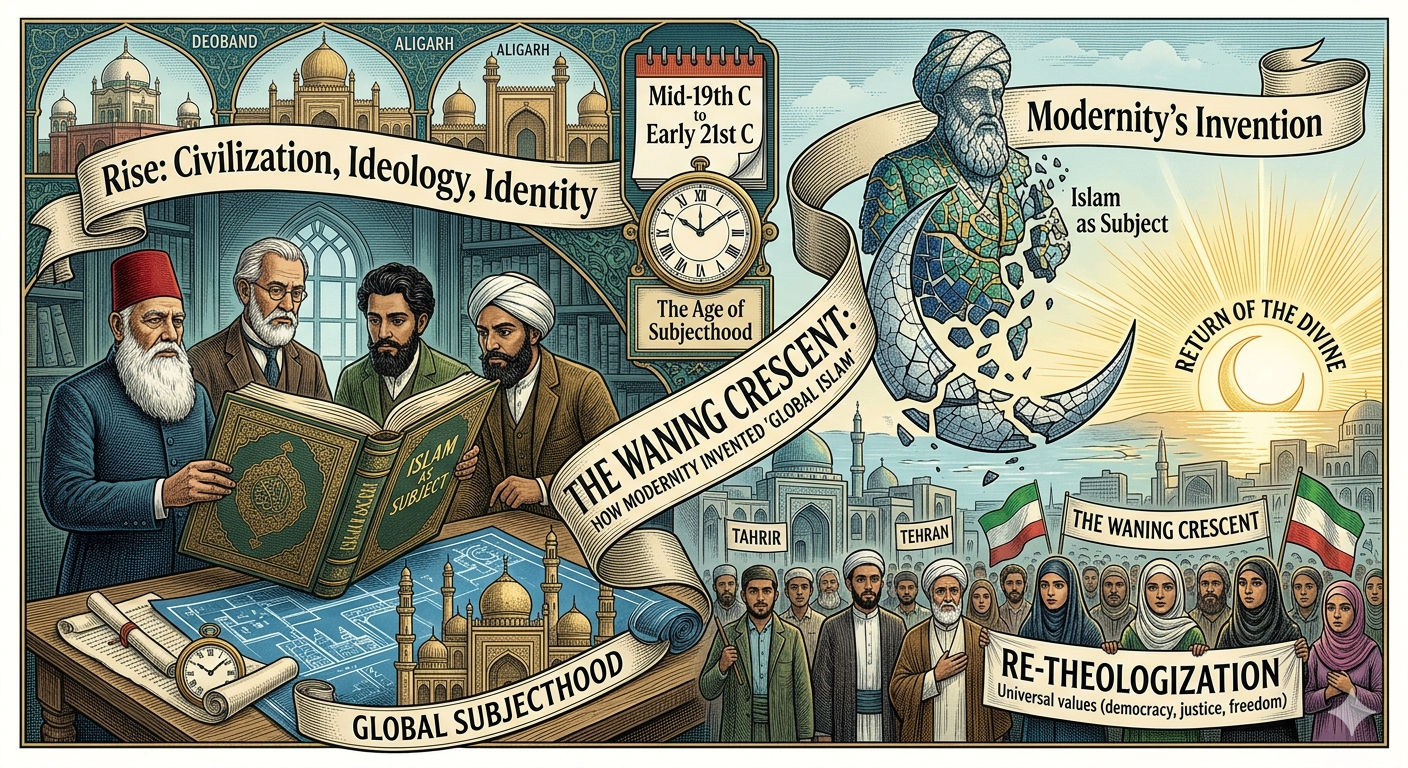
Aptly titled and profoundly analytical, Oxford scholar Faisal Devji’s latest book, Waning Crescent: The Rise and Fall of Global Islam, has ignited a vital intellectual discourse on how the modern world conceptualizes one of its largest religions. This article is based on an illuminating interview on the talk show The Searchlight, with Chief Editor of “Awaz The Voice” Mr Atir Khan, Devji, a senior faculty member and modern historian based in London, unpacked the intricate layers of his thesis. Rather than pronouncing an external sociological decline, Devji argues that the narrative of Islam’s “fall” or “end” is an internal, modern construct driven by Muslim thinkers themselves over the last 150 to 200 years. It is a history of ruptures, shifting paradigms, and the profound transformation of a faith from a localized set of spiritual practices into a monolithic, abstract global subject.
The Paradox of the “Waning Crescent”
For the uninitiated reader, the title Waning Crescent might evoke a pessimistic commentary from an outsider observing a civilizational retreat. However, Devji clarifies that the title mirrors a specific historical phenomenon. From the middle of the 19th century onwards, Muslim thinkers across the globe began to conceptualize the “end of Islam.” Crucially, this was not the traditional, apocalyptic vision found in medieval theology—the coming of the Mahdi or the inevitable cosmic end of time. Instead, it was a thoroughly profane and secularized anxiety.
Muslim intellectuals began imagining the end of Islam as a direct consequence of historical processes: the failure of Muslims themselves to live up to the sublime ideals of their faith. The decline was understood to have occurred within history, just as Islam had arisen within history. Devji’s work meticulously tracks this evolution, investigating why these thinkers believed the faith was in a state of decay and what solutions they engineered to reverse the tide.
The Rise of Islam as a Global Subject
One of the most compelling arguments Devji puts forward is the conceptualization of Islam as an independent agent or “subject.” In pre-modern times, Muslims rarely spoke of “Islam” as an abstract entity that possessed its own will, desires, or action plan. People discussed specific duties, jurisprudential rulings, or spiritual paths. However, the rise of European colonial empires in Asia and Africa shattered traditional structures of authority. The political patronage of Muslim monarchs, the institutional power of traditional clerics (the ulama), and the widespread spiritual authority of Sufi mystics were severely diminished.
In the vacuum left by the renounced authority of kings and saints, “Islam” itself emerged as a subject in its own right. Suddenly, modern thinkers began employing phrases that would have sounded peculiar to medieval ears: “Islam wants you to do this,” “Islam has certain ideals,” or “Islam makes this progress possible.” Muslims were encouraged to form a direct, unmediated relationship with this newly abstract and globalized concept. This shift paved the way for the rise of a new class of religious entrepreneurs and modern middle-class intellectuals who bypassed traditional scholarship to speak directly in the name of a personified, global Islam.
The Subcontinent as an Intellectual Laboratory
The Indian subcontinent holds a position of paramount importance in Devji’s historical narrative. Because India was colonized much earlier than the Middle East or Sub-Saharan Africa, it became the primary laboratory for rethinking Islam under secular, non-Muslim political realities. By the 19th century, thinkers in India felt acutely compelled to imagine a future where they no longer controlled the political apparatus.
This political displacement led to fascinating, paradoxical developments. While traditional clerical authority lost its direct links to state power, it proliferated independently across society. Free from the restrictive control of monarchs, the clerical classes established vast networks of madrasas—most notably institutionalized after the Rebellion of 1857 with the creation of the Deoband movement. Simultaneously, a Western-educated Muslim middle class emerged, epitomized by Sir Syed Ahmad Khan and the Aligarh movement.
Both factions the traditionalists and the modern liberals—harbored a deep disdain for the older aristocratic elites, whom they accused of decadence and a dereliction of duty that allowed colonial subjugation. However, they clashed on who should steer the reinterpretation of the faith. Figures like Sir Syed argued that the ulama had failed, necessitating a new breed of non-clerical intellectuals to take Islam in hand and reconcile it with modern scientific and political realities.
Later, the Khilafat Movement at the end of the First World War marked the first mass political mobilization of South Asian Muslims. Devji notes the radical uniqueness of this movement: it united Muslims across deep sectarian divides and, remarkably, was placed under the leadership of a Hindu, Mahatma Gandhi. The British colonial state viewed this cross-community solidarity with intense anxiety, recognizing its genealogy in the 1857 uprising. Yet, by the 1930s, the rising Muslim League began attacking the Khilafat legacy, arguing that such transnational sentimentalism had compromised the quest for distinct Muslim political autonomy and sovereignty.
The Three Metamorphoses: Civilization, Ideology, and Identity
Devji structures the modern history of global Islam through three distinct phases, aligned with broader global historical trends:
- The 19th Century (Civilization): In the era of competing European empires, Muslim thinkers sought parity by framing Islam as a global “Civilization” capable of matching or surpassing Western achievements.
- The Mid-20th Century (Ideology): Coinciding with the Cold War, Islamist thinkers like Abul A’la Maududi in Pakistan and Sayyid Qutb in Egypt transformed Islam into a totalizing “Ideology” (Nazariya). Maududi explicitly conceptualized Islam as a systemic rival to Capitalism and Communism—an abstract agent operating on the global ideological chessboard.
- The Late 20th to Early 21st Century (Identity): Under the influence of neoliberalism and global migration, Islam morphed into an “Identity,” particularly within Muslim diasporas in the West. Shorn of state backing or totalizing ideological goals, it became integrated into the modern vocabulary of identity politics.
The Displacement of the Divine
Perhaps the most philosophically profound takeaway from Devji’s research is what he describes as the “displacement of the Divine.” Drawing upon the insights of the mid-20th-century scholar Wilfred Cantwell Smith, Devji points out a striking textual shift. In the Quran and classical Islamic texts, the word Allah (God) appears thousands of times, whereas the word Islam is mentioned only a handful of times. In modern Muslim literature, however, this ratio is completely reversed. Thinkers obsessively discuss Islam, while references to God have become secondary.
By turning Islam into the primary subject of history, modern thought inadvertently relegated traditional understandings of God and Prophet Muhammad to the background. This displacement created new theological anxieties. The Prophet, no longer functioning simply as an unassailable cosmic authority, began to be viewed as vulnerable, needing protection from a hostile world. Devji argues that the modern phenomenon of mass mobilizations against blasphemy—dating back to early incidents in Bombay in 1850—arose precisely because the Prophet had been displaced as an active historical authority and re-imagined as a symbol of identity that required human defense.
Similarly, the concept of idolatry (shirk) was reimagined. For modern Islamists like Maududi, the primary threat was no longer physical stone idols, but abstract political systems like nationalism or secularism. In this intellectual framework, the ultimate antithesis to these false modern “idols” was no longer explicitly God, but the system of Islam.
Gender, Militancy, and the Crisis of Subjectivity
Devji’s book dedicates crucial chapters to how this global subjecthood altered internal social dynamics, specifically regarding gender and modern militancy. In the 19th and 20th centuries, both the ulama and the Aligarh modernists launched rigorous female reform movements. Historically, women were often viewed by reformist men as repositories of superstitious folk habits. Through this process of reform, women were refashioned into the “ideal Muslims” characterized by their obedience and non-sovereign capacities within the modern domestic spaces.
In stark contrast, Devji analyzes 21st-century militancy as a perverse manifestation of identity politics, tracking a severe crisis of individual autonomy. He highlights a fundamental shift from Al-Qaeda to ISIS. Al-Qaeda’s ideology revolved around the motif of sacrifice. The suicide bomber represented a tragic paradox: the moment an individual exercised absolute sovereign agency to kill, they were required to annihilate their own self so that only Islam remained as the true actor.
ISIS, however, discarded the sacrificial narrative in favor of “virtuality.” Through meticulously staged, theatrical spectacles of brutal violence distributed online, ISIS fighters were depicted not as self-sacrificing martyrs, but as agents taking sadistic pleasure in the enforcement of the law. Devji argues that this extreme performance was meant to showcase the complete evisceration of the militants’ inner lives; they transformed themselves into unthinking, hollow instruments of an abstract global subject.
From Poetic Lament to Contemporary Shifts
To encapsulate his thesis on the rapid shift in Muslim consciousness, Devji contrasts the poetry of two towering Urdu literary figures separated by less than half a century: Mir Taqi Mir and Altaf Hussain Hali.
Writing in 18th-century Delhi, Mir used the term “Islam” infrequently. In his ghazals, Islam represents merely a localized set of ritual practices—going to the mosque or fasting—ranking alongside terms like deen (faith) and mazhab (sect). When Mir famously wrote about sitting in a temple with sandalwood paste on his forehead, having “long abandoned Islam,” he was expressing a universalist spiritual freedom, not a civilizational crisis. His departure from ritual did not imply that Islam itself was dying.
By the late 19th century, Altaf Hussain Hali published his epic poem, the Musaddas-e-Hali (or The Ebb and Flow of Islam). Here, Islam is the absolute subject, dominating every stanza. Hali’s poem is a sweeping, historical lament over the total decline of Muslim civilization, blaming the failures of kings, clerics, and Sufis, while urgently demanding a modern revival. In a matter of decades, the intellectual framework had fundamentally transformed: Islam had expanded from a set of specific rituals into an all-encompassing, historical organism whose perceived decay haunted the Muslim imagination.
Is the Career of Global Islam Ending?
Ultimately, Waning Crescent offers a startling conclusion. Devji suggests that the world may currently be witnessing the twilight of Islam’s career as a global subject. The modern habit of mobilizing masses by invoking “Islam” as an abstract political or ideological agent appears to be losing its potency.
Looking closely at contemporary mass upheavals across the Muslim world the Arab Spring, the widespread civil protests in Iran (from the Green Movement to the Mahsa Amini protests), and the recent dramatic fall of the government in Bangladesh Devji observes a profound shift. These movements feature highly pious, practicing Muslims, yet their political and social slogans completely lack the totalizing language of Islamist ideology or global identity. They are fighting for democratic rights, accountability, justice, and liberty, rather than the abstract enforcement of an ideological system.
The era of Islamism as a grand Cold War project has largely passed. As the arc of global Muslim subjecthood bends toward its conclusion, Devji leaves his audience with an intriguing historical question: Are we on the verge of a profound re-theologization? With the decline of abstract political “Islam,” the coming decades might well witness the return of traditional spirituality, a revival of Sufi orders, and a restoration of the foundational, intimate focus on God and the Prophet at the very center of Muslim life and practice.
This article is based on an interview of Faisal Devji conducted by Atir Khan, Editor of Awaz The Voice. The views expressed in the article are solely those of the interviewee and do not necessarily reflect the editorial policy or position of Times Headlines.