
Farooq Ganderbali
The ongoing Legislative Assembly elections in Pakistan-occupied Jammu and Kashmir (PoK) have unfolded under extraordinary circumstances, prompting questions that extend well beyond the electoral outcome. While elections are often regarded as the hallmark of democratic governance, the environment in which they are conducted is equally important. In Pakistan-occupied Kashmir, the current electoral exercise has been overshadowed by widespread public protests, extensive military deployment, allegations of political manipulation and growing dissatisfaction among sections of the population. These developments have transformed what should have been a routine democratic exercise into a test of political legitimacy and public confidence.
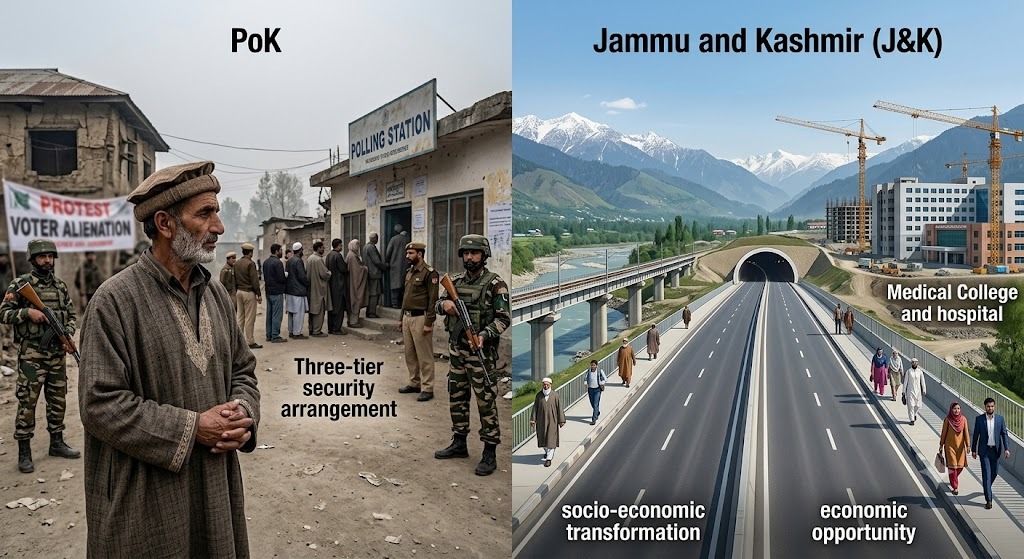
Polling for the 45 directly elected seats of the 53-member Legislative Assembly has commenced in phases, beginning with constituencies in the Mirpur division. To secure the electoral process, Pakistan has deployed a three-tier security arrangement comprising local police, Rangers and the Federal Constabulary, with the Pakistan Army serving as the final layer of security. Thousands of security personnel have been stationed across the region, underscoring official concerns over maintaining law and order.
While governments have a legitimate responsibility to ensure peaceful elections, the scale of the deployment inevitably raises questions about the political atmosphere in which citizens are exercising their democratic rights. Elections are most meaningful when voters participate freely, candidates campaigns without intimidation and political disagreements are resolved through open debate rather than overwhelming security measures.
The elections follow weeks of unrest that have reportedly witnessed widespread demonstrations, casualties, injuries and allegations of excessive use of force. Political organisations and civil society groups have criticised Islamabad’s handling of the protests, arguing that the response has deepened public alienation rather than addressing the grievances that initially brought people onto the streets. Reports emerging from the region suggest that frustration has been building over issues such as governance, economic opportunities, inflation, unemployment, access to public services and political representation.
The political landscape has also become increasingly polarised. The Pakistan Tehreek-e-Insaf (PTI) unit in Pakistan-occupied Kashmir has reportedly questioned the credibility of the electoral process, describing it as unfair and lacking transparency. Allegations of electoral engineering, restrictions on political activity and concerns regarding administrative neutrality have further fuelled scepticism among opposition parties and their supporters. Whether or not these allegations are ultimately substantiated, their very existence reflects a deficit of trust that any democratic system must seek to address.
Public confidence is strengthened not merely by holding elections but by ensuring that the electoral process is widely perceived as free, fair and credible. Institutions derive legitimacy from the trust of the people they serve. When significant sections of society begin questioning those institutions, restoring confidence becomes an urgent political priority.
Equally significant have been statements attributed to Pakistan’s Defence Minister, Khawaja Asif, who reportedly characterised protesters as enemies comparable to India while rejecting dialogue with demonstrators. Such remarks have attracted criticism because democratic governments are generally expected to engage with dissent rather than delegitimise it. Throughout history, stable democracies have demonstrated that listening to public grievances, however uncomfortable, often contributes more to long-term stability than relying solely on coercive measures.
The demonstrations themselves appear to reflect deeper structural concerns. Many residents have expressed dissatisfaction over decades of political uncertainty, limited economic development and restricted opportunities. Sections of the protesters have demanded greater political autonomy, expanded democratic rights and improved governance. Others have advocated different constitutional futures, reflecting the diversity of opinion within the region. Regardless of the political positions involved, these voices deserve peaceful engagement rather than suppression.
The developments also invite comparisons with India’s Union Territory of Jammu and Kashmir. Over the past several years, the region has witnessed substantial investments in road infrastructure, tunnels, rail connectivity, healthcare facilities, educational institutions, tourism development, sports infrastructure, digital connectivity and social welfare initiatives. New medical colleges, improved transport networks and increased tourism have contributed to broader socio-economic transformation. Challenges undoubtedly remain, as they do in any developing region, but measurable improvements in infrastructure and public investment have been widely documented.
The contrast between developmental trajectories has increasingly entered public discourse. For many observers, the comparison highlights the importance of governance, institutional accountability and sustained economic investment in improving the quality of life for ordinary citizens. Ultimately, development cannot replace political rights, nor can political rights flourish in the absence of economic opportunity. Both are essential pillars of a stable and prosperous society.
The international community also has an important role to play. Democratic values are universal, and concerns regarding political participation, human rights and electoral integrity deserve careful and impartial attention wherever they arise. Independent observation, objective reporting and continued diplomatic engagement can contribute to greater transparency while encouraging peaceful resolution of political disputes. The focus should remain on safeguarding democratic principles, protecting civilian rights and promoting dialogue among all stakeholders.
The people of Pakistan-occupied Kashmir deserve what every community across the world seeks: peace, security, economic opportunity, accountable governance and the freedom to determine their future through genuine democratic participation. Elections conducted under extraordinary security arrangements may succeed in maintaining order, but lasting political stability cannot be achieved through security measures alone. It requires trust, inclusion, transparency and institutions that command public confidence.
History has repeatedly demonstrated that democracy is not judged solely by the casting of ballots but by the freedom with which those ballots are cast and the confidence citizens have that their voices genuinely matter. Political legitimacy is earned not through overwhelming displays of force but through openness, accountability and meaningful engagement with the aspirations of the people.
As Pakistan-occupied Kashmir moves through this electoral cycle, the real challenge extends beyond announcing winners and losers. The enduring question is whether these elections will strengthen democratic institutions or merely reinforce existing political divisions. The answer will depend not only on the conduct of the polling day but on whether the voices of the people are heard long after the ballots have been counted.