
- S. Masood Husain
- Former Chairman, Central water Commission, GoI
- & Secretary (BoT), Indian Muslims for Civil Rights
Introduction: More than seven decades after Independence, Indian Muslim leadership stands at a critical juncture. The concerns that dominated the immediate post-Partition era—security, identity and religious freedom—remain important, but they no longer exhaust the challenges facing the community. Today, educational backwardness, economic deprivation, inadequate representation in public institutions, access to quality healthcare, employment opportunities, and participation in the knowledge economy have emerged as equally pressing issues. These changing realities require a fundamental rethinking of the concept and composition of Muslim leadership in India.
The Legacy of Post-Independence Leadership: In the decades following Independence, Muslim public leadership was exercised predominantly by religious organisations such as Jamiat Ulama-i-Hind, Jamaat-e-Islami Hind and various educational, charitable and religious institutions. Their contributions to preserving Islamic identity, protecting constitutional rights and maintaining community cohesion during difficult periods deserve recognition. However, Muslim political parties remained regionally confined and achieved limited electoral influence, leaving religious organisations as the principal public voices of the community.
While this model served an important historical purpose, the needs of the twenty-first century are substantially different from those of the 1950s and 1960s.
The Sachar Committee: A Paradigm Shift: The publication of the Prime Minister’s High Level Committee Report on the Social, Economic and Educational Status of the Muslim Community of India (2006), popularly known as the Sachar Committee Report, fundamentally altered the discourse on Indian Muslims. Instead of viewing the community primarily through the lens of religion or electoral politics, the Committee presented empirical evidence demonstrating significant deficits in education, literacy, employment, access to bank credit, public-sector representation, urban infrastructure and socio-economic mobility.
The report shifted the national conversation from identity politics to development politics. It showed that many of the community’s principal challenges were developmental rather than theological and therefore demanded policy interventions, institutional reform and professional leadership.
The Ranganath Misra Commission and Equal Opportunity: The National Commission for Religious and Linguistic Minorities (2007), chaired by Justice Ranganath Misra, reinforced many of the Sachar Committee’s findings. It highlighted the structural disadvantages experienced by religious minorities and recommended measures aimed at ensuring greater equality of opportunity in education and public employment, along with stronger institutional mechanisms for inclusion and social justice.
Whether or not every recommendation is accepted as public policy, the Commission underscored an important principle: the advancement of disadvantaged communities requires sustained engagement with constitutional institutions, public policy and developmental planning rather than reliance solely on religious mobilisation.
Responding to Majoritarian Challenges: The evolving political landscape of India presents an additional dimension that any contemporary framework of Muslim leadership must address. Over the past three decades, the growing influence of Hindutva as a political ideology has significantly altered the environment within which Indian Muslims negotiate questions of citizenship, identity and participation. Numerous scholars, policy analysts and civil society organisations have argued that this period has witnessed increasing concerns relating to communal polarisation, hate speech, incidents of mob violence, discrimination in housing and employment, the securitisation of Muslim identity, unequal media representation, and the shrinking of spaces for meaningful political participation. While the extent and interpretation of these developments remain matters of public and academic debate, there is little disagreement that they have generated a heightened sense of insecurity among substantial sections of the Muslim community.
Why Leadership Must Be Reimagined: Taken together, the Sachar Committee and Ranganath Misra Commission provide compelling evidence that the principal deficits confronting Indian Muslims are educational, economic, institutional and developmental. The challenge of Hindutva ideology and majoritarianism has made the situation more serious. Consequently, community leadership can no longer be conceived primarily in religious or electoral terms.
Religious scholars continue to play an indispensable role in providing moral guidance, preserving religious learning and promoting ethical values. Yet the community also requires leaders capable of addressing complex questions relating to education policy, economic development, entrepreneurship, constitutional law, media and public administration etc.
The circumstances, specially since the onset on the present political regime demand a leadership that is neither reactive nor confrontational, but strategically capable, constitutionally grounded and intellectually prepared. The response to contemporary challenges cannot be confined to expressions of grievance or episodic political mobilisation. It requires the development of institutional capacity, legal expertise, policy research, effective media engagement, strategic communication, coalition-building with other democratic and marginalised groups, and sustained participation in constitutional processes. The defence of constitutional rights must proceed simultaneously with efforts towards educational excellence, economic empowerment and social reform within the community.
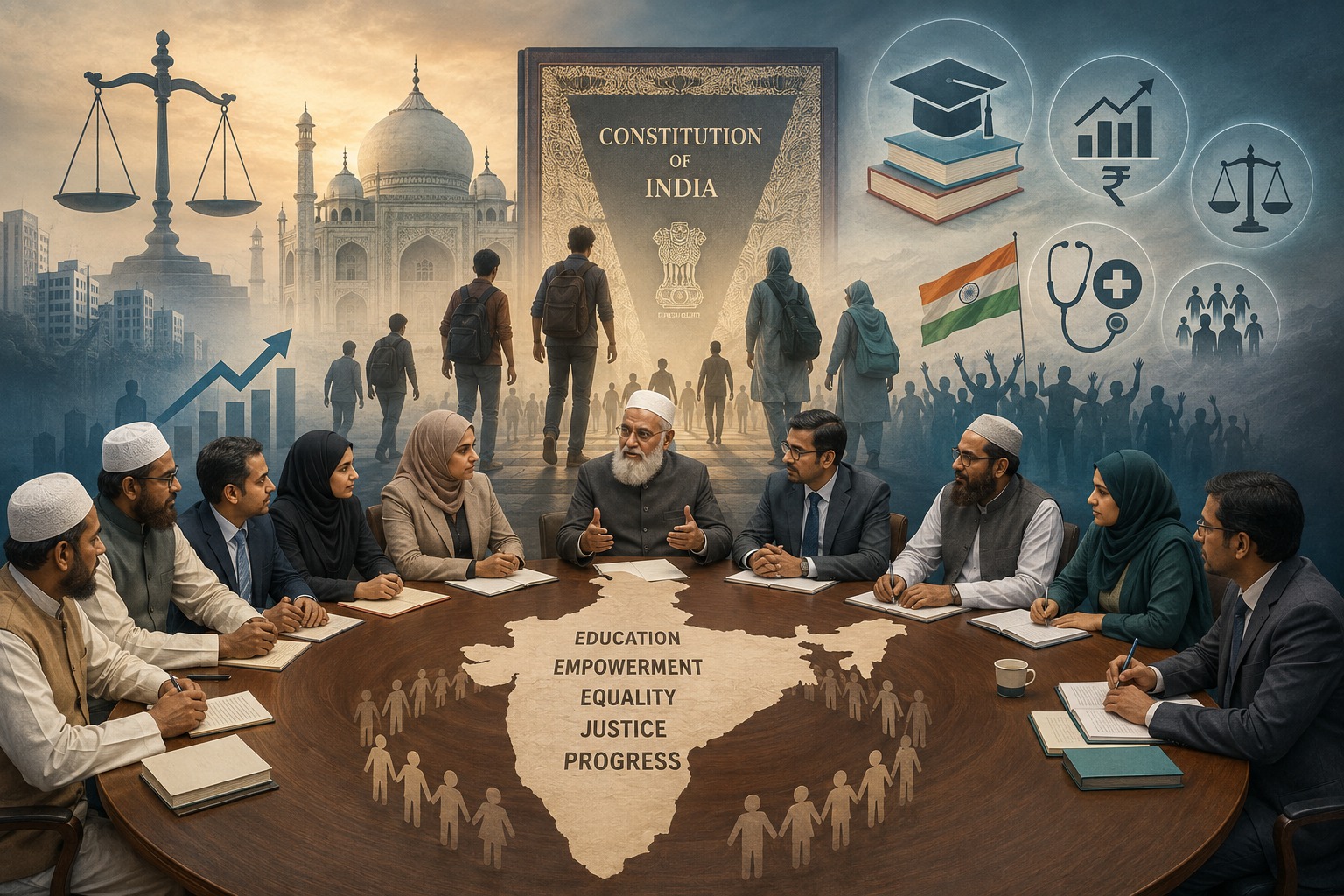
Towards a Multi-Dimensional Leadership Model: The future leadership of Indian Muslims should therefore be broad-based, representative and professionally diverse. Religious scholars should remain custodians of faith and ethics, while educationists formulate strategies for educational advancement, economists and entrepreneurs foster economic self-reliance, legal experts defend constitutional rights, professionals contribute technical expertise, and women and young leaders participate fully in shaping community priorities.
Leadership should become collaborative rather than hierarchical and institutional rather than personality-driven.
A National Muslim Community Leadership Council: To translate these principles into practice, there is a need to establish a broad-based National Muslim Community Leadership Council (NMCLC). The proposed Council would not function as a political party or a religious authority. Rather, it would serve as a representative consultative and policy platform that brings together the diverse intellectual, professional and social resources of the community. Its primary functions would include preparing long-term development strategies, coordinating research and policy advocacy, promoting educational and economic initiatives, facilitating constructive dialogue with governments and civil society, and articulating informed positions on issues affecting the Muslim community.
The Council should be constituted on the principle that no single class of leadership should dominate community affairs. Instead, it should reflect the multidimensional character of contemporary Muslim society. An illustrative composition is suggested below:
| Sector | Indicative Share |
| Educationists, academics and researchers | 15% |
| Religious scholars (Ulama and Islamic scholars) | 15% |
| Women leaders from diverse professions | 15% |
| Business leaders, entrepreneurs, economists and financial experts | 15% |
| Constitutional/Legal experts, Public Policy, Retired Civil Services and Human Right Experts (*) | 15% |
| Social workers, NGOs and civil society organisations | 10% |
| Political representatives and public policy practitioners | 10% |
| Youth leaders, innovators and technology professionals | 5% |
(*) Their responsibility would include monitoring legislative and policy developments, strengthening legal interventions where required, promoting informed public discourse, engaging constructively with governmental institutions, and building broad democratic partnerships committed to the values of equality, justice, pluralism and the rule of law.)
The proposed distribution is only illustrative and should remain flexible. Its underlying principle is that while religious leadership should continue to provide moral and ethical guidance, the responsibility for community advancement must be shared by professionals possessing expertise in education, economics, law, science, technology, governance and social development.
Such a Council should function through specialised standing committees on education, economic development, constitutional affairs, women’s empowerment, youth development, media and communications, health, skill development, research, and interfaith and national dialogue. It should publish an annual State of Indian Muslims Report, monitor socio-economic indicators, evaluate government programmes affecting the community, and formulate evidence-based policy recommendations.
A representative leadership institution of this nature would mark a significant departure from personality-centred and organisation-centred leadership towards an institutional model rooted in collective wisdom, professional competence and constitutional engagement. It would also respond directly to the developmental concerns highlighted by the Sachar Committee and the Ranganath Misra Commission, while preparing the community for the opportunities and challenges of twenty-first century India.
From Identity to Capability: A mature community derives its strength not merely from political representation but from its educational achievements, economic resources, professional excellence and institutional capacity. The emphasis of Muslim leadership should therefore move from a reactive politics of grievance to a proactive politics of capability, opportunity and nation-building.
Investment in schools, universities, research institutions, vocational education, entrepreneurship, digital literacy and leadership development is likely to yield more enduring benefits than episodic political mobilisation.
Institution Building as the Central Priority: The long-term advancement of Indian Muslims depends upon strong institutions. Universities, policy research centres, legal aid organisations, professional associations, charitable foundations, educational trusts, business networks and civil society organisations can generate intellectual capital, develop future leadership and engage constructively with government and democratic institutions. Strong institutions outlast charismatic individuals and provide continuity across generations.
Constitutional Citizenship and National Partnership: The constitutional framework of India offers the most durable basis for advancing the legitimate interests of all citizens. Muslim leadership should therefore remain firmly committed to constitutional values, democratic participation, the rule of law and constructive engagement with other communities. Such an approach recognises Muslims not merely as a minority seeking protection but as equal citizens and partners in India’s democratic and developmental future.
Conclusion: The findings of the Sachar Committee and the Ranganath Misra Commission together suggest that the future of Muslim leadership in India must be measured not only by its ability to preserve religious identity but also by its capacity to transform the socio-economic condition of the community. The leadership that India requires today is one that combines religious wisdom with educational excellence, economic vision, constitutional literacy, professional competence and institutional innovation. Such a model would be better equipped to address contemporary challenges while enabling Indian Muslims to contribute more effectively to the nation’s progress.
The long-term resilience of the Muslim community will depend not only upon preserving its religious identity but also upon strengthening its institutional presence within India’s democratic framework. A leadership that combines constitutional literacy, strategic vision, professional competence and moral credibility will be better equipped to respond to contemporary challenges while contributing positively to the strengthening of India’s plural and democratic order.
(The views expressed in the above article are personal. For comments/response: Email: syedsmhusain@yahoo.co.in)