
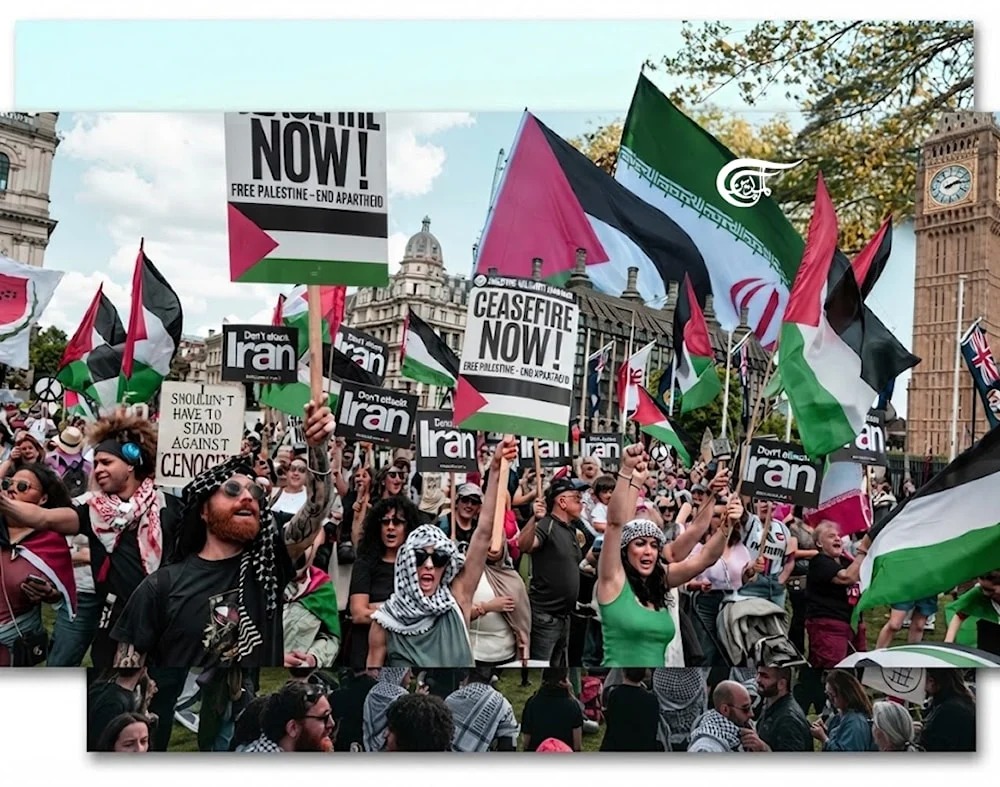
When, on 13 October 2025, Hamas was dragged into signing an agreement that neither “Israel” nor the United States intended to respect, a large portion of the Western pro-Palestinian movement registered it as a victory of its own, given that in the previous month millions of citizens had taken to the streets waving Palestinian flags.
Soon, however, it became evident that the treaty, predictably, was not at all aimed at ending the conflict. Rather, it was essentially designed to remove it from the global public eye and, even more significantly, to delegitimize the support Palestine was receiving from its regional allies
Indeed, while Western attention was focused on the Sumud Flotilla, “Israel” was under crossfire from all members of the Axis of Resistance.
Hezbollah had immediately opened a second front with the stated goal of relieving military pressure on Gaza. The following day, Yemen also intervened with a first missile attack. The Iraqi resistance followed suit shortly after, with attacks against US targets in Iraq and Syria. Iran had launched the first True Promise operation on 13 April 2024. The naval blockade imposed by Ansarallah in the Red Sea had led to the closure of the port of Eilat, resulting in economic and military difficulties for the Zionist colony, since that port provided logistical support to the Israeli navy.
On 6 June 2024, the first simultaneous combined attack by Yemeni and Iraqi forces was launched, followed by numerous joint operations coordinating multiple formations of the Axis in various configurations.
In light of the growing coordination of the anti-Zionist resistance in the region, the imposition of the so-called “peace plan” had the effect of defusing the Axis’s momentum by removing the central element of the conflict, Hamas, from the equation.
All members of the Axis paid a heavy price for their interventions alongside Palestine.
A brutal and entirely illegal campaign of targeted assassinations deprived Muslim peoples of their most beloved and charismatic leaders: Yahya Sinwar and Ismail Haniyeh in Gaza, Hassan Nasrallah in Lebanon, Ayatollah Ali Khamenei in Iran, as well as key figures in the military and governmental apparatuses in all the countries involved, including Yemen and Iraq.
Concurrently, the civilian populations of the region came under relentless fire from “Israel” and its US protector.
Southern Lebanon is still under military occupation, while the US pressures institutions and the military in an overt attempt to trigger an outright civil war. Yemen, led by the Ansarallah coalition, found itself once again under Saudi bombardment, which it had escaped less than a year prior. Syria capitulated after enduring 14 years of war and economic siege. Iraq was repeatedly hit with large-scale bombardments and targeted assassinations. And Iran, uncoincidentally the main promoter of the Axis of Resistance, has been subjected to a war whose end is not yet in sight.
Faced with this generalized aggression against an entire region, a large part of the Western pro-Palestinian movement continues to display an inexplicable difficulty in extending its solidarity beyond the borders of Palestine.
Not even the blatant violations of international law and of the ethical principles that it claims to uphold have been enough to prompt a re-examination of its ideological premises.
The fact that this aggression was directed against non-belligerent countries was not enough. Nor was the fact that, as is now a consolidated strategy for the Zionist coalition, civilian populations rather than combatants have been targeted; everywhere, and not only in Gaza. The fact that the countries under attack are the same ones that have spent themselves for Palestine, in far more concrete, active, and substantial terms than the West was willing or able to do, also does not seem to raise questions.
No organized movement has formed in this part of the world in support of Iran, Yemen, Lebanon or Iraq. Not even the assassination of 168 girls of an elementary school aroused a real public reaction, beyond narrow and marginalized fringes.
That this lack of empathy towards the Axis countries, and not by chance primarily toward Iran, stems largely from the biased and partial narrative of the media is certain, but it is not enough to explain the phenomenon when considering the very rich galaxy of movements and associations that make up the pro-Palestinian movement in the West.
This movement has over time built a consolidated and efficient counter-information network that not only avoids falling victim to Zionist propaganda, but is constantly engaged in monitoring and debunking media lies. It is capable, that is, of producing its own alternative narrative through which it commits itself with a certain effectiveness to keeping attention alive on the Palestinian question, ceaselessly exposing the daily abuses with which “Israel”, even in times of “peace”, silently carries out its genocide.
So, it is not a matter of inattention. It is not a matter of fatigue of the movement. It is a specific and deliberate choice.Among the reasons underlying this choice, there is certainly a difference in top-down control policies..
Activism focused solely on the Palestinian people enjoys a relative margin of tolerance – on the part of the media, the cultural establishment and the institutions – on condition that it maintains a strictly humanitarian and apolitical character.
This imposes a reiterated distancing not only from the countries and formations of the Axis, but from the Palestinian resistance movements themselves, Hamas first and foremost.
Even the public figures who are allowed to express solidarity with Palestine through official channels conform to this requirement of depoliticization. Therefore, In most cases their challenge to the global establishment translates into a generic solidarity with the Palestinian population, but slides towards positions entirely compatible with left-wing Zionism when the gaze shifts to Hamas, Iran or Hezbollah.
In truth, the depoliticization imposed by the establishment is rooted in the founding ideology of the West, which is shared, more or less consciously, by the majority of the population, including the pro-Palestinian movement. This ideology feeds on the universalism developed in Europe, particularly from the 18th century onward, when the philosophical movement of the Enlightenment, under the deceptive claim of liberating human beings from their “superstitions”, in fact elected the Westerner, with his specific peculiarities, as the archetype and model of all humanity. And, consequently, it delegitimized any other form of social, political, economic, religious and cultural organization.
The “universal man”, supposedly detached from the constraints, in reality inescapable, of history and geography, has produced as a consequence an idiosyncratic relationship between the Westerner and history.
To preserve the moral, political, economic and cultural primacy granted by the Enlightenment, the Westerner is forced to flee from history, on pain of falling back, from an absolute model, into the contingent: a human among humans, a nation among nations, a system of thought among many other equally legitimate systems of thought.
However, the removal of history reduces conflicts to the “good versus evil” paradigm, in which actions and actors possess an intrinsic ethical value independent of circumstances.
Within this dichotomy, the “propaganda” of a substantial portion of the Western pro-Palestinian movement aims to reduce Palestine to an equally abstract entity composed of victims, condemned to inaction in order to preserve their innocence.
Statistics concerning women and children are therefore highlighted, military actions are hidden or disavowed, the role of Hamas is barely tolerated, and the Axis allies are ignored or, more often, fiercely opposed.
Isolated from the rest of the region, transformed into an entity detached from time and space, and essentially stripped of its identity as an Arab and Muslim nation, Palestine thus becomes the stage upon which the Westerners project the dream of themselves as agents of good, reclaiming under new guises the desire for center-stage prominence that animates their ethnocentric culture.
Indeed, upon closer inspection, this is the true function of all that entire segment of the movement that defends the population but condemns Hamas: to comfort the supremacist Westerners with the fact that the liberation of Palestine can come through the West; to comfort them with the thought that, for better or worse, they are the ones determining the course of events; to reaffirm that not only the violence of their power apparatuses, but also their innate sense of justice are superior to those of others; and that, for better or worse, the West remains the true engine of history.
Yet the depoliticization of the Palestinian question entails the reduction of the occupation to an anomaly of history, to an immanent manifestation of an abstract evil devoid of geographical location, dissociated from the anti-colonial struggle blazing throughout the region.
It is the bottom-up replication of Zionism’s own strategy.
Because whoever remains silent on the geopolitical causes of the conflict, whoever refuses solidarity with the other nations of Western Asia, whoever bans Iranian flags from demonstrations after having banned Syrian ones for 14 years, whoever circumscribes political discourse by hiding behind the justification that “we must not divide the movement” in reality is doing nothing other than re-enacting, in different attire, the same plan of fragmentation of the Arab and Muslim world cultivated by the United States and “Israel”.
They are doing nothing other than isolating Palestine from its natural allies, namely the forces fighting for the liberation of the entire region from Zionist occupation and from Western – military, political, economic – interference.
Because even amid the exceptional gravity of the ongoing genocide, the right to self-determination is not denied to Palestinians alone. The right to self-determination is denied to Yemen when it is attacked by a coalition of over 10 nations simply for having freed itself from a puppet government subservient to Saudi Arabia and the United States. The right to self-determination is violated when, in the wake of the Islamic Revolution, Iran finds itself not only gripped in an economic vice, but subjected to continuous and repeated military aggressions and regime-change attempts. Iraq’s right to self-determination is violated not only through invasions but also when the President of the United States takes the liberty of blackmailing an entire nation because he does not like its electoral results.
The principle of self-determination is denied to Lebanon when the United States imposes on it the highest institutional offices of its own choice or when it orders the disarmament of its only effective territorial defense force. The right to self-determination was also violated in Bahrain in 2011, when the US sent the Saudi army to crush a popular uprising in blood. The right to self-determination was stolen from the Syrian people across nearly fifteen years of war and economic siege, and again when a terrorist was imposed on them as president, who is massacring thousands of citizens on an ethnic basis in general silence.
Western activists are neither morally nor politically entitled to insinuate themselves as a wedge between peoples who are victims of the same aggression. Western activists are neither morally nor politically entitled to ignore that these divisions are the obvious and explicitly stated goal of Zionism.
On the contrary, anyone participating in the political debate in the West, at any level and in any capacity, today should take on the task of consistently placing Palestine within the geopolitical dynamics to which it belongs, and fighting against any attempt to isolate it from the rest of the region.
Because the independent forces of Western Asia are its natural allies, attempting to sever Palestine from the network of solidarity and alliances to which it belongs by ethnic and religious identity, and by political and geographical coordinates, is, itself, a form of colonialism.
Source : almayadeen