
By Grace Mubashir
Al-Baqarah 2:228 is unlikely to stop being controversial because it contains a genuine tension: it speaks of reciprocal rights while also mentioning a darajah for men. Classical Muslim scholars developed different explanations of that difference, ranging from authority and social advantage to responsibility, generosity and particular marital rights.
Major points:
· The modern debate should therefore avoid two extremes. One is to declare that the verse straightforwardly establishes permanent male superiority and then reproduce every historical legal consequence without examination. The other is to pretend that classical Muslim jurists never understood darajah hierarchically. Both approaches oversimplify the history.
· A more productive approach begins with the Qur’an’s own language of rights, reciprocity, maʿrūf, reconciliation, affection and mercy.
· It then asks how these principles should operate in societies where women participate equally in education, employment, citizenship and public life.
· For Indian Muslims, this means that reform of personal law need not be presented as a choice between Islam and modernity. Islamic jurisprudence has always involved interpretation, disagreement, analogy, custom, public welfare and changing circumstances.
· Contemporary ijtihad can therefore examine whether inherited rules continue to realise the Qur’anic objectives of justice and human dignity.
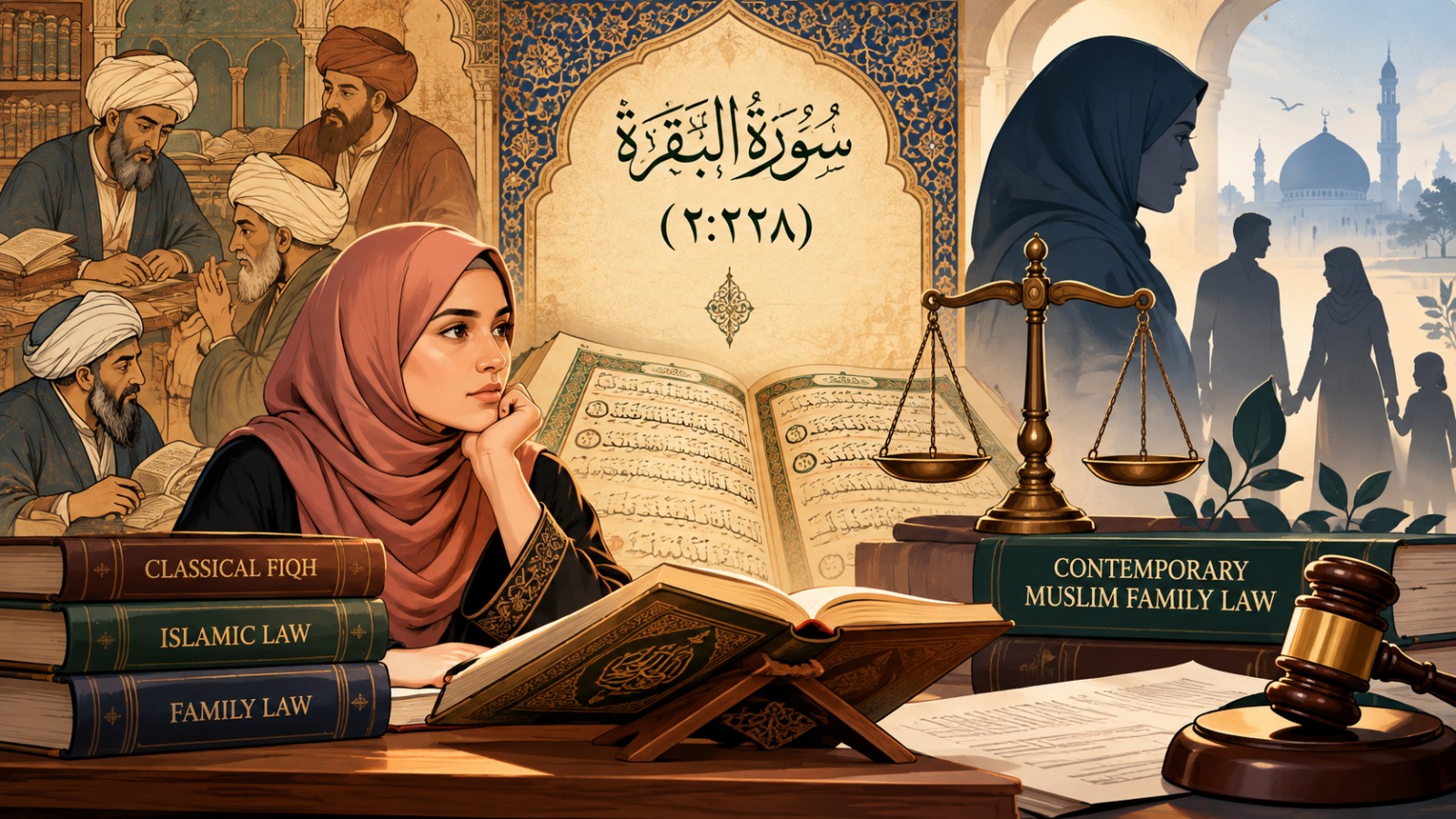
Few Qur’anic verses have generated as much discussion about marriage, divorce and gender relations as Qur’an 2:228. The verse speaks about divorced women, their waiting period, the possibility of reconciliation, mutual rights between spouses and what it calls a darajah, or “degree”, for men over women. Classical jurists generally understood the verse within a marital system in which husbands possessed certain additional legal powers and responsibilities. Contemporary Muslim scholars, particularly women scholars and Muslim feminist interpreters, have asked whether those interpretations should continue to determine Muslim family law today.
The debate is important because the verse itself contains two seemingly different messages. On one side, it establishes an important principle of reciprocity: “وَلَهُنَّ مِثْلُ الَّذِي عَلَيْهِنَّ بِالْمَعْرُوفِ” — “Women have rights similar to those against them, according to what is reasonable.” On the other, it concludes, “Men have a degree over them.”
The central modern question is therefore not whether the verse should simply be accepted or rejected. It is how its language, historical context, legal consequences and ethical purpose should be understood in the twenty-first century.
What does Qur’an 2:228 actually say?
Al-Baqarah (2:228)
وَٱلْمُطَلَّقَـٰتُ يَتَرَبَّصْنَ بِأَنفُسِهِنَّ ثَلَـٰثَةَ قُرُوٓءٍۢ ۚ وَلَا يَحِلُّ لَهُنَّ أَن يَكْتُمْنَ مَا خَلَقَ ٱللَّهُ فِىٓ أَرْحَامِهِنَّ إِن كُنَّ يُؤْمِنَّ بِٱللَّهِ وَٱلْيَوْمِ ٱلْـَٔاخِرِ ۚ وَبُعُولَتُهُنَّ أَحَقُّ بِرَدِّهِنَّ فِى ذَٰلِكَ إِنْ أَرَادُوٓا۟ إِصْلَـٰحًۭا ۚ وَلَهُنَّ مِثْلُ ٱلَّذِى عَلَيْهِنَّ بِٱلْمَعْرُوفِ ۚ وَلِلرِّجَالِ عَلَيْهِنَّ دَرَجَةٌۭ ۗ وَٱللَّهُ عَزِيزٌ حَكِيمٌ
“Divorced women must wait three monthly cycles [before they can remarry]. It is not lawful for them to conceal what Allah has created in their wombs, if they ˹truly˺ believe in Allah and the Last Day. And their husbands reserve the right to take them back within that period if they desire reconciliation. Women have rights similar to those of men equitably, although men have a degree ˹of responsibility˺ above them. And Allah is almighty and all-wise.”
The relevant portion of the verse reads:
وَلَهُنَّ مِثْلُ الَّذِي عَلَيْهِنَّ بِالْمَعْرُوفِ ۚ وَلِلرِّجَالِ عَلَيْهِنَّ دَرَجَةٌ ۗ وَاللَّهُ عَزِيزٌ حَكِيمٌ
“And women have rights similar to those against them, according to what is fair and reasonable. And men have a degree over them. And Allah is mighty and wise.”
The verse cannot be separated from its immediate context. It is principally discussing divorced women, the waiting period (ʿiddah) and the husband’s possibility of reconciliation during that period. It therefore belongs to a larger Qur’anic discussion of regulating divorce rather than providing an abstract statement about the entire social status of women.
The beginning of the verse states that divorced women should wait for three qurūʾ and should not conceal pregnancy. The husband may take his wife back during this period if he genuinely wants reconciliation. The verse then introduces the principle of reciprocal rights.
This context matters. The statement about a darajah occurs after the Qur’an has affirmed that women have corresponding rights. The verse is therefore not simply saying that men possess rights while women possess duties. It begins from reciprocity and then introduces a difference.
The meaning of maʿrūf
One of the most important words in the verse is بِالْمَعْرُوفِ (bil-maʿrūf), usually translated as “according to what is fair”, “reasonable”, “customary” or “recognised as good”.
This is a flexible ethical concept. It does not describe one fixed social arrangement for all societies. What is maʿrūf can involve justice, dignity, accepted good practice and the circumstances of the people concerned.
This becomes important for contemporary family law. A legal system can ask whether a rule developed in a premodern society continues to fulfil the Qur’anic demand for maʿrūf in a society where women are educated, employed, property-owning citizens and equal participants in public life.
The Qur’an itself repeatedly uses maʿrūf when regulating family relationships. For example:
وَعَاشِرُوهُنَّ بِالْمَعْرُوفِ
“Live with them honourably/kindly.” — Qur’an 4:19
The ethical principle is therefore not merely obedience to a formal rule. It is decent and equitable treatment.
Classical interpretation of the darajah
Classical tafsir did not produce a single explanation of darajah. Al-Tabari records several interpretations. Some early authorities associated the degree with men’s advantages in inheritance, warfare and other areas; others connected it with authority or obedience. But al-Tabari ultimately preferred an interpretation associated with Ibn ʿAbbas: the darajah involved a husband’s willingness to show generosity, overlook some of his rights and fulfil the rights owed to his wife.
This is an important point because modern discussions sometimes present classical tafsir as though every classical scholar understood darajah simply as unrestricted male superiority. The historical record is more complicated.
Al-Tabari writes:
وَلِلرِّجَالِ عَلَيْهِنَّ دَرَجَةٌ بِتَفَضُّلِهِمْ عَلَيْهِنَّ، وَصَفْحِهِمْ لَهُنَّ عَنْ بَعْضِ الْوَاجِبِ لَهُمْ عَلَيْهِنَّ
In substance, he interprets the degree as connected with men’s showing generosity and overlooking some of what they might otherwise claim from their wives.
Other classical interpreters gave the phrase a more hierarchical meaning. Ibn Kathir, for example, connects it with advantages that men possess in aspects of family authority, social position and responsibility.
Al-Qurtubi’s discussion likewise treats the verse within the legal structure of marriage and divorce, while stressing that the rights of both spouses have to be observed according to maʿrūf.
The result is a long-standing tension within Islamic interpretation: is darajah primarily a legal hierarchy, or is it a limited responsibility associated with the particular institution of marriage and divorce?
The Hadith principle of mutual responsibility
The broader prophetic tradition provides important material for interpreting this verse.
The Prophet Muhammad is reported to have said:
خَيْرُكُمْ خَيْرُكُمْ لِأَهْلِهِ، وَأَنَا خَيْرُكُمْ لِأَهْلِي
“The best of you are those who are best to their families, and I am the best of you to my family.”
This principle is important because it places moral quality inside the household. Religious virtue is not demonstrated merely through public worship or public authority. It is demonstrated through treatment of one’s family.
Another well-known report states:
اسْتَوْصُوا بِالنِّسَاءِ خَيْرًا
“Treat women well.”
And in the Prophet’s Farewell Sermon, the tradition reports:
فَاتَّقُوا اللَّهَ فِي النِّسَاءِ
“Fear Allah concerning women.”
Ibn Kathir cites the latter tradition while discussing the reciprocal rights of husbands and wives in connection with 2:228.
These traditions provide an important ethical context. Whatever darajah means, it cannot legitimately be interpreted as a licence for cruelty, humiliation or arbitrary domination.
Does darajah mean superiority?
This is the most contentious question.
The Arabic word darajah literally means a “degree”, “rank”, “level” or “step”. It can indicate a difference in position, but its precise meaning depends on context.
A modern egalitarian interpretation, therefore, asks whether the word should be understood as an ontological statement—that men are inherently superior to women—or as a functional statement concerning particular marital responsibilities.
This distinction is crucial.
The Qur’an does not present men as spiritually superior beings. It repeatedly establishes moral accountability for both sexes. Qur’an 33:35, for example, lists believing men and believing women alongside each other in virtually identical spiritual categories.
إِنَّ الْمُسْلِمِينَ وَالْمُسْلِمَاتِ وَالْمُؤْمِنِينَ وَالْمُؤْمِنَاتِ …
“Surely the Muslim men and Muslim women, believing men and believing women…
The verse proceeds to promise forgiveness and reward to both.
Similarly, Qur’an 9:71 says:
وَالْمُؤْمِنُونَ وَالْمُؤْمِنَاتُ بَعْضُهُمْ أَوْلِيَاءُ بَعْضٍ
“The believing men and believing women are allies/supporters of one another.”
This makes it difficult to argue that Qur’anic gender difference automatically means a hierarchy of human worth.
Amina Wadud and the problem of patriarchal interpretation
Muslim women scholars have been especially important in reopening this discussion. Amina Wadud argues for reading individual verses within the Qur’an’s larger ethical and linguistic structure rather than allowing isolated passages to determine the whole Qur’anic view of women.
Her approach is sometimes described as a holistic or hermeneutical reading: text, historical context and the Qur’an’s larger moral trajectory must be considered together. Scholarship discussing Wadud notes that she challenges interpretations that turn functional distinctions into permanent gender hierarchy.
Importantly, Wadud does not simply erase 2:228. One scholarly analysis of her work notes that she acknowledges a male privilege in the specific context of divorce while questioning whether that limited distinction should be transformed into a general principle of male superiority.
This is a more nuanced position than saying that the verse has no distinction whatsoever.
Asma Barlas and “unreading” patriarchy
Asma Barlas takes another influential approach. Her central argument is that the Qur’an itself should not automatically be identified with patriarchal interpretations produced by male exegetes.
Her method of “unreading” asks readers to identify assumptions introduced by later interpretive traditions and distinguish them from the Qur’anic text itself.
In her discussion of 2:228, Barlas challenges the assumption that darajah establishes an inherent male privilege. Contemporary scholarship on her work reports that she interprets the term in relation to functional responsibility rather than ontological superiority.
The significance of Barlas’s argument is methodological. This distinction is essential when discussing Muslim family law today.
The historical argument of Fatima Mernissi
Fatima Mernissi approached gender questions through historical and sociological analysis. Rather than simply asking what a particular verse appears to say in isolation, she investigated how Islamic political and social institutions developed and how Hadith and Qur’anic interpretation became embedded in gendered structures of authority.
Modern scholarship describes Mernissi’s approach as socio-historical: patriarchy is understood as something maintained through social institutions rather than as an inevitable consequence of Islam itself.
Her work encourages an important question concerning 2:228:
How much of the later legal meaning attributed to the verse reflects the Qur’anic text itself, and how much reflects the social structure in which mediaeval jurists lived?
That question does not require rejecting classical scholarship. It requires historicising it.
The verse and contemporary marriage
Modern Muslim societies are very different from those in which classical family law was formulated. Women today may be:
university professors, lawyers, doctors, business owners, judges, civil servants, farmers, political representatives and primary earners.
A husband may be the principal breadwinner, but the wife may also earn more than him. In other families, the wife may support the husband. In still others, both partners may contribute equally.
This raises an important question:
If darajah is understood through a social arrangement in which the husband bears financial responsibility, what happens when the economic arrangement changes?
The Qur’an itself connects men’s financial role with responsibility in Qur’an 4:34:
بِمَا أَنْفَقُوا مِنْ أَمْوَالِهِمْ
“Because they spend from their wealth.”
This makes a functional reading possible: authority cannot simply be detached from responsibility.
If a particular legal privilege is justified historically by a corresponding obligation, contemporary jurists should ask whether the underlying social conditions remain the same.
Updating Muslim personal law
This does not mean that every traditional rule should automatically be discarded. It means that Muslim family law should be subjected to serious ijtihad and contemporary legal reasoning.
Three principles are especially important.
First, the Qur’anic principle of reciprocity should be taken seriously. The statement that women have rights corresponding to their obligations should not be reduced to a rhetorical sentence.
Second, harm should be prevented. The prophetic legal principle commonly expressed as
لَا ضَرَرَ وَلَا ضِرَارَ
“There should be neither harm nor reciprocating harm.”
provides an important basis for regulating marriage and divorce.
Third, the Qur’anic objective of reconciliation and fairness should guide procedure. Qur’an 2:228 itself says that a husband can take his wife back during ʿiddah only:
إِنْ أَرَادُوا إِصْلَاحًا
“If they genuinely desire reconciliation.”
This phrase is significant. It prevents rujūʿ from being treated simply as an arbitrary unilateral power.
What should change in Indian Muslim family law?
In India, reform can occur through a combination of statutory law, judicial interpretation, community reform and internal Islamic jurisprudence.
The first priority should be equal procedural protection in marriage and divorce. A woman should not be economically or legally vulnerable simply because her marriage was solemnised under Muslim personal law.
India has already legislated against instant triple talaq. The Muslim Women (Protection of Rights on Marriage) Act, 2019, declares such a pronouncement void and illegal and provides associated protections, including a subsistence allowance and custody provisions.
The second priority should be economic security after divorce. In 2024, the Supreme Court in Mohd. Abdul Samad v. State of Telangana affirmed that divorced Muslim women can seek maintenance under Section 125 of the CrPC irrespective of personal law, and it was held that the 1986 Muslim Women Act does not eliminate that remedy.
The significance of this development is larger than the technical question of maintenance. It demonstrates that religious personal law and secular constitutional protections do not necessarily have to be enemies. A Muslim woman can have rights under Islamic law and additional rights under general law.
The third priority should be accessible marriage contracts. Muslim marriages should encourage explicit contractual provisions concerning mahr, residence, education, employment, property, divorce procedures and financial responsibilities. Classical Islamic law itself recognises contractual conditions in marriage within the limits recognised by the relevant school of law.
The fourth priority should be mediation without coercion. Reconciliation can be encouraged, but mediation should never become a mechanism for forcing women back into abusive marriages.
The fifth should be women’s equal access to Islamic legal knowledge. Reform cannot depend exclusively on male religious leadership. Women scholars, lawyers, theologians and community educators should participate in developing contemporary Muslim family law.
A new application of 2:228
The most productive contemporary reading of 2:228 may therefore begin with its strongest universal statement:
“And women have rights similar to those against them, according to what is reasonable.”
The verse can be understood as establishing a principle of reciprocity, fairness and relational responsibility within marriage.
The darajah should then be interpreted in relation to the specific legal and economic context of the verse rather than automatically transformed into a permanent principle of male superiority in every area of life.
This approach does not require pretending that the classical tradition never understood the verse hierarchically. Classical scholars plainly did so in various ways. Al-Tabari records interpretations involving authority, obedience, social advantage and the husband’s exercise of generosity. Ibn Kathir also gives a broader account of male advantage.
A modern interpretation can acknowledge that history while asking whether those interpretations should continue to determine contemporary law.
From male guardianship to shared responsibility
The larger Qur’anic vision of marriage can also be considered. Qur’an 30:21 describes marriage in terms of affection and mercy:
وَجَعَلَ بَيْنَكُم مَّوَدَّةً وَرَحْمَةً
“And He placed between you affection and mercy.”
This provides an important ethical framework. Marriage should not be reduced to a hierarchy of command.
The Qur’anic language of maʿrūf, mawaddah, rahmah, justice and reciprocal rights provides a basis for imagining marriage as a partnership of responsibilities.
Such a model would not necessarily deny all gender differences. It would, however, reject the assumption that every difference in classical fiqh must become a permanent difference in citizenship, economic capacity, education, employment or intellectual authority.
Conclusion
Al-Baqarah 2:228 is unlikely to stop being controversial because it contains a genuine tension: it speaks of reciprocal rights while also mentioning a darajah for men. Classical Muslim scholars developed different explanations of that difference, ranging from authority and social advantage to responsibility, generosity and particular marital rights.
The modern debate should therefore avoid two extremes. One is to declare that the verse straightforwardly establishes permanent male superiority and then reproduce every historical legal consequence without examination. The other is to pretend that classical Muslim jurists never understood darajah hierarchically. Both approaches oversimplify the history.
A more productive approach begins with the Qur’an’s own language of rights, reciprocity, maʿrūf, reconciliation, affection and mercy. It then asks how these principles should operate in societies where women participate equally in education, employment, citizenship and public life.
For Indian Muslims, this means that reform of personal law need not be presented as a choice between Islam and modernity. Islamic jurisprudence has always involved interpretation, disagreement, analogy, custom, public welfare and change circumstances. Contemporary ijtihad can therefore examine whether inherited rules continue to realise the Qur’anic objectives of justice and human dignity.
The most important lesson of 2:228 may ultimately be found not only in the controversial word darajah, but also in the sentence that surrounds it: women have rights corresponding to their obligations according to what is fair and reasonable. A contemporary Muslim family law that takes this principle seriously would seek to ensure equal legal protection, economic security, meaningful consent, fair divorce procedures and women’s participation in religious interpretation. Such reform would not require abandoning the Qur’an. It would require taking its ethical language of justice and reciprocal rights seriously in the conditions of the present.
Source : newageislam