
(Abu Ashraf Zeeshan)
There is a tendency in political debate to ask a very simple question about government schemes: how many Muslims benefited? The question sounds straightforward, but in many cases the answer is not. Some schemes are community-specific, while others work through geography, income, education or occupation. The Pradhan Mantri Jan Vikas Karyakram (PMJVK) belongs largely to the second category. And that makes it an interesting case study of how Muslims in India can benefit from a Central government scheme without the government handing out a benefit exclusively in the name of religion.
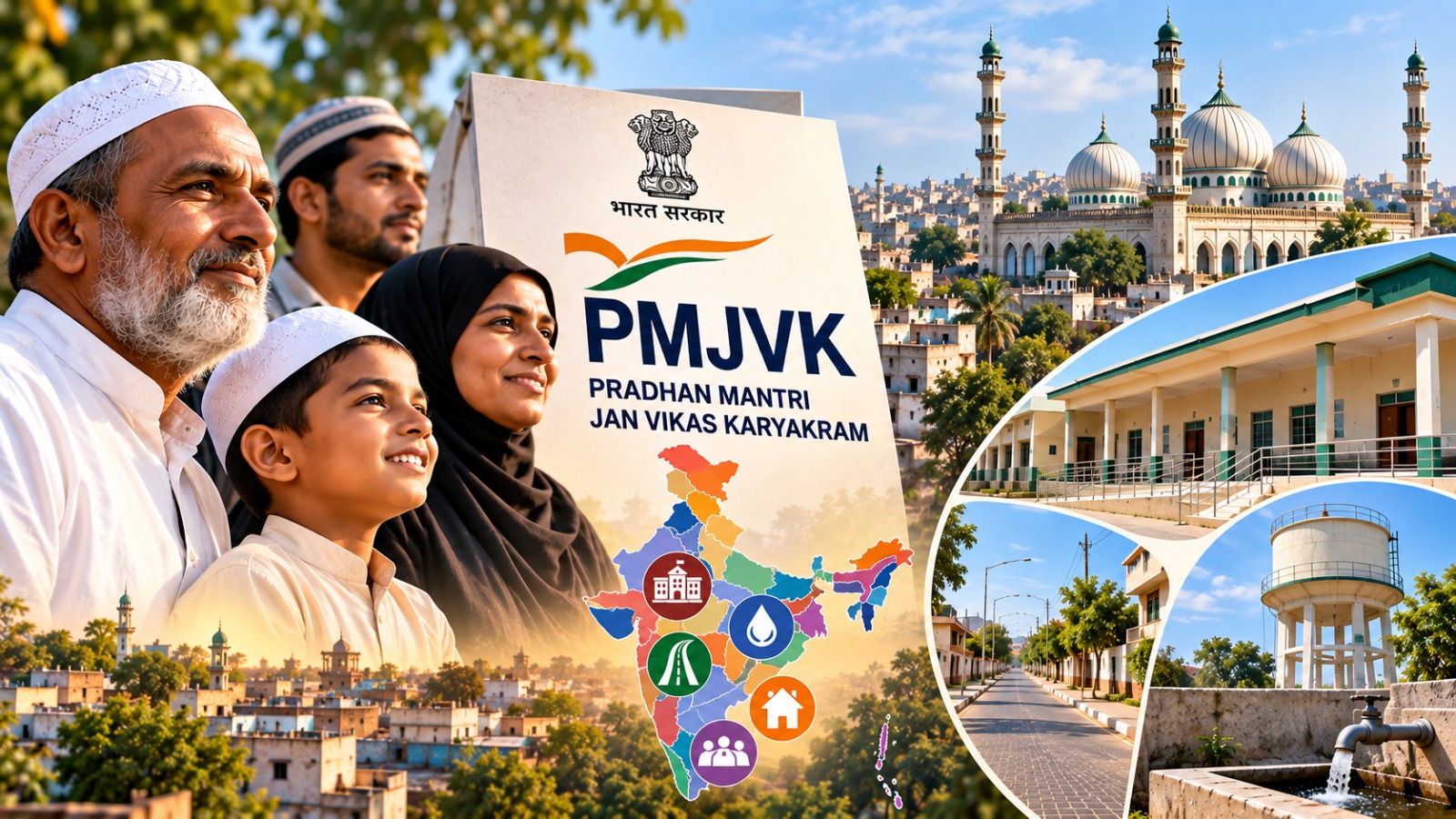
PMJVK is an area-development programme of the Ministry of Minority Affairs. Its basic idea is simple: identify areas where minorities are concentrated and where socio-economic or basic-amenity indicators lag behind national levels, and then build the infrastructure that is missing schools, classrooms, hostels, health facilities, drinking-water projects, skill centres, anganwadi centres and other community assets. The present framework covers 870 Minority Concentration Blocks, 321 Minority Concentration Towns and 109 district headquarters.
This matters particularly for Muslims because Muslims are by far India’s largest minority community. According to Census 2011, Muslims numbered about 172.2 million, accounting for roughly 14.2% of India’s population. The Census remains the latest completed population census with religion-wise figures publicly available, so these numbers should not be presented as a current 2026 population estimate.
The geographical design of PMJVK creates an important, if sometimes overlooked, channel of benefit. The infrastructure is not reserved for Muslims. The Ministry explicitly says that the assets created under the scheme are meant for all people living in the area. At the same time, the identification of these areas takes minority concentration into account. Historically, Minority Concentration Areas were identified using a minority population threshold along with indicators such as literacy, work participation, access to drinking water, electricity and household sanitation. In other words, the benefit is communal at the point of targeting but universal at the point of use.That distinction is important.
Imagine a government-funded school built in an area with a high concentration of Muslim families. A Muslim child may be among its beneficiaries, but so may a Hindu, Sikh or Christian child living in thesame catchment. A health centre does not check religion before treating a patient. A drinking-water project does not ask which community a household belongs to. This is public expenditure working through location rather than individual identity.
The scale is not insignificant. According to the Ministry’s 2023-24 annual report, between 2014-15 and March 31, 2024, projects with a total cost of about Rs 17,915 crore had been approved under PMJVK, including a Central share of Rs 12,718 crore. The Ministry reported expenditure of Rs 10,014.11 crore during the period.The physical numbers tell another story. The programme had approved 1,589 school buildings, 23,103 additional classrooms, libraries, laboratories and halls, 14,758 smart classrooms or computer labs and 2,173 health projects. There were also 17,414 drinking-water projects, 6,129 anganwadi centres, 710 hostels and numerous other facilities.
These numbers are more revealing than a simple headline saying that “minorities received thousands of crores”. They show where the money is supposed to end up: in physical infrastructure that can influence education, health and everyday living conditions. But there is also a caution hidden in the data.
A large number of sanctioned projects does not automatically mean an equally large social impact. A school building is an input; regular teachers, functioning classrooms and students attending school are outcomes. A health centre is infrastructure; doctors, medicines and patients actually receiving treatment are outcomes. A drinking-water project matters only when water reaches households reliably. This is where the discussion about PMJVK needs to become more sophisticated.
The government’s own monitoring framework has increasingly emphasised geo-tagging and online monitoring of assets through the PMJVK portal and the Bhuvan platform of NRSC-ISRO. The Ministry has also linked new releases to progress on previously approved projects, utilisation certificates and unspent balances.That is significant because implementation is often where ambitious welfare programmes become ordinary government projects. The Central government may approve and fund a project, but state governments and local agencies are generally responsible for implementing and managing the infrastructure. PMJVK itself is a Centrally Sponsored Scheme, with funding shared between the Centre and states in most cases.
There is another data problem that deserves attention. The Ministry has stated in Parliament that it does not normally maintain the community-wise ratio of beneficiaries under its schemes. Therefore, it would be misleading to take the entire PMJVK expenditure in minority-concentration areas and label it “money spent on Muslims”. There is no such clean accounting.But the absence of religion-wise beneficiary data should not be interpreted as absence of Muslim benefit. It simply means the benefit is being delivered through an area-based model. This distinction also changes the political conversation.
For many Muslim families, the most meaningful government intervention may not be a scholarship carrying a particular scheme’s name. It may be a better school nearby, a functioning anganwadi, a hostel that allows a girl to continue her education, a health facility that saves a long journey, or a skill centre that makes formal employment more accessible.The Ministry says that 80% of PMJVK resources are to be used for education, health and skill development, with 33-40% earmarked for assets or facilities for women and girls. That focus is particularly relevant in communities where physical access to institutions can itself determine whether an opportunity is usable. Yet the real test should now move beyond expenditure.
The next generation of PMJVK evaluation should ask how many additional children completed secondary education because of a project; whether girls’ enrolment and retention improved; how many people actually used newly created health facilities; whether drinking-water access became more reliable; and whether skill centres translated training into jobs or sustainable livelihoods.That would tell us far more than the number of buildings inaugurated.
For India’s Muslims, therefore, PMJVK represents an important but easily misunderstood form of government support. It is not a cash transfer to one religious community. Nor is every rupee spent under the programme attributable to Muslims. It is an attempt to direct public infrastructure towards areas identified as having minority concentration and development deficits, while making the resulting assets available to everyone living there.
Perhaps that is the more useful way to understand welfare in a diverse country: not simply by asking who received the money, but by asking what changed because the money was spent. For a Muslim family, a government school, a hospital, a water connection or a skill centre does not become less valuable because a neighbour from another community can use it too. In fact, that may be the point.
(The author is the President of Muslim Youth organisation of India, UP State)