
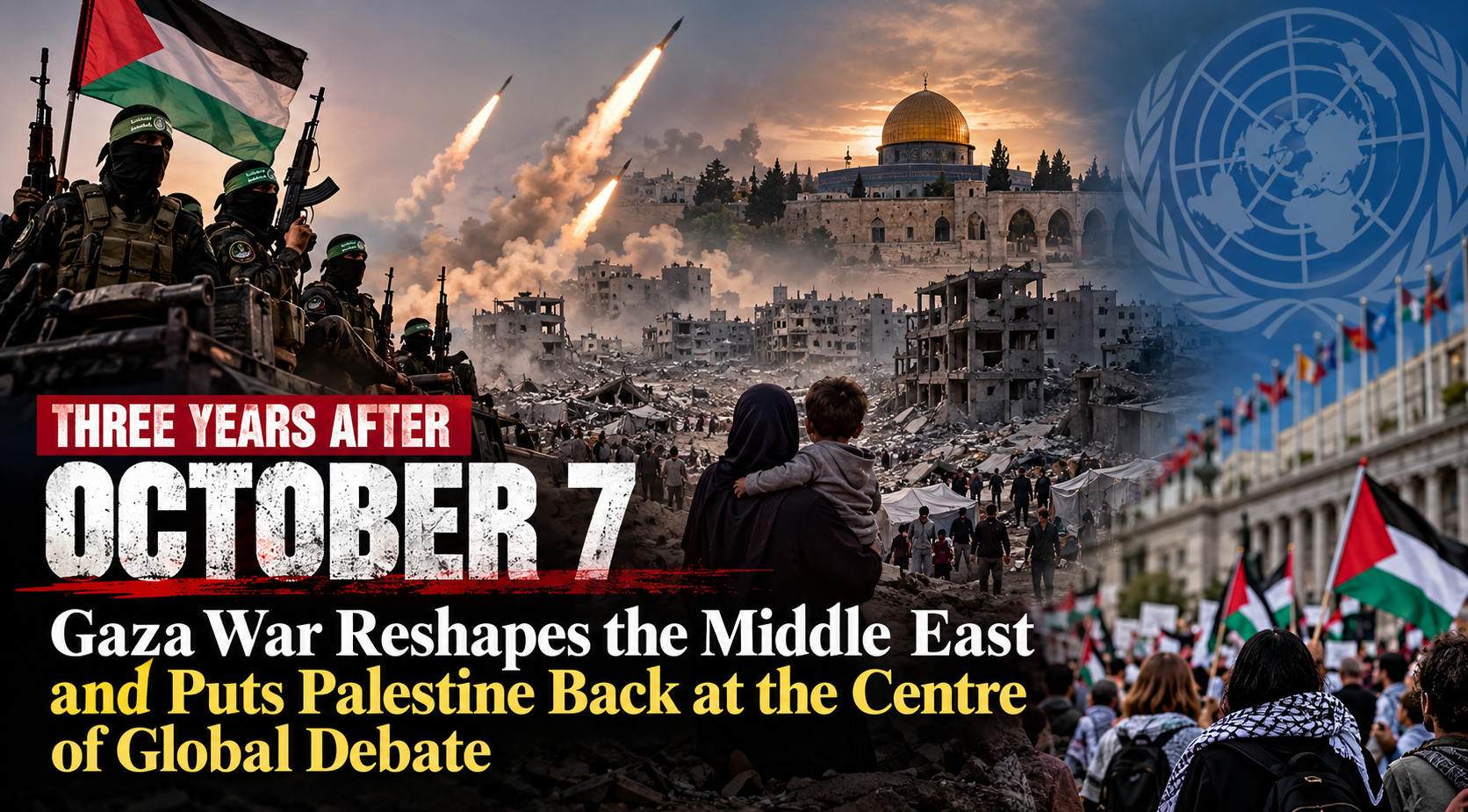
Three years after the October 7, 2023 attack, the conflict that began with the Hamas-led assault from Gaza continues to shape the political, security and humanitarian landscape of the Middle East.
On October 7, 2023, the Al-Qassam Brigades, the armed wing of Hamas, announced the launch of “Operation Al-Aqsa Flood,” accompanied by rocket fire and coordinated attacks on Israeli military positions and communities near the Gaza border.
The scale and speed of the assault challenged long-standing Israeli assumptions about border security, intelligence and deterrence. Areas that Israel had heavily fortified with surveillance systems, sensors, barriers and military infrastructure were breached within hours.
Intelligence and Security Failures
The attack triggered intense scrutiny inside Israel over the preparedness of the security establishment. Subsequent investigations and Israeli reporting pointed to failures in intelligence assessment, troop deployment and the interpretation of warnings concerning Hamas’s preparations. Analysts have described the episode as not simply a failure to collect information, but a failure to correctly interpret and connect available intelligence. The events also raised broader questions about the effectiveness of technology-driven security systems when confronted with unconventional military tactics.
Gaza: A Humanitarian Catastrophe
The Israeli military campaign that followed transformed Gaza into the centre of a prolonged humanitarian crisis. Large-scale destruction, mass displacement and the loss of civilian lives have generated widespread international concern. Palestinians have faced severe difficulties accessing basic necessities, including food, clean water, shelter and medical care. The humanitarian dimension of the conflict has subsequently become one of the central issues in international discussions over Gaza’s future.
The Political and Legal Battle
Alongside the military conflict, Palestinians have faced a complex political and diplomatic struggle. International law experts and Palestinian representatives have repeatedly stressed that negotiations must focus on ending hostilities, protecting civilians and addressing the underlying political issues, while avoiding arrangements that could permanently alter Gaza’s political or territorial status without Palestinian consent. The future governance, reconstruction and security arrangements for Gaza remain among the most difficult questions facing regional and international policymakers.
Palestine Returns to Global Focus
One of the most significant consequences of the conflict has been the renewed international focus on the Palestinian question. For years, regional diplomacy had increasingly focused on normalization agreements and broader strategic partnerships, while the Palestinian issue received comparatively less attention.
October 7 and the war that followed changed that dynamic. Questions surrounding occupation, blockade, displacement, Palestinian statehood and self-determination once again became central to international debate.
Pro-Palestine demonstrations also spread across cities, university campuses and public spaces around the world, reflecting growing public attention to the humanitarian and political dimensions of the conflict.
Memories of the Nakba
For Palestinians, the conflict also remains deeply connected to memories of the Nakba of 1948 and the displacement of Palestinian communities. Names such as Damra, Simsim, Burayr, Deir Suneid, al-Muharraqa, Najd and Huj continue to carry historical significance for Palestinians whose families trace their origins to communities affected by displacement.
These memories have remained an important part of Palestinian demands concerning historical rights, displacement and the right of return.
Three Years Later
Three years after October 7, the consequences of the conflict extend far beyond the original battlefield. Gaza has suffered enormous human and physical destruction, while Israel’s security assumptions have undergone unprecedented scrutiny. At the same time, the Palestinian question has once again become a central issue in Middle Eastern diplomacy and international politics. The future of Gaza, the question of Palestinian self-determination, reconstruction, security arrangements and the prospects for a lasting political settlement remain unresolved.
Three years on, October 7 continues to represent a defining turning point—one that fundamentally altered the regional equation and returned Palestine to the centre of global attention.