
(Dr. Shujaat Ali Quadri)
For decades, public conversations around Muslim leadership in India have often revolved around a limited set of organised religious and socio-political bodies. In television debates, policy consultations, legal interventions, and political negotiations, a handful of institutions associated with Deobandi & Wahhabi theological traditions have frequently emerged as the most visible interlocutors. Yet this visibility does not always reflect the full sociological complexity of Indian Muslim society.
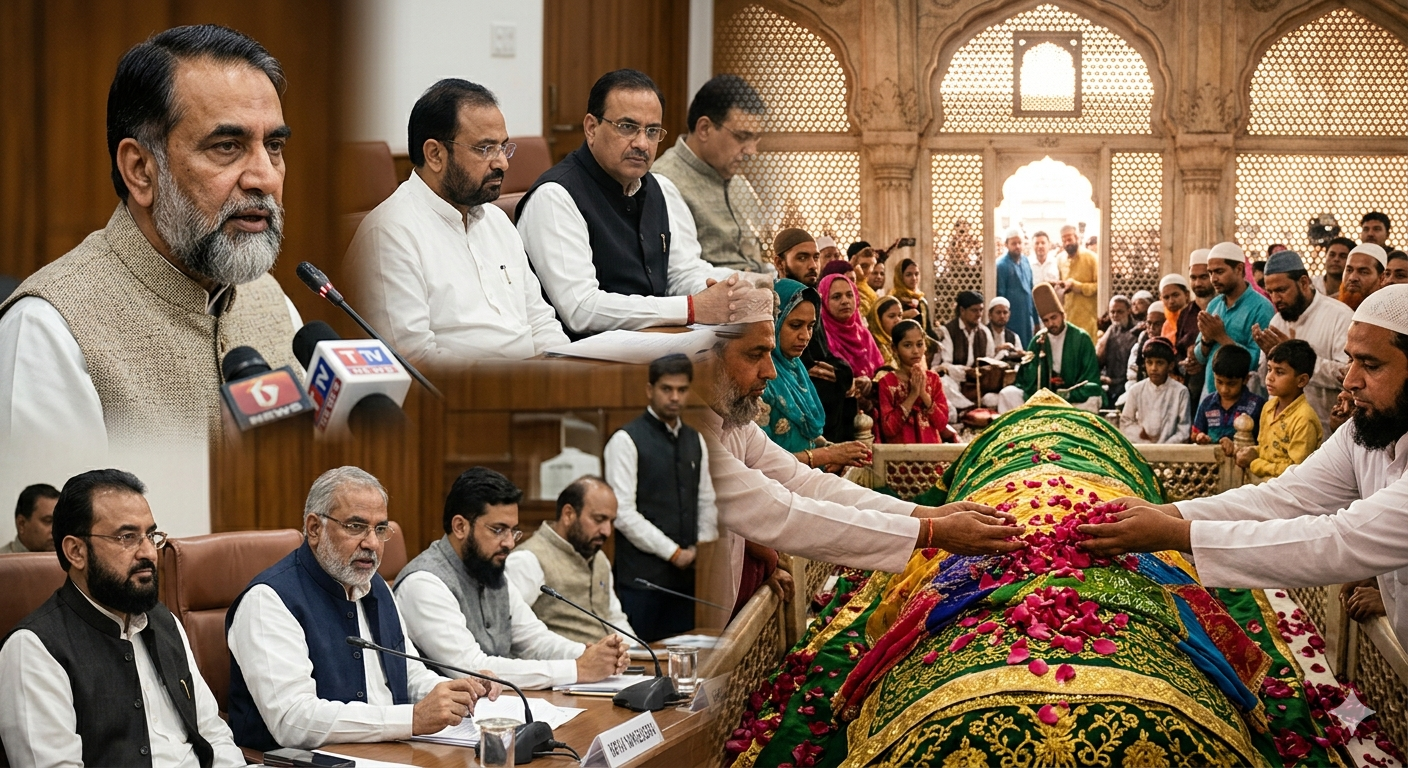
The religious life of a large section of Indian Muslims continues to be shaped by traditions rooted in Sufi practice, shrine centred devotion, inherited spiritual networks, and local religious cultures that evolved over centuries across the subcontinent. From Uttar Pradesh and Rajasthan to Karnataka, Maharashtra, Bengal, and Kashmir, Shrines, Khanqahs, and traditional religious institutions remain central to everyday faith and social belonging. Centres such as Dargah Ajmer Sharif and Dargah Aala Hazrat continue to command moral and emotional authority among millions, often in ways that extend beyond formal organisational politics.
However, when governments and public institutions seek Muslim representation, they often rely on groups such as Jamaat-e-Islami Hind and Jamiat Ulema-e-Hind, whose national visibility has been strengthened by long standing institutional discipline, media familiarity, and coherent organisational structures. This prominence is not accidental. Organisations linked to Deobandi and Wahhabi seminaries built extensive networks of publications, educational institutions, legal advocacy, spokesperson systems, and urban intellectual outreach. Darul Uloom Deoband and Darul Uloom Nadva in particular, emerged as a major intellectual centre whose graduates came to occupy an influential position in visible clerical discourse. Their ability to articulate positions quickly and engage institutions consistently gave them an advantage in the public sphere.
By contrast, traditional Sunni Sufi society remained broad in social reach but diffuse in institutional coordination. Authority was distributed across local scholars, hereditary custodians, shrine based leadership, and regional seminaries rather than concentrated in centralised structures. This produced deep grassroots legitimacy but often limited the emergence of a unified national voice. The result has been a representational asymmetry: socially expansive constituencies have often remained less visible in formal policy conversations, while smaller but better-organised groups have shaped much of the public narrative.
This matters because democratic consultation is strongest when it reflects internal diversity rather than administrative convenience. The religious experience of many Indian Muslims is not organised primarily around ideological literature or political theology. It is shaped by devotional practices, reverence for prophetic traditions, local customs, and long standing habits of coexistence within India’s plural social environment. Traditional Sunni Sufi institutions have historically functioned through accommodation rather than confrontation. Their role in local society has often included social mediation, spiritual guidance, inter community interaction, and cultural continuity. In many regions, shrines and Khanqahs retain public trust that extends beyond doctrinal boundaries.
For policymakers, this suggests the need for wider engagement. Consultation on Muslim affairs need not remain confined to a narrow circle of familiar representatives. Scholars from traditional Sunni institutions, custodians of major dargahs, Sufi educational reformers, youth intellectuals, and women emerging from traditional religious spaces also deserve a place in national dialogue. The issue is not exclusion of one voice in favour of another. It is recognition that no single organisational stream can fully represent a community as internally diverse as India’s Muslims.
If public policy seeks long term trust, representation must move closer to social reality. Voices from Bareilly, Ajmer, Marehra, Kichhauchha, Gulbarga, Hyderabad, and other historic centres should not remain peripheral to conversations that affect millions. India’s democratic strength lies in hearing complexity rather than simplifying it. Muslim representation, too, must reflect that principle.
(The Author is the National Convener of Muslim Youth Organisation of India MYO, he writes on a wide range of issues, including, Sufism, Public Policy, Geopolitics and Information Warfare.)