
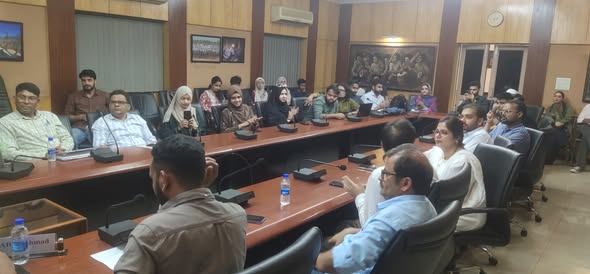
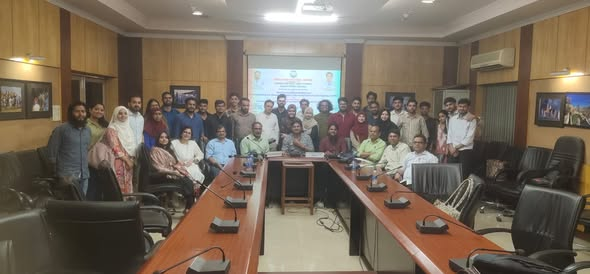
India Arab Cultural Centre Jamia Millia Islamia in collaboration with Centre for West Asian Studies, JMI, organized an Extension Lecture on “Shari’a and International Law: Understanding the Strategic Silence of the Arab States in the Ongoing Conflict” on Thursday, April 09, 2026 at 2:30 pm, in the conference room of IACC. Dr. Nizamuddin Ahmad Siddiqui, Independent researcher and formerly with Jindal Global Law School enlightened the audience as a speaker of the session. The event was chaired by Prof. Sebastian N., Centre for West Asian Studies, JMI. Dr. Md. Aftab Ahmad, Director, India Arab Cultural Centre graced the event as a mentor while Dr. Abdulla NC moderated the session.
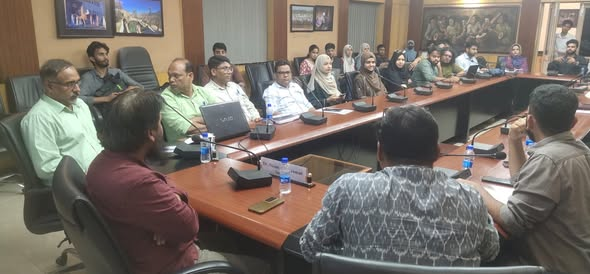
Dr. Ahmad inaugurated the event by thanking honorable Vice Chancellor, Prof. Mazhar Asif and Registrar, Prof. (Dr.) Md Mahtab Alam Rizvi for supporting and patronizing such academic activities which enhance the debate and discussions among students and faculties. He also welcomed Dr. Nizamuddin Ahmad Siddiqui to Jamia Millia Islamia and thanked for accepting his invitation to speak on this important topic and enlighten the students with his academic and research expertise and Prof. Sebstian N for chairing the session.
Dr. Nizamuddin Ahmad Siddiqui explored that the ongoing war involving the United States, Israel and Iran represents one of the most volatile crises in contemporary international relations. Despite being geographically, politically and religiously central to the conflict, many Arab states have adopted a policy of measured response, restraint, or strategic silence. He believed that the strategic silence should not be oversimplified. At a time, when Arab states face multi-layered threats like Iran, Israel, internal instability, their silence cannot be interpreted as a pure inaction, but a form of calculated diplomacy and it is observed that both Shari’a and international law are often instrumentalized rather than fully implemented.
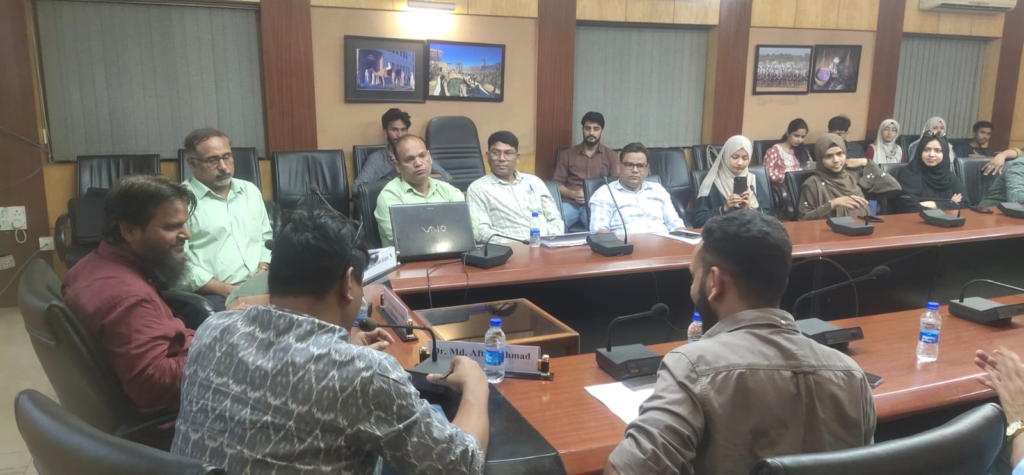
In his presidential remarks, Prof. Sebastian explored that many Arab states maintain security alliances with the United States and economic ties with Western powers, these relationships constrain the open opposition to U.S. or Israeli actions. State survival, economic stability, and regime security often outweigh Pan-Islamic or Pan-Arab solidarity. In this context Shari’a, principles are often invoked rhetorically rather than operationalized and international law is applied selectively due to political considerations.
The event was concluded by a formal vote of thanks followed by an engaging question answer session in which Jamia students and research scholars from South Asian University and JNU posed relevant questions to the speaker. Dr. Abdulla N.C., Assistant Professor of India Arab Cultural Centre, proposed the vote of thanks to all the participants present in the event including faculty members and research scholars from different Centers and departments of JMI.
Source : Jamia Millia Islamia, New Delhi