
(Dr. Shujaat Ali Quadri)
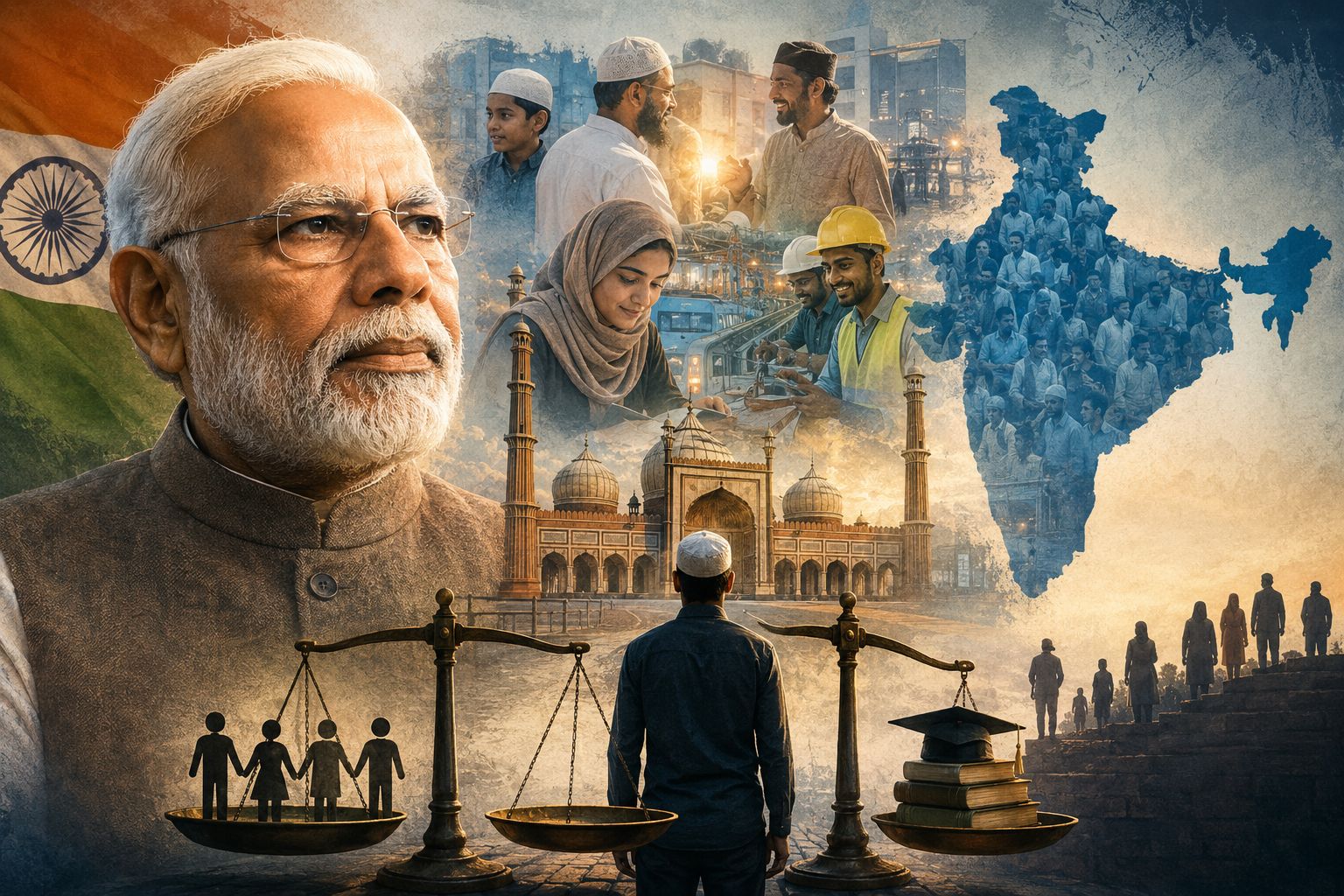
As Prime Minister Narendra Modi completes twelve years at the centre of India’s political landscape first as a national challenger and later as the country’s most dominant political leader the question of his government’s relationship with India’s nearly 200 million Muslims remains one of the most consequential issues in contemporary Indian politics. The story of these twelve years is neither one of relentless persecution, as some critics suggest, nor one of successful inclusion, as many supporters claim. Rather, it is a paradox: a period marked by relative communal stability, improved welfare delivery, and stronger state capacity, yet accompanied by a growing sense of political and psychological alienation among many Muslims.
The Positive Record: Breaking Old Patterns of Violence
Any honest assessment must begin by acknowledging certain realities. Unlike previous decades, India has not witnessed large-scale nationwide communal riots on the scale of the 1984 anti-Sikh violence, the 1992–93 Mumbai riots, or the Muzaffarnagar riots of 2013. There has also been a notable decline in the cycle of serial bomb blasts and terror attacks that once regularly shook major Indian cities. Equally significant is the fact that the widespread arrests and detention of Muslim youth on suspicion of terrorism an issue that generated considerable resentment during the 2000s – 2010s have become far less common. The security discourse has gradually shifted from broad based suspicion of communities to more targeted intelligence-driven operations.
Furthermore, welfare initiatives such as housing, sanitation, electrification, cooking gas connections, and direct benefit transfers have largely followed a religion-neutral framework. Millions of Muslims, alongside other Indians, have benefited from these programmes. These developments deserve recognition and should not be dismissed simply because they occurred under a government that many Muslims continue to view with scepticism.
The Missing Piece: Trust and Outreach
Yet governance cannot be measured solely by the absence of violence. The Modi government’s most significant failure in relation to Indian Muslims has been its inability or perhaps unwillingness to build political trust and sustain meaningful engagement with the community.
For more than a decade, the ruling establishment has relied heavily on the language of development while largely avoiding structured political outreach to Muslims. The underlying assumption appears to be that economic benefits alone can compensate for the absence of political representation, symbolic inclusion, and social reassurance.
That assumption has not worked. Many Muslims today readily acknowledge improvements in infrastructure and welfare delivery, yet simultaneously feel excluded from the broader national conversation. The result is a persistent sense of psychological insecurity despite the relative absence of physical insecurity. The distinction is crucial. Citizens may feel safer from riots and violence, yet still wonder whether they are fully accepted within the political mainstream.
The Radicalisation Challenge: A Missed Opportunity
Another significant policy failure has been the government’s inability to reshape the internal discourse within the Muslim community.
For centuries, India’s Islamic tradition has been enriched by moderate, Sufi-oriented, pluralistic, and syncretic currents. Yet these voices continue to receive limited institutional support and public visibility. Instead, organisations and networks associated with more exclusivist theological tendencies whether linked to Jamaat-e-Islami, Wahhabi-Salafi influences, or sections of the Deobandi establishment continue to exercise considerable influence over religious and community narratives.
To be clear, theological conservatism should not automatically be equated with extremism. However, governments across the world recognise the importance of empowering moderate religious leadership capable of countering radical tendencies and strengthening social cohesion. The Modi government frequently speaks of combating radicalisation, yet it has failed to develop a coherent strategy for supporting moderate Muslim institutions, Sufi traditions, intellectual platforms, and reform-oriented leadership. The result has been a vacuum that more organised ideological groups continue to occupy. If the objective is genuine social integration, merely opposing radicalism is insufficient; moderation must also be actively encouraged and empowered.
Declining Political Representation
Political representation remains one of the clearest indicators of inclusion. Over the past decade, Muslim representation in legislative bodies has steadily declined. The BJP, despite being the world’s largest political party and governing a nation that is home to one of the world’s largest Muslim populations, continues to have only a marginal Muslim presence within its elected ranks.
This is not solely a BJP problem. Several opposition parties have also reduced Muslim nominations due to changing electoral calculations. Nevertheless, the ruling party bears a greater responsibility because it aspires to represent the entire nation.
A democracy as diverse as India cannot indefinitely sustain a situation in which a major community remains largely absent from the structures of the country’s dominant political party. Representation is not merely symbolic; it serves as a bridge between government and society. When such bridges weaken, mistrust inevitably deepens.
The Psychology of Exclusion
Perhaps the most underappreciated aspect of the Modi era is the psychological dimension of Muslim experience. Many Muslims today do not fear riots in the way previous generations did. Yet they frequently express concerns about public discourse, social media hostility, polarising rhetoric, and recurring controversies surrounding identity, citizenship, and religious practices.
Whether these concerns are always justified is a separate question. In politics, perception often matters as much as reality. The responsibility of a government extends beyond maintaining law and order. It must also create an environment in which every citizen feels respected, valued, and secure in their place within the nation. The persistence of psychological anxiety among large sections of Muslims suggests that this objective remains incomplete.
What Prime Minister Modi Can Do
As Narendra Modi enters another phase of leadership, he has a unique opportunity to reshape this relationship.
First, he should initiate structured engagement with a broad spectrum of Muslim voices, including academics, professionals, entrepreneurs, women leaders, reformists, and Sufi institutions not merely traditional clerical establishments.
Second, the government should actively support platforms that promote moderate, pluralistic, and constitutional interpretations of Islam while encouraging intellectual reform and interfaith dialogue.
Third, the BJP should increase Muslim participation within its organisational and electoral structures. Inclusion cannot remain rhetorical; it must become visible.
Fourth, the government should focus on educational advancement, skills development, entrepreneurship, and economic empowerment in districts with significant Muslim populations through targeted yet constitutionally sound interventions.
Finally, the Prime Minister himself should articulate a stronger narrative of belonging one that reassures Muslims that they are not merely beneficiaries of welfare schemes but equal stakeholders in India’s future.
A Message for Indian Muslims
The responsibility for improving Muslim political engagement does not rest solely with the government. Indian Muslims must also move beyond a reactive political strategy centred exclusively on defeating the BJP. For decades, electoral choices have often been shaped more by fear than by a clearly defined developmental agenda. Consequently, many political parties have come to view Muslim votes as a predictable electoral bloc while paying insufficient attention to critical issues such as education, skill development, entrepreneurship, employment, healthcare, and political leadership.
The community must increasingly hold all political parties not just the BJP accountable for measurable outcomes. A mature democratic approach requires engagement with every political formation on questions of governance, policy, and development rather than reducing political participation to a single objective of electoral opposition. Such an approach would not only strengthen Muslim bargaining power but also contribute to a healthier and more issue-based democratic culture.
Beyond Fear and Victimhood
Twelve years of Modi’s leadership have produced a complex and often contradictory reality for Indian Muslims. The period has witnessed relative communal stability and improved welfare delivery, yet it has not generated the trust necessary for genuine national integration. The challenge before India is not merely preventing riots or defeating extremism. It is building a political culture in which Muslims feel neither fearful nor politically irrelevant, and in which the state actively promotes moderate voices over sectarian and exclusionary tendencies.
The next chapter of Indian democracy will depend not only on economic growth or electoral victories, but also on whether the country’s largest minority feels fully included in the national project. Prime Minister Modi possesses the political capital to make that happen. The question is whether he possesses the inclination to do so.
(The Author is the National Convener of Muslim Youth Organisation of India MYO, he writes on a wide range of issues, including, Sufism, Public Policy, Geopolitics and Information Warfare.)