
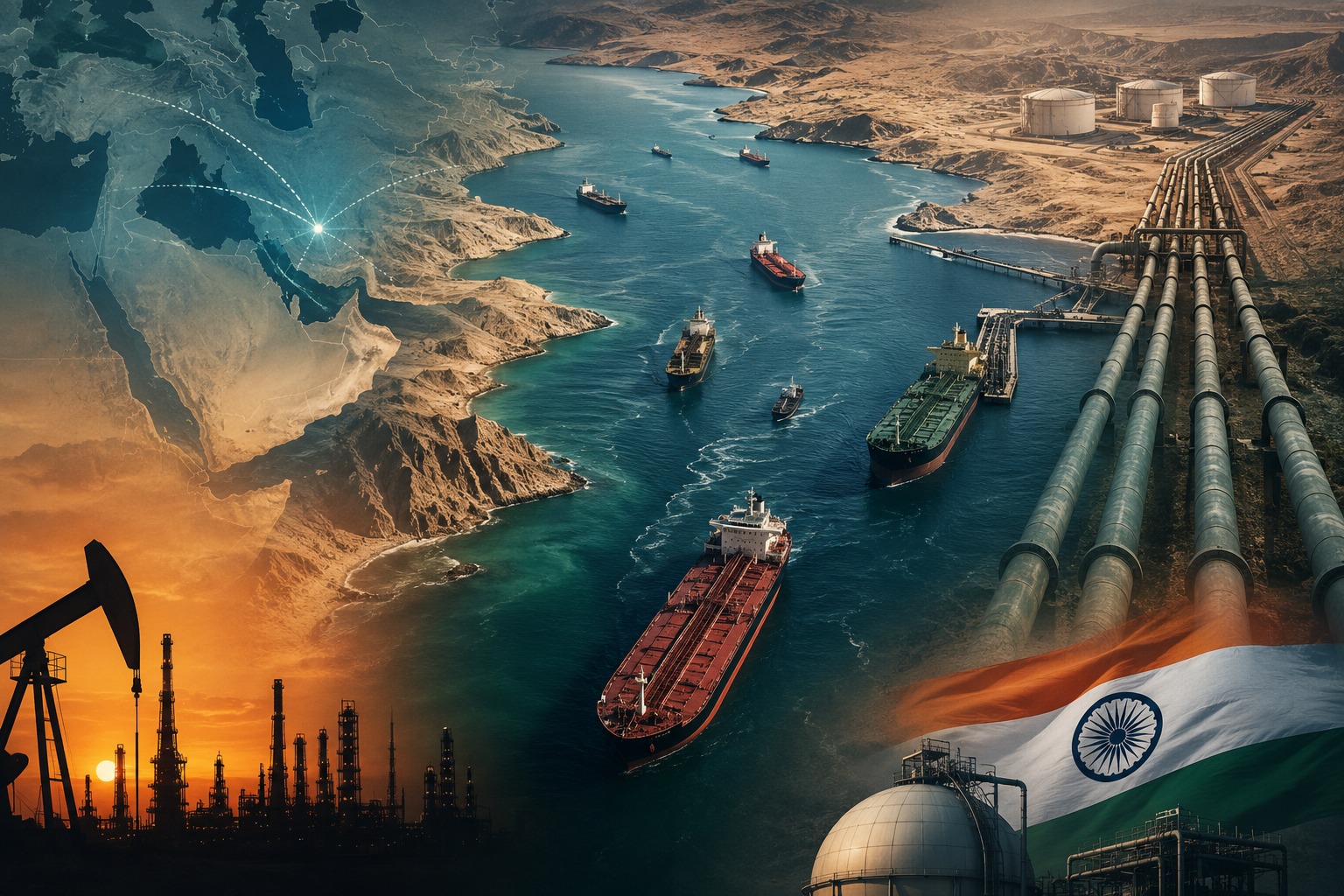
For decades, the Strait of Hormuz has occupied a singular place in global geopolitics. Barely 33 kilometres wide at its narrowest point, this narrow waterway links the Persian Gulf with the Gulf of Oman and the Arabian Sea. Yet its strategic importance far exceeds its geography. Around one-fifth of the world’s seaborne oil and significant volumes of liquefied natural gas (LNG) transit through this maritime corridor every day, making it one of the world’s most critical energy chokepoints.
Successive crises have reinforced the belief that the Strait represents Iran’s ultimate source of strategic leverage. Whenever tensions escalate, threats to shipping through Hormuz trigger immediate reactions in global energy markets, insurance premiums rise, freight costs increase, and importing nations brace for higher prices. Conventional wisdom has long assumed that the vulnerability of this passage strengthens Tehran’s bargaining position.
Yet a less discussed but increasingly important reality is emerging. The repeated use or even the persistent threat of disrupting Hormuz is producing an unintended consequence. Rather than leaving Gulf energy permanently dependent on a single maritime bottleneck, it is accelerating efforts to bypass it altogether. In attempting to maximise the value of the chokepoint, the region may be gradually diminishing its strategic importance. This shift has profound implications not only for the Gulf but also for India, one of the world’s fastest-growing energy consumers and among the economies most exposed to disruptions in Hormuz.
According to the International Energy Agency (IEA) and the U.S. Energy Information Administration (EIA), approximately 20 million barrels of crude oil and petroleum products transit the Strait each day, representing roughly one-fifth of global petroleum consumption and nearly one-quarter of global seaborne oil trade. For Asian economies, Hormuz is particularly indispensable. India and China together account for nearly half of the crude oil transported through the Strait, making regional stability directly relevant to their energy security. India remains heavily dependent on imported hydrocarbons. Despite increasing diversification of suppliers, a substantial share of its crude oil, LNG and LPG imports continues to move through Hormuz. Any disruption—whether military, political or merely perceived rapidly translates into higher import costs, greater pressure on the rupee, a widening current account deficit and eventually increased inflation. Recent episodes of regional tension have once again demonstrated how quickly market uncertainty can affect Indian consumers, even without a prolonged interruption of physical supplies.
The strategic value of Hormuz lies not merely in the volume of oil passing through it but in the lack of viable alternatives. Only Saudi Arabia and the United Arab Emirates currently possess operational infrastructure capable of exporting substantial quantities of crude while bypassing the Strait altogether. Even these alternatives remain significantly below the normal volume transiting Hormuz. This imbalance explains why the Strait has remained such a powerful geopolitical pressure point for decades.
Ironically, however, it is this very vulnerability that is now driving one of the largest infrastructure transformations in the Gulf’s modern energy history.
Saudi Arabia anticipated this vulnerability years ago through the development of its East-West Pipeline, commonly known as Petroline. Running from the Kingdom’s eastern oil fields near Abqaiq to Yanbu on the Red Sea coast, the pipeline enables crude exports without entering the Persian Gulf. Following capacity enhancements after 2019, Petroline can reportedly transport approximately seven million barrels per day under emergency conditions, providing Riyadh with considerable strategic flexibility during regional crises.
The UAE followed a similar strategy with the Abu Dhabi Crude Oil Pipeline (ADCOP), connecting Habshan to the port of Fujairah on the Gulf of Oman. Operational since 2012, the pipeline allows Abu Dhabi’s crude exports to reach international markets without transiting Hormuz, carrying roughly 1.5 to 1.8 million barrels per day. What distinguishes today’s situation is not these existing pipelines themselves but the renewed urgency behind expanding them.
Abu Dhabi is moving ahead with plans for a parallel west-east pipeline that could roughly double Fujairah’s bypass capacity to approximately 3.6 million barrels per day. Saudi Arabia is examining further expansion of Petroline and associated Red Sea export infrastructure. Iraq, whose exports remain overwhelmingly dependent on Hormuz, has revived discussions around Mediterranean export routes through Turkey while reconsidering northern pipeline options. Taken individually, these projects may appear incremental. Collectively, however, they signal something much larger: the gradual redrawing of the Gulf’s energy geography.
Infrastructure decisions are rarely driven by ideology; they respond to incentives. Every period of instability in Hormuz increases the commercial rationale for investing in alternative export corridors, storage facilities, deep-water ports and redundant transport networks. A coercive instrument derives its value from being indispensable. But the more frequently its disruption is threatened, the greater the incentive for everyone else to reduce their dependence on it. Over time, the leverage gradually weakens not because the geography changes, but because infrastructure does.
For India, this transformation extends well beyond developments in the Middle East. India imports the overwhelming majority of its crude oil requirements. While purchases from Russia have increased significantly in recent years, Gulf producers remain central to India’s long-term energy mix, particularly for LNG and LPG supplies. Any disruption in Hormuz immediately affects shipping costs, insurance premiums and benchmark crude prices, regardless of whether Indian cargoes themselves are interrupted.
Higher energy prices ripple through the economy, increasing transport costs, industrial production expenses and consumer inflation while placing pressure on fiscal management. India has responded prudently by diversifying suppliers, expanding strategic petroleum reserves and strengthening long-term energy partnerships across multiple regions. Nevertheless, diversification of suppliers cannot entirely eliminate route risk when much of the world’s energy still traverses the same maritime corridor.
That is why Gulf investments in bypass infrastructure directly enhance India’s long-term energy resilience. A more diversified export network means reduced vulnerability to regional shocks, greater predictability of supplies and ultimately more stable global energy markets.
The evolution of the Gulf’s energy infrastructure illustrates an enduring principle of strategic economics Markets adapt, Infrastructure evolves and Political leverage is rarely permanent. The Strait of Hormuz will remain one of the world’s most important maritime passages for years to come. No pipeline can presently replace its enormous throughput. But the long-term trajectory is becoming increasingly clear. Each new pipeline to Fujairah or Yanbu, every expansion of storage capacity and every alternative export corridor gradually chips away at the monopoly that Hormuz once represented.
The ultimate irony is difficult to ignore. A waterway long viewed as the region’s greatest strategic pressure point may ultimately be accelerating the development of the very infrastructure designed to reduce dependence upon it.
For India, the lesson is equally clear. The immediate risks associated with Hormuz remain real and require careful management. Yet the longer-term direction offers cautious optimism. As Gulf producers continue investing in diversified export routes and resilient energy infrastructure, India’s own energy security stands to benefit. The Gulf’s energy map is slowly being redrawn not by conflict alone, but by economics, engineering and the enduring search for reliability. In the long run, resilience may prove more powerful than coercion.